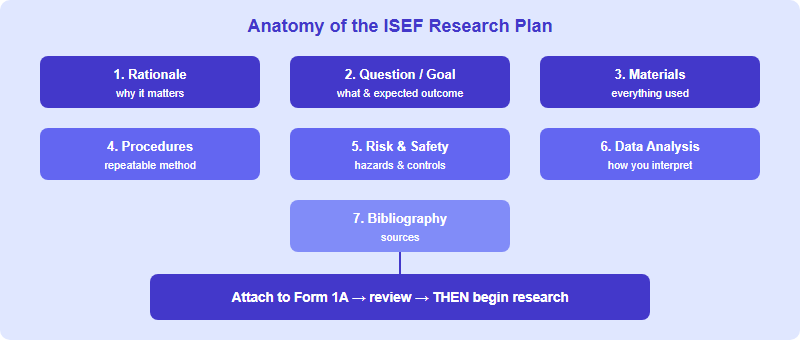
The ISEF Research Plan is the detailed document you write before any experimentation begins, describing exactly what you will study and how. It is attached to your Student Checklist (Form 1A) and, per the official rules, must contain seven parts: Rationale; Research Question, Hypothesis, Engineering Goals and Expected Outcomes; List of Materials; Procedures; Risk and Safety; Data Analysis; and Bibliography. Getting it right up front is what keeps your project compliant — and keeps you from redoing months of work.
Why the Research Plan comes first, not last
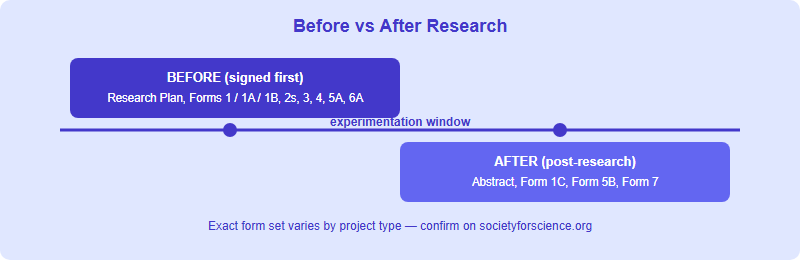
Many students treat documentation as an afterthought — something to write up once the data is in. ISEF flips that order. According to societyforscience.org, most forms “should be filled out and signed before any research takes place.” Only a small set of items — including Form 1C, Form 5B (for some vertebrate-animal projects), Form 7 (continuation projects), and the abstract — are completed after research. The Research Plan is a “before” document.
This is not bureaucracy for its own sake. The Research Plan is what your Adult Sponsor, and where required the Scientific Review Committee (SRC), reads to decide whether your project is safe and compliant. If you start collecting data before the plan is reviewed and the required approvals are in place, that data may not be usable — a costly mistake. For the full picture of how a project moves from an affiliated fair to the finals, see how ISEF works; and for what the fair itself is, our complete ISEF guide.
The seven sections, one by one
Here is what each required part of the Research Plan is asking for, and the mistake students most often make in it.
| Section | What it must show | Common mistake |
|---|---|---|
| 1. Rationale | Why the project matters and what background led to it, with a short review of relevant prior work. | Writing a general essay about the topic instead of building toward your specific question. |
| 2. Research Question / Hypothesis / Engineering Goals / Expected Outcomes | The precise question or hypothesis (for science) or the goal and success criteria (for engineering), plus what you expect to find. | Stating a topic, not a testable question; forgetting to define what "success" looks like. |
| 3. List of Materials | Every material, chemical, organism, device, or dataset you will use. | Leaving out an item that later triggers a safety rule you did not plan for. |
| 4. Procedures | A step-by-step method detailed enough that someone else could repeat it, including controls and sample sizes. | Vague procedures ("test the samples") with no controls or replication described. |
| 5. Risk and Safety | Hazards involved and how you will manage them; this is where human, animal, and hazardous-agent rules surface. | Underestimating risk, which delays or blocks approval. |
| 6. Data Analysis | How you will analyse results — which comparisons, statistics, or metrics answer your question. | Planning to "see what happens" with no analysis method chosen in advance. |
| 7. Bibliography | A reference list (minimum number and style per current rules) of the sources behind your plan. | Thin or missing citations, or a bibliography that does not match the rationale. |
The forms that surround the Research Plan
The Research Plan does not stand alone. It travels with a set of forms whose exact requirements depend on your project type. The core ones, as listed on societyforscience.org for the current cycle, include:
- Form 1 — Checklist for Adult Sponsor / Safety Assessment: your sponsor confirms they have reviewed the project and flags any special rules.
- Form 1A — Student Checklist / Research Plan: your own checklist, to which the Research Plan is attached.
- Form 1B — Approval Form: the sign-off confirming approvals are in place.
- Forms 2A / 2B / 2C: disclosures for student support, a qualified scientist, or a regulated research institution, if your project uses one.
- Form 3 — Risk Assessment: for projects involving hazardous chemicals, activities, or devices.
- Forms 4, 5A/5B, 6A/6B: for human participants, vertebrate animals, and potentially hazardous biological agents or tissue.
- Form 7 — Continuation Projects: if you are building on prior-year work.
Because form numbers and requirements are updated each cycle, do not rely on a form list you found in a forum. Use the official ISEF forms page or the ISEF Rules Wizard to generate the exact set for your project. Our companion article on the choosing your category by strength helps you decide where the project belongs; the forms then confirm how it must be documented.
How to write a Research Plan that survives review
A first-party observation from guiding China-based students through this document: the projects that pass review smoothly are the ones whose procedures are genuinely repeatable and whose safety section is honest about hazards. Reviewers are not trying to fail you — they are checking that a student can actually run this project safely. Some practical habits:
- Write procedures as a numbered protocol. If a classmate could not follow your steps and get the same setup, add detail until they could.
- Name your controls and replication explicitly. “Three trials per condition, with an untreated control group” reads far stronger than “repeat several times.”
- Choose your data-analysis method now. Deciding in advance which comparison or statistic answers your question prevents fishing for a result later.
- Be candid in Risk and Safety. Flagging a hazard and its mitigation builds trust; hiding one delays approval.
- Keep the abstract for later. The 250-word, one-page abstract summarises the current year’s work and is written after experimentation — do not confuse it with the plan.
Treat the Research Plan as the blueprint for your whole ISEF year. A clear, compliant plan written before you start is the difference between a project that runs on schedule and one that stalls waiting for approvals — or worse, has to throw out data collected too early.
The Adult Sponsor: the person who signs first
You cannot submit a Research Plan alone. Every ISEF project needs an Adult Sponsor — typically a teacher, mentor, or supervising adult — who reviews the plan and completes the Checklist for Adult Sponsor (Form 1). This is the first signature your project needs, and it is more than a formality: the sponsor’s job is to confirm that the project is appropriate, that its risks are understood, and that any special rules (human participants, animals, hazardous materials) are flagged before work begins.
For a China-based student, choosing the right Adult Sponsor early removes a common bottleneck. A few practical points:
- Line up your sponsor before you finalise the plan, not after. Their review can send you back to strengthen procedures or safety — better to hear that now than a week before a deadline.
- The Adult Sponsor is not the same as a Qualified Scientist. Some projects also need a Qualified Scientist (Form 2B) or a Designated Supervisor, especially where specialised techniques or regulated settings are involved. Confirm which roles your project requires on societyforscience.org.
- A sponsor who understands the rules saves weeks. If your teacher has guided an ISEF project before, they can anticipate which forms the Scientific Review Committee will expect — and help you avoid a rejected submission.
Think of the sponsor sign-off as the gate between planning and doing. Once the plan is written, reviewed, and approved by the people the rules require, you can begin collecting data with confidence that it will count.
Frequently asked questions
Do I write the Research Plan before or after my experiment?
Before. Per societyforscience.org, most forms and the Research Plan are completed and signed before any research takes place; only a few items and the abstract come after.
What are the required sections of the ISEF Research Plan?
Rationale; Research Question/Hypothesis/Engineering Goals/Expected Outcomes; List of Materials; Procedures; Risk and Safety; Data Analysis; and Bibliography.
Is the Research Plan the same as the abstract?
No. The plan is a detailed pre-research document. The abstract is a separate one-page, 250-word summary written after experimentation.
How do I know which forms my project needs?
The exact set depends on your project type. Use the official ISEF forms page or Rules Wizard on societyforscience.org to generate it.
This is an independent guide operated by Hanlin Education for China-based international-school students. It is NOT affiliated with, endorsed by, or sponsored by the Society for Science or Regeneron ISEF. Rules, forms, eligibility, deadlines, categories, and award details change — always confirm current details on societyforscience.org. Any error will be corrected within 7 working days.