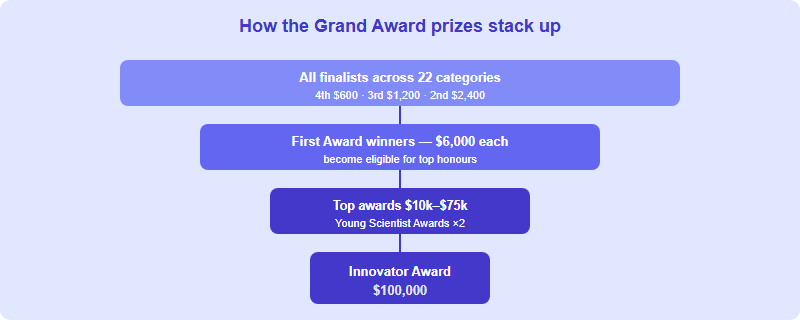
ISEF runs two separate award systems. Grand Awards are the official prizes given within each of the 22 categories — first through fourth place, worth $6,000, $2,400, $1,200, and $600 — and the top first-place projects then compete for headline honours like the $100,000 Innovator Award. Special Awards are a completely separate set, given by outside organisations (Special Award Organizations) that run their own judging panels. Understanding both is the difference between hoping to win and knowing what you are competing for.
Two award tracks, judged separately
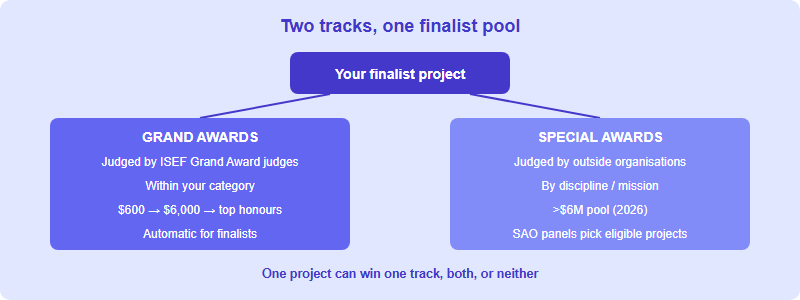
Many students assume ISEF has one prize list. It does not. A single project can win a Grand Award, a Special Award, both, or neither — because the two tracks are judged by different panels against different criteria.
- Grand Awards are the core ISEF prizes, awarded within your category by ISEF’s Grand Award judges. Placement is what most people mean by “winning at ISEF.”
- Special Awards come from external organisations — universities, professional societies, government agencies, and companies — that partner with the Society for Science and present prizes tailored to their own fields. Per societyforscience.org, these organisations “establish independent judging panels” and award “scholarships, internships and other prizes to hundreds of student Finalists.”
If you are still deciding whether the whole endeavour is worthwhile, that is a separate question we treat in our complete guide to ISEF. Here we focus on the mechanics of the prizes themselves — because knowing how they work changes how you present your project. For the journey that gets you to the awards stage at all, see how ISEF works from affiliated fairs to the finals.
The Grand Awards structure
Within each of the 22 categories, ISEF awards four tiers. The dollar amounts, as published on societyforscience.org, are:
| Grand Award tier | Prize amount | Notes |
|---|---|---|
| First Award | $6,000 | Top projects in a category; also become eligible for the top ISEF-wide honours. |
| Second Award | $2,400 | — |
| Third Award | $1,200 | — |
| Fourth Award | $600 | — |
Two details matter here. First, team projects split the award equally — a first-place team of two does not receive $6,000 each. Second, the number of awards per category scales with entries: a category with more projects distributes more awards. That is why the count of winners differs from category to category, and why choosing a category you fit well matters. Our guide to choosing your ISEF category by strength walks through that decision.
The top awards: from First Award to the headline prizes
The prizes that make the news are drawn from the pool of First Award winners across all categories. These are the ISEF-wide top honours, with amounts published by the Society for Science:
| Top award | Amount |
|---|---|
| George D. Yancopoulos Innovator Award | $100,000 |
| Regeneron Young Scientist Awards (2 awards) | $75,000 each |
| Gordon E. Moore Award for Positive Outcomes for Future Generations | $50,000 |
| F. Thomson Leighton & Bonnie Berger Family Prize for STEM Excellence | $50,000 |
| Craig R. Barrett Award for Innovation | $10,000 |
| H. Robert Horvitz Prize for Fundamental Research | $10,000 |
| Peggy Scripps Award for Science Communication | $10,000 |
| Mary Sue Coleman Award for Life Science Innovation & Impact | $10,000 |
Special Awards: a parallel prize pool
Alongside the Grand Awards, Special Award Organizations (SAOs) present their own prizes. This is a large, separate pool: the Society for Science announced Special Awards of more than $6 million at Regeneron ISEF 2026. Because each SAO judges independently and rewards work relevant to its own mission, a project that does not place highly in its category can still be recognised by an SAO — and vice versa.
What this means practically for you:
- You do not “apply” separately in the usual sense — SAO judges review eligible finalist projects at the fair. Exactly which projects each organisation considers is set by that organisation; confirm details on the official site.
- Special Awards vary widely — from cash and scholarships to internships and conference trips. Amounts differ by sponsor; societyforscience.org notes examples such as a grand prize of $5,000 plus conference attendance.
- Communication and relevance help. Because SAOs reward work in their field, a project that clearly connects to a discipline an SAO cares about — and that you can explain well — has more surface area to be noticed.
The honest picture: what “over $7 million” really means
You will often see the figure that ISEF finalists compete for over $7 million in awards, prizes, and scholarships. That headline is accurate, but read it correctly. Per societyforscience.org, roughly 600 of the 1,600+ finalists receive awards and prizes beyond the category-level winners — a large share, but not everyone, and the top six-figure prizes go to a very small number of projects each year.
For a China-based student, the realistic goal is usually not the $100,000 headline prize. It is to reach the finals with a clean, well-documented project and place for a Grand Award and/or catch the attention of a Special Award Organization in your field. Both are meaningful outcomes — and both are far more attainable than the single top honour. We do not promise any placement or admissions result; ISEF is a competition, and the value comes from the research and the process, not a guaranteed prize.
You can only win if you qualify: the affiliated-fair gate
None of these awards are reachable directly. A student competes at ISEF only after advancing through an ISEF-affiliated fair — a regional, national, or Society-recognised fair that earns the right to send finalists. For students in China, the recognised route runs through CASTIC (the China Adolescents Science and Technology Innovation Contest) and its associated pathway; confirm the current affiliated fairs and eligibility for your region on societyforscience.org.
This matters for how you think about awards. The prize pool is only in play if you first place well enough at your affiliated fair to reach the finals. In other words, the $6,000-to-$100,000 ladder sits on top of a qualifying step you have to clear first. Plan your project timeline backward from your affiliated fair’s deadline, not just from the ISEF finals in May. The mechanics of that path are covered in how ISEF works from affiliated fairs to the global finals.
Team projects and how awards are split
ISEF allows both individual and team projects, and the award rules treat them differently in one important way: a team splits its Grand Award equally among members. A first-place team does not multiply the $6,000 — it divides it. That is a financial footnote, not a reason to avoid teamwork; strong collaborative projects are common and welcome. But it is worth knowing before you decide whether to work solo or with a partner.
- The award amount is per project, not per student for Grand Awards — teams share equally.
- Special Award terms vary by organisation, so how an SAO treats a team prize depends on that sponsor. Check the specific award’s rules.
- Judging still evaluates the project as a whole, and each team member is expected to understand and be able to defend the work — a point that connects directly to how the interview is judged.
| Award type | Who gives it | Scale | How to be considered |
|---|---|---|---|
| Grand Awards | ISEF Grand Award judges | $600–$6,000 per category; top honours up to $100,000 | Automatic for finalists in your category |
| Special Awards | Special Award Organizations | >$6M total (2026); amounts vary by sponsor | SAO panels review eligible finalist projects at the fair |
Frequently asked questions
How much is a first-place ISEF Grand Award worth?
A First Award is $6,000 per category, per societyforscience.org. Team members split the award equally rather than each receiving the full amount.
What is the difference between Grand Awards and Special Awards?
Grand Awards are ISEF’s category prizes judged by ISEF judges. Special Awards come from outside organisations that run their own independent judging panels.
What is the biggest prize at ISEF?
The George D. Yancopoulos Innovator Award, at $100,000, selected from First Award winners. Two Regeneron Young Scientist Awards of $75,000 follow. Confirm current amounts officially.
Can a project win both a Grand Award and a Special Award?
Yes. The two tracks are judged separately, so a single project can receive one, both, or neither.
This is an independent guide operated by Hanlin Education for China-based international-school students. It is NOT affiliated with, endorsed by, or sponsored by the Society for Science or Regeneron ISEF. Rules, forms, eligibility, deadlines, categories, and award details change — always confirm current details on societyforscience.org. Any error will be corrected within 7 working days.