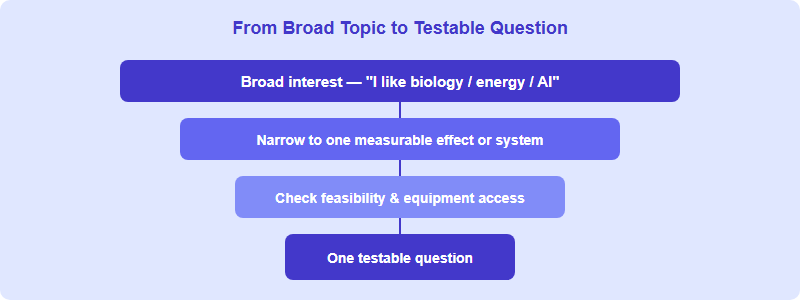
A strong ISEF research question is narrow, testable within roughly 12 months, and answerable with the equipment and mentorship you can actually reach. The best questions are not the grandest — they are the ones where you can collect real data, control your variables, and say something specific that was not already known. For a China-based student, feasibility usually matters more than ambition: pick the question you can finish, not the one that sounds impressive.
Why the question — not the topic — decides your project
Most students start with a topic (“cancer”, “batteries”, “machine learning”) and get stuck for months because a topic is not something you can test. A research question turns a broad interest into a single, measurable investigation. Compare the two:
- Topic: “I want to work on water pollution.” — There is nothing to measure here.
- Question: “Does adding a specific low-cost biochar dose reduce lead concentration in simulated wastewater, and how does removal change with contact time?” — Now you have an independent variable (biochar dose, contact time), a dependent variable (lead concentration), and a clear method.
ISEF judging rewards the second version. Grand Award judges look for a project with a clear scientific goal, a sound method, and data that actually answers the goal — not a broad survey of an important area. This is the same standard described in our full guide to what ISEF is, and it starts the moment you write your question. If you want the deeper detail on how judges weigh this, see how ISEF works from affiliated fairs to the finals.
The five tests every ISEF question should pass
Before you commit a term to a project, run your candidate question through these five filters. A question that fails two or more is a warning sign, not a death sentence — but you should redesign it.
| Test | The question you ask yourself | Why it matters for ISEF |
|---|---|---|
| 1. Testable | Can I state an independent variable I change and a dependent variable I measure? | Judges expect a controlled experiment or a defined engineering goal, not a literature review. |
| 2. Feasible | Can I get the equipment, samples, software, or mentor access within my real budget? | An impossible method means no data — and no data means no competitive project. |
| 3. Bounded in time | Can I collect enough data in roughly 12 continuous months? | ISEF generally expects research done within a limited, continuous time window — confirm the current time-limit rule on societyforscience.org; long timelines get cut short. |
| 4. Novel enough | Does my question add something not already answered in the literature I have read? | Repeating a well-known textbook demonstration rarely scores well. |
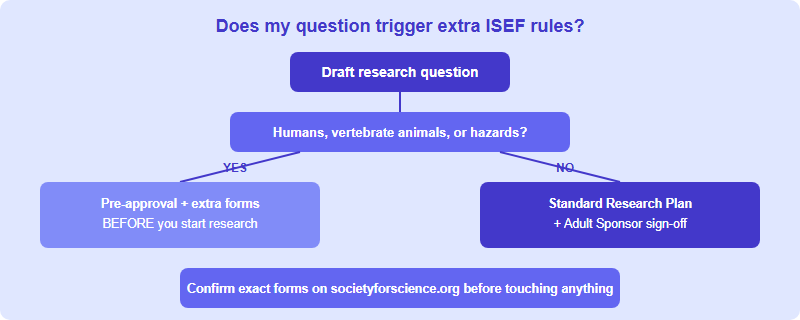
| 5. Compliant | Does it involve humans, vertebrate animals, or hazardous agents that trigger extra ISEF forms? | Some questions require pre-approval before you touch anything — plan the paperwork first. |
The feasibility problem for China-based students
The hardest of the five tests, for students at international schools in China, is usually feasibility. You may not have a university wet lab, a supervised animal facility, or a hospital ethics board within reach. That is a real constraint — but it should shape your question, not stop your project. Instead of forcing a question that needs equipment you cannot get, choose a question whose method fits what you can access.
| What you can realistically access | Question styles that fit | Example direction |
|---|---|---|
| A school science lab (basic chemistry / biology kit) | Controlled bench experiments with cheap, safe materials | Effect of a variable on plant growth, corrosion, filtration, or enzyme activity |
| A laptop + public datasets + open-source code | Computational, data-science, or modelling projects | Predicting an outcome from open data; comparing algorithms on a public benchmark |
| Consumer electronics, sensors, a 3D printer, or microcontrollers | Engineering / systems design with a defined goal | Building and testing a low-cost sensor, assistive device, or measurement tool |
| A willing university mentor (remote or in person) | Projects needing specialised guidance or occasional lab time | A narrow slice of the mentor's field you can run mostly independently |
A first-party observation from advising China-based students: computational, engineering, and simple-materials chemistry or biology questions are far more finishable than projects that depend on borrowed high-end lab equipment. The students who reach an affiliated fair with clean data almost always chose a method they could run themselves, repeatedly, without waiting on someone else’s schedule.
A worked example: turning “I like neuroscience” into a question
Suppose you are drawn to neuroscience but have no EEG machine and no research subjects. Watch how the question tightens through the five tests:
- Too broad: “How does the brain process memory?” — untestable, no variable, no method.
- Still too big: “Does sleep affect memory?” — testable in principle, but human-subject research needs consent, likely triggers additional ISEF forms, and is hard to control rigorously in a home setting.
- Feasible pivot: “Can a simple reaction-time task, taken on a laptop, detect a measurable difference in performance between two clearly defined conditions I can ethically create in myself or willing volunteers, and how large is that effect?” — Now the method is a piece of software you write, the variables are defined, and the ethics are manageable if you follow the human-participant rules.
- Computational alternative (no subjects at all): “Using a public neuroimaging or cognitive dataset, can a model I build predict a labelled outcome better than a baseline, and which features drive the prediction?” — No consent issues, all data is finishable on a laptop.
Either of the last two is a genuine ISEF project. The first two are dead ends. Notice that the pivot did not abandon the interest — it found the version of the interest you can finish. Once you have your question and know which of the 22 categories it belongs in, our guide to choosing your ISEF category by strength helps you place it correctly.
Where good questions come from
Strong ISEF questions rarely appear from a single brainstorm. They come from reading and noticing gaps. A practical routine:
- Read the discussion sections of real papers, not just abstracts. Authors often end with “future work should investigate…” — that sentence is a gift.
- Look for a variable no one has isolated, a cheaper method for something expensive, or a local version of a global problem (a dataset, material, or condition specific to where you live).
- Talk to a mentor early, even by email. A researcher can tell you in one reply whether a question is already answered or genuinely open.
- Prototype the method on paper before committing. Write out exactly what you would measure and how. If you cannot describe the procedure in a paragraph, the question is not ready.
Once your question survives all five tests, you are ready to write the formal Research Plan — the document that turns your question into a project the fair can review. Give yourself a full term for question selection; it is the cheapest place to fix a project and the most expensive place to get it wrong.
Frequently asked questions
How specific should an ISEF research question be?
Specific enough that you can name one thing you change and one thing you measure. If you cannot, narrow it further until you can.
Can a computational or data-science question win at ISEF?
Yes. ISEF has categories covering computational and data-driven work, and these projects are often the most feasible from home. Confirm current category definitions on societyforscience.org.
Do I need a university lab to have a competitive question?
No. Many strong projects use school labs, consumer sensors, or public datasets. Choose a question whose method matches your real resources.
What if my question involves human participants?
It likely triggers additional ISEF forms and pre-approval before you begin. Check the exact requirements on the official site before collecting any data.
This is an independent guide operated by Hanlin Education for China-based international-school students. It is NOT affiliated with, endorsed by, or sponsored by the Society for Science or Regeneron ISEF. Rules, forms, eligibility, deadlines, categories, and award details change — always confirm current details on societyforscience.org. Any error will be corrected within 7 working days.