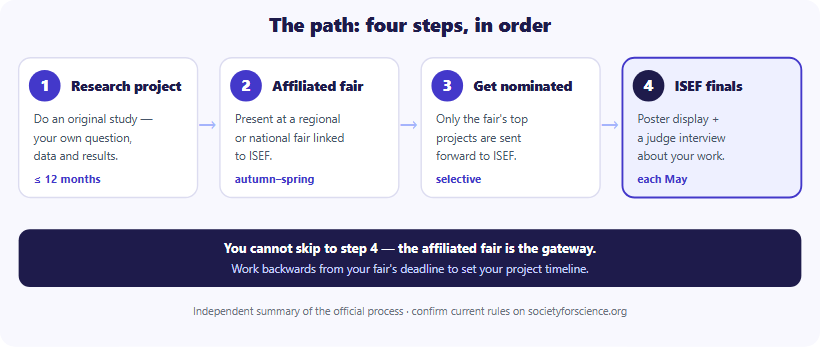
Here is the single most important thing to understand about ISEF — the Regeneron International Science and Engineering Fair: you cannot enter it directly. ISEF works like a pyramid. You complete an original research project, present it at a local ISEF-affiliated fair, and only the top projects nominated there advance to the global finals each May. This guide explains that path — and how students outside the U.S., including in China, qualify.
The pathway at a glance
| The rule | You qualify through an affiliated fair — there is no direct ISEF entry |
| Affiliated fairs | About 365 regional and national fairs, in 60+ countries, regions and territories (2026) |
| Who advances | Each fair may send a set number of projects, based on its participation and high-school population |
| The finals | ~1,700 finalists compete at ISEF each May (ISEF 2026: Phoenix; ISEF 2027: Los Angeles) |
| What you bring | One project (≤ 12 months of research), a poster/display board, a 250-word abstract, and official forms — all in English |
| Official source | societyforscience.org · Affiliated Fair Network |
Why “you can’t enter directly” changes everything
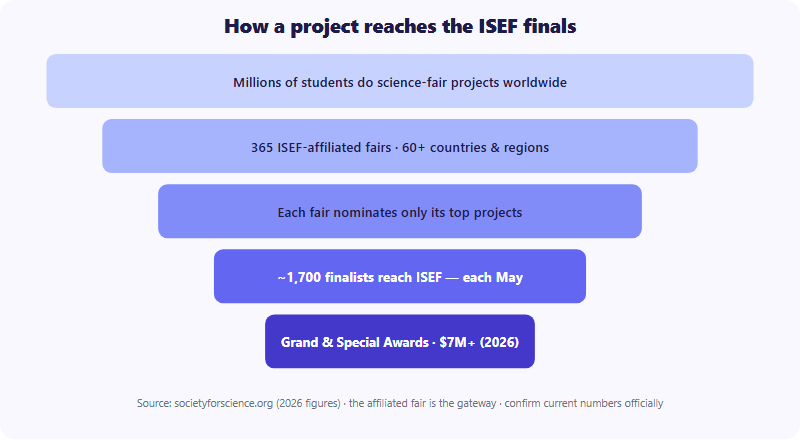
Most students discover ISEF by reading about the finals — the 1,700 finalists, the categories, the more than $7 million in awards handed out in 2026. But you do not apply to that event. ISEF sits at the top of a global selection pyramid run by the non-profit Society for Science. Beneath it sit roughly 365 affiliated fairs in more than 60 countries, regions and territories, and beneath those, millions of students doing science-fair projects. Your entry point is the fair that serves your school or region — not ISEF itself.
This one fact reorganises everything about how you plan. Your real deadline is not ISEF in May; it is your affiliated fair’s deadline, which usually falls months earlier. Miss that, and there is no finals to reach.
What an “affiliated fair” actually is
An affiliated fair is a regional or national science fair that is officially linked to ISEF and granted a number of nomination slots to the international finals. The number of projects a fair may send is pre-determined by its participation and the high-school population it serves, so a large national fair sends more than a small regional one. A few ground rules follow directly from the official International Rules:
- You may compete in only one ISEF-affiliated fair — except when you advance from a local fair to a state or national fair that is itself ISEF-affiliated.
- Each student enters one project, covering no more than 12 months of continuous research.
- Projects may be done individually or by teams of up to three.
- English is the official language of ISEF; the project and its materials must be in English.
The path, step by step
Finding your affiliated fair — international and China students
For a student outside the United States, the practical first question is not “how do I win ISEF?” but “which affiliated fair serves my country or region, and when is its deadline?” The official, authoritative way to answer it is the Society for Science Find a Fair directory — affiliations are reviewed yearly, so always confirm there rather than relying on last year’s list.
In China, the best-known national route is the China Adolescents Science and Technology Innovation Contest (CASTIC) — jointly organised by the China Association for Science and Technology and other bodies, for students roughly aged 12–20 — which has functioned as an ISEF-affiliated competition from which strong projects can advance. Regional ISEF-affiliated fairs also exist (for example, a Regeneron-branded fair in Sichuan). Because the exact affiliated fairs and their slots change year to year, treat CASTIC and any regional fair as starting points and verify current affiliation on the official directory before you plan.
What happens at the ISEF finals
If your project is nominated, you join roughly 1,700 finalists for a week each May. ISEF 2026 was held in Phoenix, Arizona; ISEF 2027 will be in Los Angeles. At the fair, you set up a display board and are interviewed by judges about your work. Projects compete within one of 22 categories for Grand Awards, and dozens of professional organisations give additional Special Awards; in 2026 the total exceeded $7 million. Crucially, judges weight your understanding of your own project far more heavily than how polished your board looks — the interview is the single largest scored component.
How to use this structure when you plan
Because the affiliated fair is the gate, plan in reverse. First, identify the fair you are eligible for and write down its registration and presentation deadlines. Then count backwards: a credible ISEF-track project usually needs the better part of a school year for the research itself, plus time to prepare the 250-word abstract, the display board, and the required forms and approvals (some projects need committee review before experimentation even begins). Students who treat “May” as the deadline almost always run out of time at the fair stage; students who treat their fair’s deadline as the real one give themselves room to do the science well.
New to all of this? Start with our companion guide, What Is ISEF?, then read about how to choose your category and what ISEF judges are really looking for as you shape the project itself.
Frequently asked questions
Can I apply to ISEF directly?
No. There is no direct entry. You must present your project at an ISEF-affiliated fair (regional or national), and only nominated projects advance. The affiliated fair is the required gateway.
How do international and China-based students qualify?
Through an ISEF-affiliated fair serving your country or region. In China, the national CASTIC route and certain regional fairs have served this role. Confirm current affiliations on the official Find a Fair directory, then work backwards from that fair’s deadline.
How many projects reach the ISEF finals?
About 1,700 finalists compete each May, drawn from roughly 365 affiliated fairs across 60+ countries, regions and territories. Each fair may send a pre-set number of projects based on its size.
When and where is ISEF held?
Each May in a U.S. city. ISEF 2026 was in Phoenix, Arizona; ISEF 2027 will be in Los Angeles. Always confirm current dates on the official site.
This is an independent guide to the Regeneron International Science and Engineering Fair, operated by Hanlin Education for China-based international-school students. We are not affiliated with, endorsed by, or sponsored by the Society for Science or Regeneron ISEF. Affiliated fairs, eligibility, dates and rules change by year — always confirm the current details on the official Society for Science / ISEF site. Confirmed errors are corrected within 7 working days.