ISEF — the Regeneron International Science and Engineering Fair — is the world’s largest pre-college science research competition, run by the non-profit Society for Science. Each May it brings together around 1,700 finalists from 60+ countries, regions and territories, who first qualify through a local affiliated fair. This independent guide explains how ISEF works, the science categories, who can enter, and how international students take part.
Quick facts (2026)
| What it is | A pre-college science & engineering research competition — students present an original research project |
| Who runs it | The Society for Science (we are an independent guide — not affiliated) |
| Who can enter | Students in grades 9–12 (roughly ages 14–18); individual or teams of up to three |
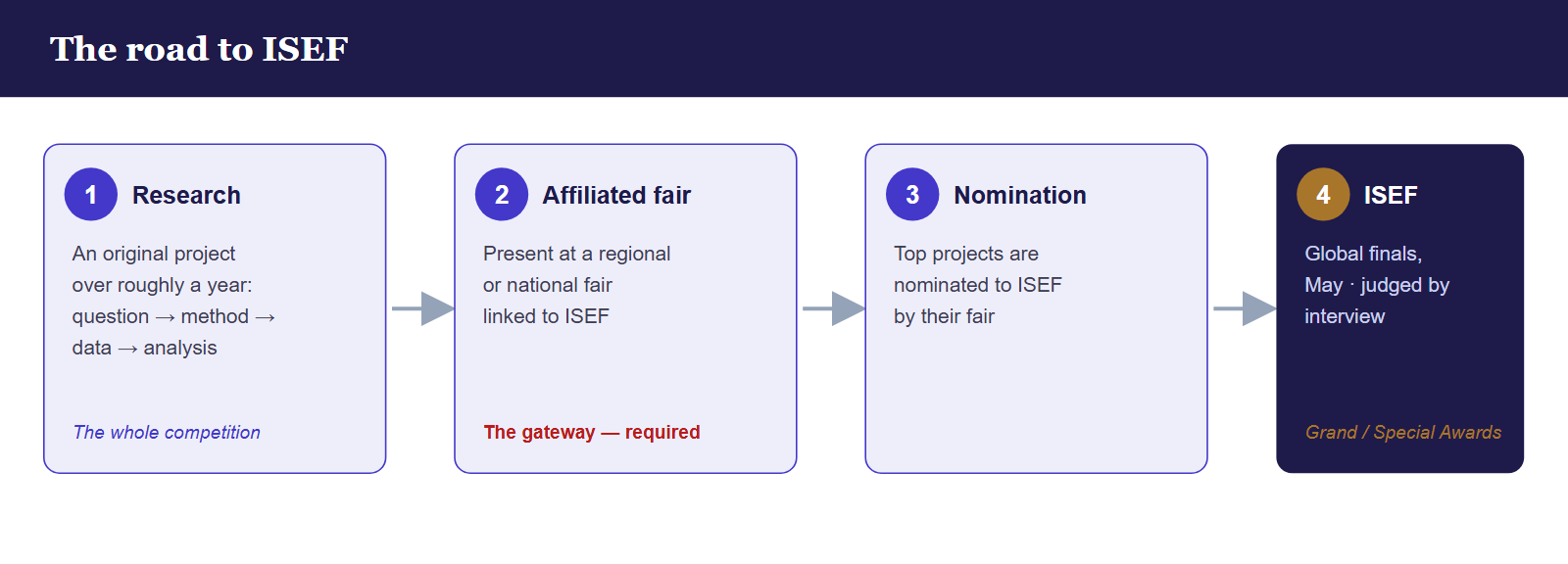
| How you qualify | Through an affiliated fair (a regional or national fair linked to ISEF) — you cannot enter ISEF directly |
| When & where | Held annually in May in a U.S. city (most recently Phoenix, May 2026; ISEF 2027 will be in Los Angeles); finalists from 60+ countries/regions/territories |
| Official source | societyforscience.org |
How ISEF works: the road from your lab to the finals
The single most important thing to understand is that you do not enter ISEF directly. ISEF is the top of a pyramid: you carry out an original research project, present it at a local affiliated fair, and the top projects there are nominated to ISEF. The project itself — not a test — is the whole competition.
The science categories
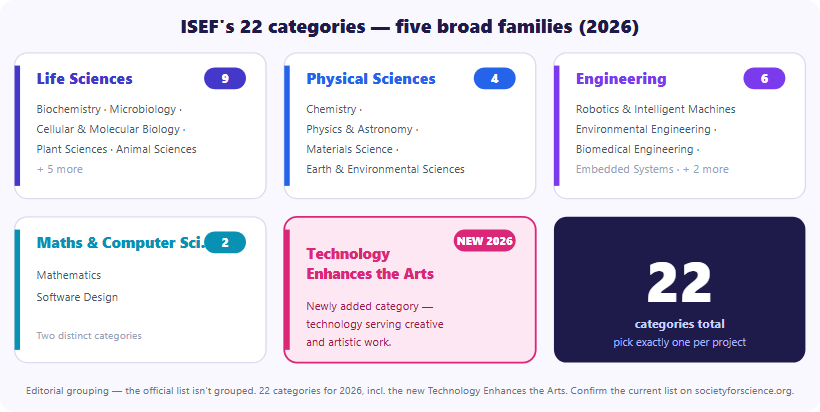
Every project is entered in one category, and there are 22 of them for 2026 — including a new one, Technology Enhances the Arts. Choosing the right category is a real decision — it determines who judges your project and which projects you are compared against. The categories group into a few broad families.
What you actually do
An ISEF project is real research, and the work spans roughly a school year. In short: pick a focused question, design and run the research, then communicate it through a 250-word abstract, a project board (your display), and a set of official forms documenting safety and ethics. At the fair, judges interview you about your work — so understanding your own project deeply matters as much as the result.
Who can enter, and how international students take part
ISEF is open to students in grades 9–12 worldwide, as individuals or teams of up to three. Because you qualify through an affiliated fair, the practical question for students outside the U.S. is: which affiliated fair serves my country or region? Many countries — including in China and across Asia — have ISEF-affiliated fairs that nominate finalists. Start by identifying the affiliated fair you are eligible for, then work backwards: its timeline sets your project deadlines. (We cover the China and Asia path in a dedicated guide.)
Is ISEF worth it for college applications?
For students aiming at STEM and research-focused programs, yes — as strong evidence of genuine research ability, not as a trophy. Reaching ISEF signals that you can carry an original project from question to defensible result, the exact skill top science and engineering programs look for. It does not guarantee admission, and you should treat it as one credible signal among many. The deeper value is upstream: the research itself — and being able to explain it — is what genuinely strengthens an application, whether or not you place.
Frequently asked questions
Can international students compete at ISEF?
Yes. ISEF is open to students in grades 9–12 around the world. You qualify through an ISEF-affiliated fair in your country or region, which nominates its top projects. Confirm the affiliated fairs serving your area on the official site.
Can I enter ISEF directly?
No. You must first present your project at an affiliated fair (regional or national); only nominated projects advance to ISEF. The affiliated fair is the required gateway.
What grades and ages can take part?
Students in grades 9 to 12, roughly ages 14 to 18, as individuals or teams of up to three. Confirm current eligibility on the official site, as rules can change.
How long does an ISEF project take?
Usually about a school year — choosing a topic and reviewing literature, running the research and collecting data, then preparing the abstract, project board and forms before your affiliated fair.
How many categories are there?
There are 22 for 2026 — including a new category, Technology Enhances the Arts — grouped into broad families such as life sciences, physical sciences, engineering, and maths & computer science. Each project is entered in exactly one category.
This is an independent guide to the Regeneron International Science and Engineering Fair, operated by Hanlin Education for China-based international-school students. We are not affiliated with, endorsed by, or sponsored by the Society for Science or Regeneron ISEF. Categories, eligibility, dates and rules change by year — always confirm the current details on the official Society for Science / ISEF site. Confirmed errors are corrected within 7 working days.