Behavioral and Social Sciences is the most accessible ISEF category for a student with no laboratory, and, in our own coaching records, the one where projects most often run into trouble before a judge ever sees them. The reason is a single sentence in the International Rules: an IRB must approve the study before any interaction with participants may begin. Recruitment counts as interaction. A quick pilot on classmates counts as interaction.
What the category covers, and why it is the default choice here
Behavioral and Social Sciences (BEHA) is one of the 22 ISEF categories. Checked on societyforscience.org in September 2026, it is divided into six subcategories: Behavioral Neuroscience, Development, Cognitive Psychology, Social Psychology, Sociology and Anthropology, and Other. That last one exists because human behaviour does not sort itself neatly, and the Society expects some projects to sit awkwardly.
The distinction that matters most for planning is not which label sounds most impressive. It is what each subcategory obliges you to do in practice, because the method drives the paperwork and the paperwork drives your calendar.
| Subcategory | Typical China-based project | What the method obliges you to do |
|---|---|---|
| Behavioral Neuroscience | Reaction-time or attention tasks linked to sleep, screen time or exercise | Human-participants review; often physiological or performance measures, so risk language matters |
| Development | How a skill or preference changes across age bands in a school | Almost always minors on both sides; assent plus written parental permission for every participant |
| Cognitive Psychology | Memory, decision-making or reasoning under a manipulated condition | A real experimental manipulation, so controls and randomisation are judged, not just the survey |
| Social Psychology | Peer influence, group identity, conformity, bilingual code-switching | Deception and debriefing questions arise fast; review these with your IRB early |
| Sociology and Anthropology | Community, migration, governance or economic behaviour of a group | Frequently workable from public records, which changes the review path entirely |
| Other | Genuine hybrids that fit none of the above | Expect the fair to reassign you; write the plan so it survives reassignment |
Category assignment is not purely your decision. Fairs and the Society can move a project, and a study of a health outcome or a brain measurement may belong somewhere else entirely. Read the full descriptions on societyforscience.org before you commit, and if you are still weighing options, our guide to choosing your ISEF category works through the trade-offs across all 22.
In a Chinese international school the appeal of this category is obvious. You do not need a fume hood, a cell culture, an animal facility or a university supervisor. You need a question, an instrument, and people willing to answer. The subject matter also sits close to the life of the student writing it: sleep debt before mock exams, bilingual switching, short-video habits, exam anxiety, the social life of a boarding house.
The cost is that a low barrier to starting is not a low barrier to scoring. In our own coaching records the same two failures come up more than any others, and both are avoidable. Results vary, and this is our own observation rather than an official statistic, but the pattern is consistent enough to plan against.
- The survey went out first. A form is drafted in an afternoon, circulated in a class group chat, and 180 responses arrive by the weekend. The approval is then sought retrospectively. Those responses cannot be rescued by a later signature.
- The sample is whoever was nearby. One grade, one school, one language, self-selected. The analysis that follows can be perfectly competent and still cannot support the claim on the poster.
The approval chain, in the only order it works
The wording on societyforscience.org is unambiguous. “Student research involving human participants must be reviewed and approved by an Institutional Review Board (IRB) before any interaction (e.g., recruitment, data collection) with human participants may begin.” The parenthesis is doing the work: recruitment is named explicitly, so posting the link is already too late.
Two further requirements follow. “A consent process is required. Participation in research may begin only after participants have voluntarily given informed consent/assent.” And for the population most students actually have access to: “All human participant studies involving minors (students under 18 years of age) must receive assent from the student participant and written parental permission from a legal guardian.”
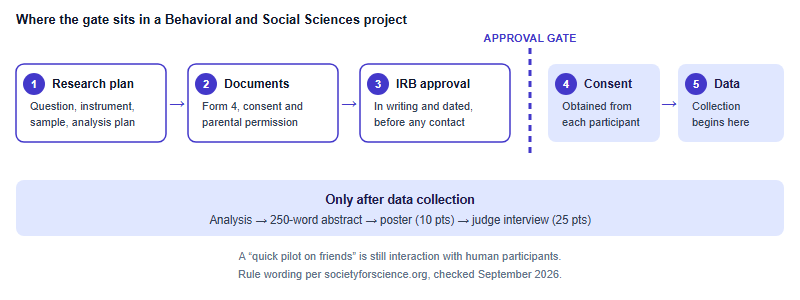
There is a survey-specific instruction that catches almost every questionnaire circulated to schoolmates. Per the same page, “the survey must be attached to the consent form as part of the written parental permission process and parental permission obtained prior to the minor accessing the survey.” Read that literally. The parent sees the questions before the child sees the questions. An anonymous link shared in a group chat, however innocent the items, does not meet this.
The rules list four categories of exempt study. The two that survey projects usually reach for are both narrower than students hope. The rules list exempt studies including “Data/record review studies (e.g., baseball statistics, crime statistics) in which the data are taken from preexisting data sets that are publicly available…and do not involve any interaction with humans”, and behavioural observation in public settings where there is no interaction, no manipulation of the environment, and no personally identifiable information recorded. Neither is self-certifying. You do not decide you are exempt; your fair does.
Where survey projects lose points
Approval only gets you judged. The Grand Award criteria on societyforscience.org allocate 100 points across five headings: Research Question 10, Design and Methodology 15, Execution 20, Creativity and Potential Impact 20, and Presentation 35, split into poster 10 and interview 25. A questionnaire project can be fully compliant and still land in the lower half of every one of them.
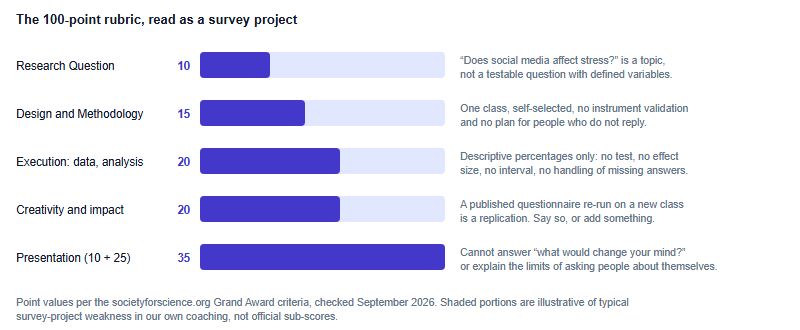
The interview line is worth reading closely, because it is the largest single block of points in the rubric and it is where self-report projects are most exposed. Among the things listed under the 25-point interview are “understanding interpretation and limitations of results and conclusions” and “degree of independence”. A student who has genuinely wrestled with why people misreport their own screen time will sail through that; a student who has only tabulated answers will not.
What a defensible project looks like
None of the above argues against the category. It argues for treating a questionnaire as an instrument that has to be defended, in the same way a chemist defends a titration. The following moves are cheap, legal and usually decide whether a project reads as work or as homework.
- Manipulate something. In our own coaching experience the strongest projects in this category are usually experiments with a survey attached, not surveys alone. Two conditions, randomised assignment, and a pre-registered prediction turn a description into a test.
- Validate the instrument before the main run. Where a published scale exists, use it and cite it; where you wrote your own items, show how you checked that they measure what you claim. This must itself sit inside the approved protocol.
- Design the sample deliberately. If you can only reach one school, say so in the limitations and narrow the claim to match. A well-bounded claim about one population beats an unsupported claim about teenagers in general.
- Plan the analysis before you collect. Write the test you will run into the research plan. It stops the analysis drifting towards whatever result appears.
- Keep the paper trail. Dated approval, blank consent and permission forms, the instrument as administered, and a log of when each wave went out.
Two timing facts constrain all of this. Per the International Rules, “students will be judged only on laboratory experiment/data collection performed over 12 continuous months beginning no earlier than January 2026 and ending May 2027”, and after experimentation you submit a maximum 250-word abstract. Approval takes time, parental permission takes longer, and neither counts as data collection. Build both into the calendar rather than discovering them in it. If the surrounding structure is new to you, our overview of what ISEF is and our walk-through of how the route from affiliated fairs to the finals works set the context.
What it does inside an application
A social-science project is unusually easy for an admissions reader to check against the rest of a file. If the transcript shows psychology or economics, the activity list shows a research project, and an essay describes the moment the data did not say what you expected, those three documents corroborate each other. That mutual confirmation is what makes a profile believable, and it is the reason a modest, honestly-scoped survey study with a real method can read better than a grand claim nobody can verify. No result guarantees an outcome, and the value here is in the cross-checking, not in the label.
Questions students ask
Can I run a pilot survey on friends before IRB approval?
No. The rules require approval before any interaction with participants, and recruitment counts as interaction.
Do I need parental permission if my classmates are 17?
Yes. Anyone under 18 is a minor, so you need their assent plus written permission from a legal guardian.
Is a project using public survey data exempt from IRB review?
Record-review studies on publicly available preexisting data with no interaction can be exempt. Confirm with your fair.
Which subcategory should an economics survey go in?
Sociology and Anthropology covers group behaviour including economics and governance. Read the descriptions on societyforscience.org.
This is an independent guide operated by Hanlin Education for China-based international-school students. We are not affiliated with, endorsed by, or sponsored by the Society for Science or Regeneron ISEF. Rules, categories, forms and judging criteria are revised between editions, so confirm current details on societyforscience.org before acting on anything here. Factual errors are corrected within 7 working days of being reported.