Most students without a laboratory think their problem is equipment. It is almost never equipment. It is provenance: being able to say, for every number on the poster, who produced it, how, when and with what instrument. In our own coaching we sort ISEF data sets into four acquisition routes, each carries a different rule, and judges test all four with the same question.
The bottleneck is provenance, not apparatus
Twenty of the 100 Grand Award points sit under Execution, and the criteria on societyforscience.org name what is being looked for: “systematic data collection and analysis”, “reproducibility of results”, and “appropriate application of mathematical and statistical methods”. Reproducibility is the operative word. A judge is not asking whether your equipment was expensive. They are asking whether a stranger with your records could produce the same numbers again.
That reframes the whole resourcing problem. A ten-dollar sensor with a documented calibration history is more defensible than borrowed access to an instrument you cannot describe. A public data set you have interrogated properly is more defensible than a private one you were handed. In our own coaching notes the question that most often stalls a student in the interview is not technical at all: it is some version of “where did this particular number come from?” Results vary, but the pattern is stable enough to prepare for.
Four routes, four rule sets, and the window that governs all of them
Sort your project by a single question — who produced the first version of the number? — and the applicable rules fall out immediately.
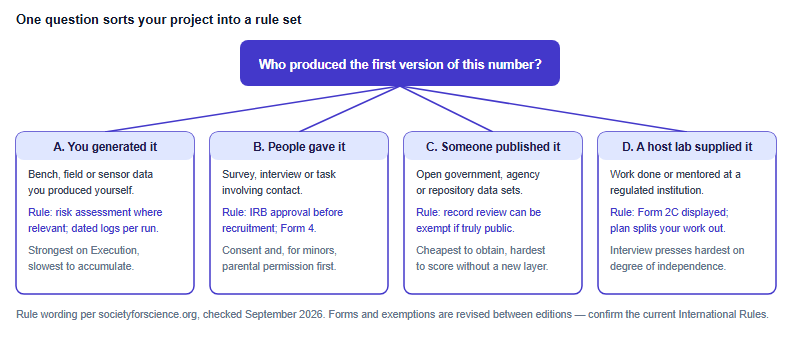
Route D deserves a specific warning because it is the one that looks most impressive and carries the most exposure. Per the International Rules, work conducted or mentored — virtually or on site — at a regulated research institution, industrial setting or any work site other than home, school or field during the ISEF project year requires the Regulated Research Institutional/Industrial Setting Form (2C) to be completed and displayed at the project booth. The same document adds that “if a mentor was involved in the project, the research plan should delineate what parts of the project were done by the student and which parts of the project were done by the mentor.”
Both of those exist because the 25-point interview explicitly scores “degree of independence”. A borrowed data set is not disqualifying. A borrowed data set you cannot account for is.
Mixed projects are common and are not a problem in themselves; a study that pairs your own sensor readings with a published reference series simply inherits both rule sets. What causes trouble is discovering the second rule set late, because the paperwork on one of these routes has to precede the data rather than follow it.
Whatever route you take, one further sentence governs when the numbers may be made. Per the International Rules, “students will be judged only on laboratory experiment/data collection performed over 12 continuous months beginning no earlier than January 2026 and ending May 2027.” That is a data rule, not a paperwork rule, and read alongside an acquisition plan its practical consequences separate sharply by route.
| Route | Realistic lead time before first usable number | What eats the time | Where it earns points |
|---|---|---|---|
| A. You generated it | Weeks to months | Building and calibrating the rig; failed runs; seasonal windows for field sampling | Execution and Design, because every choice is yours to defend |
| B. People gave it | Weeks, mostly before contact | IRB review, consent documents, parental permission, response rates | Creativity, if the question is genuinely new |
| C. Someone published it | Days | Locating a set with the variables you need; cleaning; documenting licence and version | Analysis and interpretation, provided you add a layer |
| D. A host lab supplied it | Depends entirely on the host | Access negotiation, supervision scheduling, Form 2C, delineating your contribution | Scale and instrumentation — but only if independence is documented |
Note what this does to autumn planning. Route C is the only one that can produce usable numbers in days, which is precisely why it is the rescue route for a project that has lost a term. It is also the route with the lowest ceiling if you stop at the download.
Making a public data set into a project
The exemption language is helpful here and worth quoting accurately: exempt studies include “data/record review studies (e.g., baseball statistics, crime statistics) in which the data are taken from preexisting data sets that are publicly available…and do not involve any interaction with humans.” That removes a review burden. It does not remove the scoring burden, and students consistently confuse the two.
A downloaded table is an input, not a project. What converts it into one is a layer you added that did not exist before you started. In practice there are four that work:
- Join two sources nobody has joined. Air-quality monitor output against school attendance records; transport timetables against noise readings. The novelty lives in the join, not in either table.
- Ground-truth it. Take fifty of your own measurements at points the public set also covers and quantify the disagreement. You now have a methods contribution as well as a result.
- Ask a question the publisher did not. Most agency data are published for monitoring, not for hypothesis testing. The variable you care about is often already there, unexamined.
- Interrogate the data quality itself. Missingness, rounding, instrument changes mid-series and reporting-boundary shifts are legitimate objects of study and demonstrate exactly the scepticism judges reward.
Whichever you choose, record the provenance as you would an experiment: source, exact URL or citation, version or release date, download date, licence or terms of use, and every transformation you applied. If your analysis is a script, the script is your lab notebook.
Low-cost sensors, and the four rungs of defensibility
Cheap sensors have made Route A viable from a bedroom, and they are also where naive projects fall apart under questioning. A single unregarded module reporting to three decimal places invites exactly one question: how do you know it is right? The answer is not a better sensor. It is a documented chain.
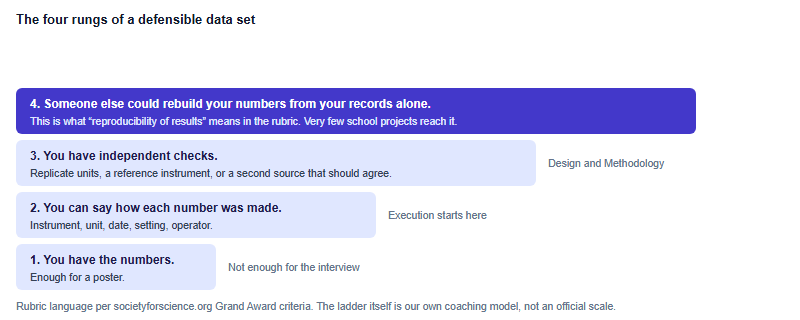
Climbing from rung one to rung three with hobby hardware is mostly bookkeeping, not budget. Run at least two identical units side by side so you can see the disagreement between them. Co-locate against any reference you can reach, even a calibrated school instrument for an hour, and report the offset rather than hiding it. Log the ambient conditions, because most cheap sensors drift with temperature and humidity. Record firmware and sampling interval, because changing either mid-season creates a discontinuity you will otherwise have to explain on the day.
And write the limitations onto the poster yourself. A judge who finds a weakness you have already named reads you as careful; a judge who finds one you concealed reads everything else differently. For how the poster and interview fit into the wider route, see our explanation of how ISEF works from affiliated fairs to the finals; if you are still deciding what to study at all, start with what ISEF is.
A provenance checklist for the booth
Before the fair, put the following in a single folder, and know where each item is without searching. In our own coaching records, every item on this list has come up in a judging conversation at some level of the route.
- For every figure on the poster: which raw file it came from, and which script or worksheet produced it.
- Instrument list with model, serial or unit ID, and calibration or check dates.
- For public data: citation, version, download date, licence, and the cleaning steps applied.
- For host-institution work: Form 2C, plus the section of the research plan that separates your contribution from your mentor’s.
- For human-participant work: the dated approval and blank consent and permission documents.
- A short written statement of what you would do differently with another six months. This is the single best preparation for the interview’s “quality of ideas for further research” line.
A dataset you can account for is also the part of a research claim an admissions reader can sanity-check later. When an essay describes a finding and a recommender describes the same student running the same instrument, the file corroborates itself. That is worth more than volume, and it starts with knowing where the numbers came from.
Questions students ask
Can I use a data set I downloaded rather than collecting my own?
Yes, but the rubric rewards what you add. Judges will ask how the data were produced and what analysis is yours.
Do I need a form if my data came from a university lab?
Yes. Work conducted or mentored at a regulated research institution requires Form 2C displayed at the booth.
How do I make a cheap sensor credible to a judge?
Run replicate units, co-locate against a reference instrument, and log calibration and drift with dates.
Does data from a previous year count?
Only data collected inside the twelve-month window are judged. Check the current dates on societyforscience.org.
This is an independent guide operated by Hanlin Education for China-based international-school students. We are not affiliated with, endorsed by, or sponsored by the Society for Science or Regeneron ISEF. Rules, forms, research-window dates and judging criteria are revised between editions, so confirm current details on societyforscience.org before acting on anything here. Factual errors are corrected within 7 working days of being reported.