Five women who started out presenting posters at science fairs are heading to Oxford this autumn as 2026 Rhodes Scholars — and all five came up through Society for Science competitions. The Society’s own alumni feature (published 13 August 2026) names Aruna Balasubramanian, Sydney Barta, Vivian Chinoda, Julie Sieg and Sophia Wang: between them, veterans of the Intel and Regeneron ISEF, the Broadcom MASTERS, and the Regeneron Science Talent Search. For any student currently deciding whether a research project is worth a year of weekends, these five trajectories are the most concrete recent answer available — not because a fair leads to a scholarship, but because of what visibly carried forward.
The five trajectories, side by side
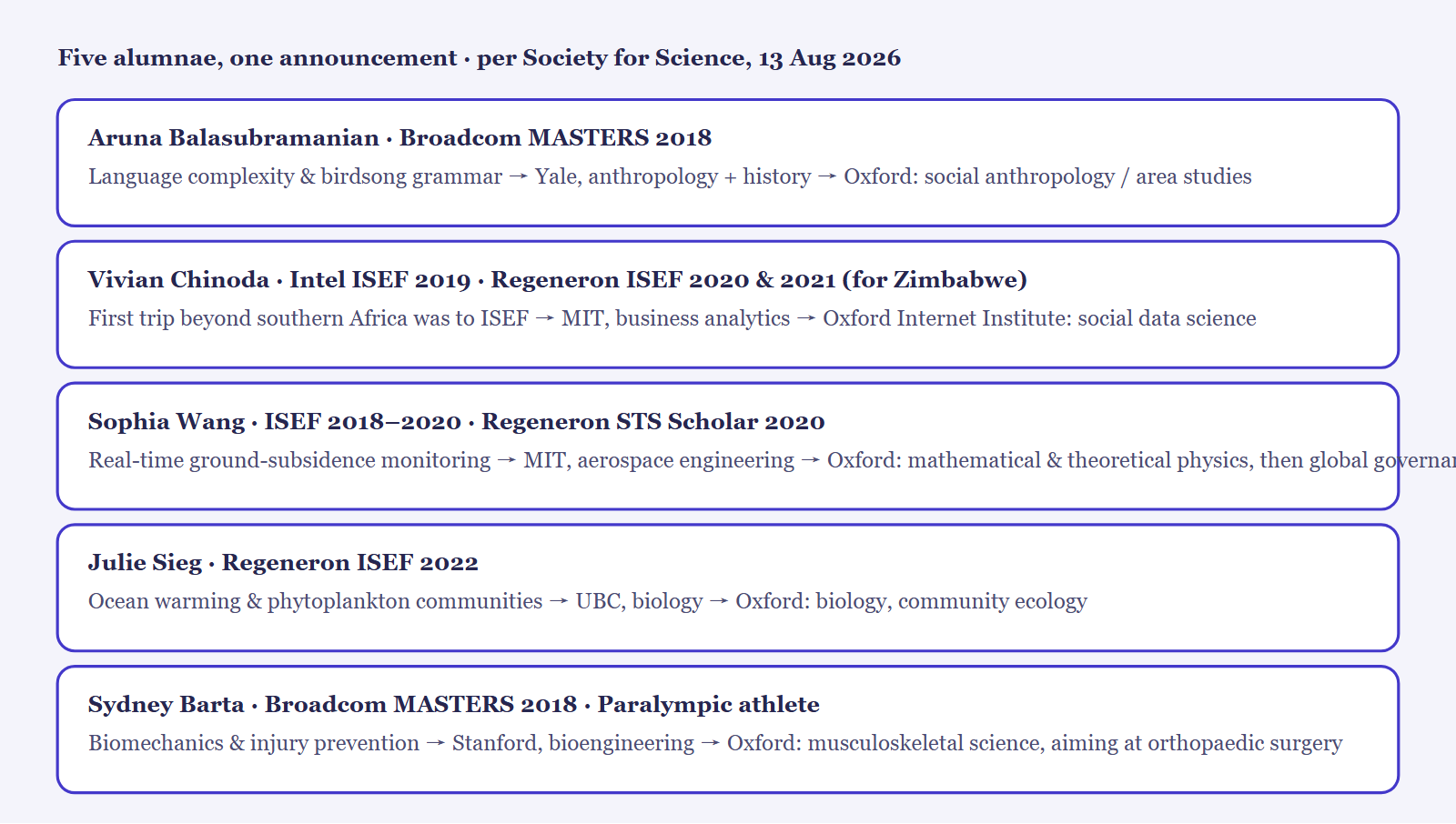
Two structural things stand out before any individual story. First, the range: ecology, anthropology, data science, theoretical physics and musculoskeletal health — science-fair research did not funnel these five into one “science track”; it fed five entirely different directions, including two that ended up closer to the humanities and policy than to a laboratory. Second, the entry points: two of the five came through the Broadcom MASTERS, the middle-school competition since renamed the Thermo Fisher Junior Innovators Challenge — meaning the arc can start well before high school, and well before anyone is thinking about applications at all.
What actually carried forward
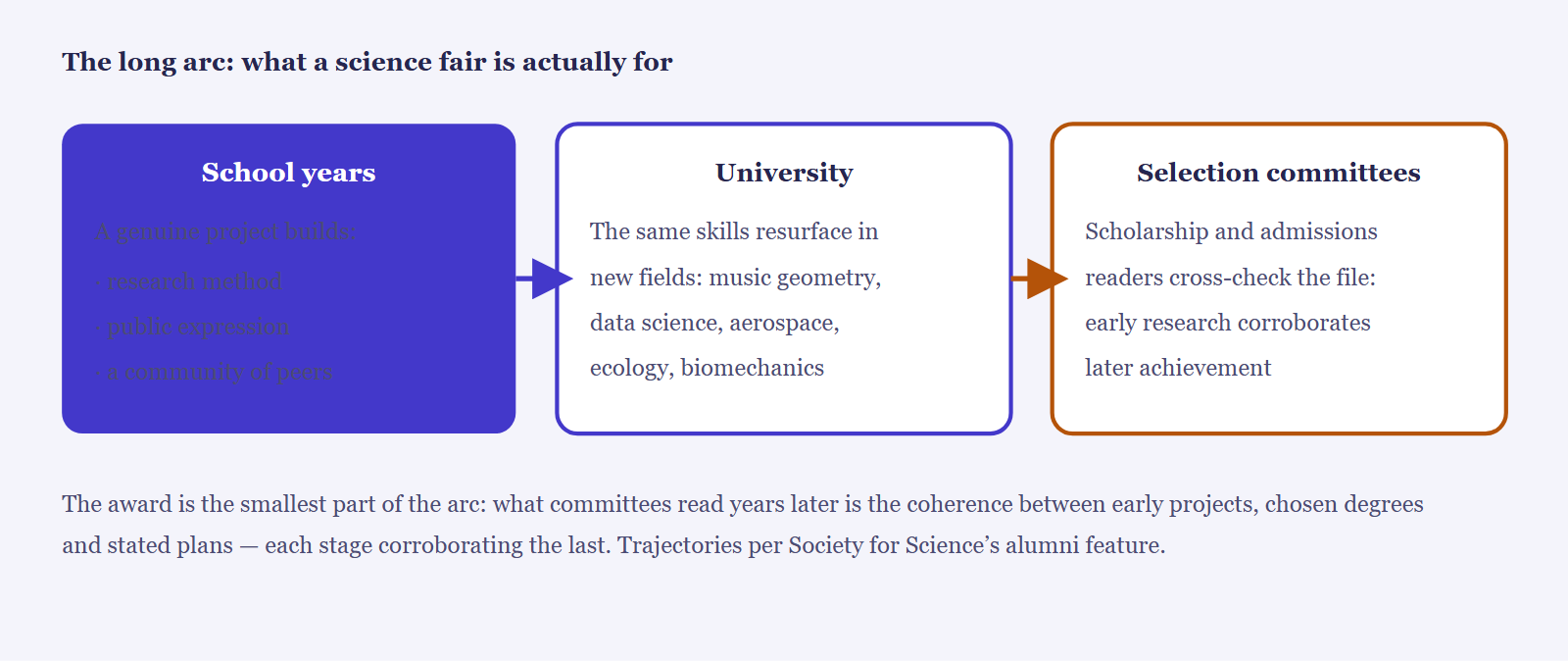
The feature is specific about what each scholar kept from the fair years, and none of it is a trophy. Balasubramanian credits the research methods she learned on her middle-school projects — on human language complexity and the grammar of birdsong — with shaping her later university work on the geometry of Indian musical scales, and the poster sessions with building the public-speaking muscle she now wants to use writing for general audiences. Chinoda, who had never left southern Africa before her first ISEF, describes walking the aisles between booths and hearing other students’ motivations as the moment science stopped being “coursework plus my project” and became a connected global community. Wang’s high-school engineering — a real-time ground-subsidence monitoring system — matured into an MIT aerospace degree and now a mathematics-and-physics plan with a governance layer on top. The pattern repeats: method, expression, community — the three things a genuine project builds whether or not it wins anything.
The honest reading for a student starting now
It would be easy — and wrong — to read this as “do ISEF, get a Rhodes.” Thousands of students compete each season; five scholarships is not a conversion rate worth planning around. The defensible reading runs the other way: when selection committees years later look at these five files, the early research is part of what makes everything else believable. A Yale anthropology thesis on a Japanese art island is more legible when the file also shows a twelve-year-old dissecting birdsong grammar; an Oxford data-science plan is more legible from someone who carried a project across three ISEFs for Zimbabwe. That is cross-checking, and it is how strong applications are actually read — awards, coursework and stated direction corroborating one another rather than any single line doing the work alone.
For students building toward this arc from China, the practical map is the one we maintain across this site: the 2026-27 season structure for how affiliated fairs feed ISEF, our guide to choosing a category by contribution, and — if you are weighing the American research-competition family — the STS vs ISEF eligibility comparison and our eleven-year dataset of STS finalist disciplines. One of the five scholars, Sophia Wang, was both an ISEF finalist and an STS Scholar — the two competitions are different doors into the same long arc.
Frequently asked questions
Who are the five Society for Science alumnae named 2026 Rhodes Scholars?
Per Society for Science’s alumni feature of 13 August 2026: Aruna Balasubramanian (Broadcom MASTERS 2018; Yale), Sydney Barta (Broadcom MASTERS 2018; Stanford), Vivian Chinoda (ISEF 2019-2021 for Zimbabwe; MIT), Julie Sieg (Regeneron ISEF 2022; UBC) and Sophia Wang (ISEF 2018-2020 and Regeneron STS Scholar 2020; MIT). All five head to Oxford this autumn.
Does competing at ISEF lead to scholarships like the Rhodes?
Not as a conversion — thousands compete each season, and no fair result produces a scholarship by itself. What these trajectories show is corroboration: years later, selection committees read early research alongside degrees and stated plans, and the coherence between them is what carries weight. The fair’s durable output is method, expression and community, not the medal.
Can the arc start before high school?
Yes. Two of the five came through the Broadcom MASTERS, the middle-school competition since renamed the Thermo Fisher Junior Innovators Challenge — their fair years began in grades seven and eight. Early does not mean rushed: both describe the same skills (research method, presenting) as what carried forward, not early wins.
Where can I read the original feature?
On Society for Science’s blog, published 13 August 2026, under the title “Five Society alumni headed to Oxford this fall as 2026 Rhodes Scholars”. Our summary follows that feature; the Society is the source for all five trajectories.
This is an independent guide. We are not affiliated with, endorsed by, or sponsored by the Society for Science or Regeneron ISEF. All five trajectories are as described in the Society’s alumni feature of 13 August 2026 at societyforscience.org. Corrections within 7 working days of notice.