The rule is short and specific. Checked on societyforscience.org on 31 August 2026, the International Rules state that “a student may not use generative AI to write the research plan, abstract, poster or to create citations.” That sentence names four documents, not every use of AI in a season — and the mechanism that actually enforces it is not a detector. It is a 25-point conversation with a judge.
What the rule says, and what it does not say
Take the wording apart, because students misread it in both directions. Some assume any use of an AI tool anywhere in a project is forbidden; others assume that if a detector cannot flag their text, nothing has happened. Both are wrong, and the second is expensive.
What the sentence does say is that four specific artefacts must not be written by generative AI: the research plan, the abstract, the poster, and citations. Three other rules from the same document sit alongside it and matter just as much:
- “The project should reflect independent research done by the student(s) and presented in their own words with proper citation.”
- The abstract “must describe research conducted by the student(s), not by the supervising adult(s).”
- Where a mentor is involved, “the research plan should delineate what parts of the project were done by the student and which parts of the project were done by the mentor.”
What the sentence does not say is that a machine-learning system cannot be the subject of your research. It is a rule about who writes four documents, not a rule about what you are allowed to study. Rule text is revised between editions, so read the current version in full rather than relying on any summary, this one included. If the wider structure is new to you, our overview of what ISEF is sets the context.
Three uses, three different rules
Almost every question we get collapses once you separate the three things students actually mean when they say “I used AI.” They are not variations of one activity; they sit in different places in the rulebook.
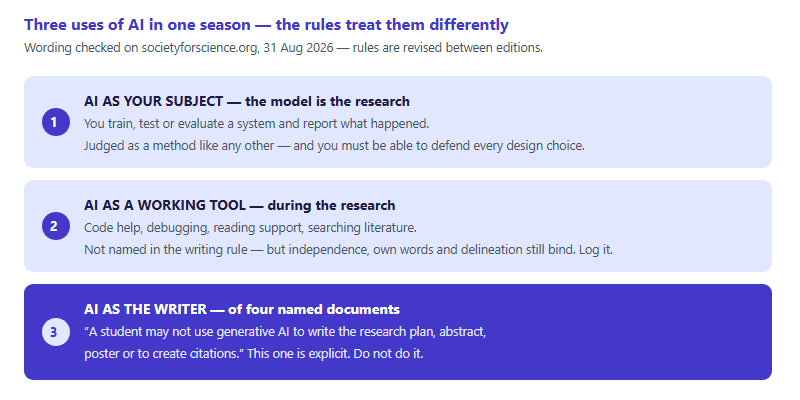
| Use | Typical example | What governs it | What you must be able to produce |
|---|---|---|---|
| AI as the research subject | Training a classifier and comparing it against a baseline you measured | The ordinary judging criteria; nothing in the writing rule prevents it | Every design decision, in your own words: why this architecture, this split, this baseline, these limits |
| AI as a working tool | Asking a model to explain an error message, suggest a plotting library, or paraphrase a paper you are reading | “Independent research … presented in their own words”; the requirement to delineate contributions; disclosure of support | A record in your data book of what you asked for and what you changed, plus the ability to explain any code you kept |
| AI writing the required documents | Generating the research plan, drafting the abstract, producing poster text, or generating a reference list | Explicitly named: not permitted | Nothing — there is no compliant version of this. Write them yourself. |
The reason this matters more in the 2026–27 cycle than it did three years ago is not only the tools. Per our operator briefing of 1 August 2026 — our own record, not a Society statistic — the 2026 final ran under the theme Future Forward, and its official programme included a session on the future of AI. When a large share of a field involves a model, judges get faster at telling the difference between a student who built something and a student who prompted something.
The citation trap
Of the four named artefacts, citations are where students get caught most cheaply, and it is worth being blunt about why. Language models produce reference lists that look correct: plausible authors, a plausible journal, a plausible year, sometimes a plausible identifier. A judge or a fair reviewer checks one of them in about ten seconds.
Two habits remove the risk entirely:
- Cite only what you have opened. If you have not read at least the abstract and the methods section, it does not go in your reference list. The rule requires research “presented in their own words with proper citation” — a citation you cannot describe is not proper.
- Keep the source, not the string. Save the PDF or the link when you first find a paper, in a folder that matches your reference numbering. Reconstructing a bibliography at the end of a season from memory is how honest students end up with dishonest reference lists.
This applies with equal force to the abstract, which is capped at 250 words and written after experimentation. A 250-word limit is exactly the kind of compression task students are tempted to delegate. Do not: it is one of the four named documents, and it is also the text a judge reads before meeting you.
Enforcement is a conversation, not a detector
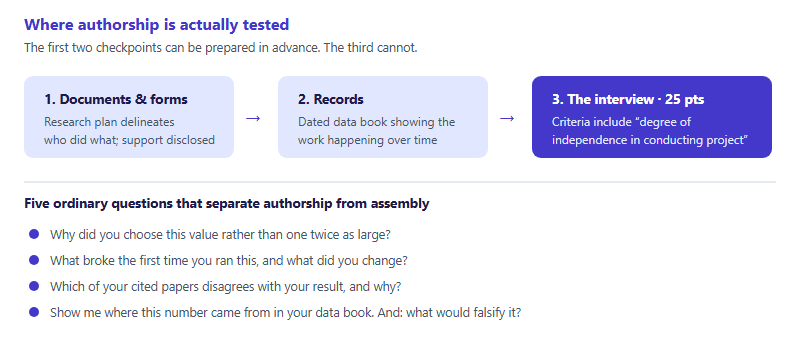
Students assume that compliance is a text-scanning problem. In practice the strongest check in the system is the interview, which carries 25 of the 100 Grand Award points — the largest single block on the sheet. Its published criteria include “degree of independence in conducting project,” “understanding of basic science relevant to project,” “understanding interpretation and limitations of results and conclusions,” and “clear, concise, thoughtful responses to questions.”
Notice what those four have in common. None of them can be prepared by a tool, because all four are tested by follow-up questions to answers you have just given. Generated text survives a page; it does not survive the second question.
Your selection fair may add rules of its own, and it judges you months before the final does — see how ISEF works from affiliated fairs to the global finals. Ask that fair directly what its position on AI assistance is, and keep the answer in writing.
If you use AI tools legitimately, document them like an instrument
You would not hide a pH meter. Treat a coding assistant the same way: named, dated, and described precisely enough that someone else could evaluate its role. Three habits carry almost all of the value.
- Log the interaction in your data book, on the day. One line is enough: what you asked for, what came back, and what you changed before keeping it. A dated record showing you debugging over three weeks is powerful evidence of authorship; a clean folder that appeared in April is not.
- Delineate contributions in the research plan. The rules already require this for mentors. Applying the same discipline to tools costs you two sentences and removes any later ambiguity — for example: “Data-processing scripts were written by me; I used a coding assistant to diagnose two errors in the plotting routine and rewrote the affected functions myself.”
- Disclose support through the proper channel. A Student Support Disclosure Form (2A) sits in the required set for every project, and forms — per the Society's 2027 forms page — are signed before research begins, with only a few items completed afterwards. Ask your Adult Sponsor how support should be recorded on the current version, and follow that rather than a template you found online.
The one line you should not cross is subtler than a rule and easier to test: if you cannot explain why a line of code, a parameter or a sentence is there, it should not be in your project. That standard is stricter than any detector and it is the one a judge applies.
A safe operating standard for the 2027 season
- Write the research plan, the abstract and the poster yourself, in your own English, from the first draft. These are named in the rule.
- Never generate a citation. Build your reference list from papers you have opened and saved.
- Keep a dated data book from the first week, including the days nothing worked.
- Record any tool that materially shaped your code or your analysis, the way you would record an instrument.
- Rehearse the five probe questions above out loud, in English, until the answers are specific rather than general.
- Ask your selection fair, in writing, whether it has additional requirements on AI assistance.
- Re-read the current International Rules yourself before you submit anything. Wording changes; last year's summary is not a defence.
If your project is itself a machine-learning project, one more decision follows from all of this: the category you enter determines which judges will interrogate those design choices and which projects yours is compared against. Our guide to choosing your ISEF category covers that decision in detail.
Frequently asked questions
Can I use ChatGPT to write my ISEF abstract?
No. The rules state a student may not use generative AI to write the research plan, abstract, poster or to create citations.
Can my ISEF project be about AI?
Yes. The writing rule concerns four documents, not your subject. You must still be able to defend every design choice yourself.
May I use a coding assistant while doing the research?
It is not named in the writing rule, but independence, own-words and disclosure requirements still apply. Log it and confirm with your fair.
How would anyone know?
The 25-point interview scores degree of independence. Follow-up questions about parameters, failures and limitations expose work you did not do.
This is an independent guide operated by Hanlin Education for China-based international-school students. We are not affiliated with, endorsed by, or sponsored by the Society for Science or Regeneron ISEF. Rules, forms and judging criteria are revised between editions: confirm current details on societyforscience.org and with the fair you intend to enter. Rule and criteria wording quoted here was checked on 31 August 2026; the observation about 2026 project trends is attributed to our own operator briefing of 1 August 2026 and is not a Society statistic. Errors reported to our editorial desk are corrected within 7 working days.