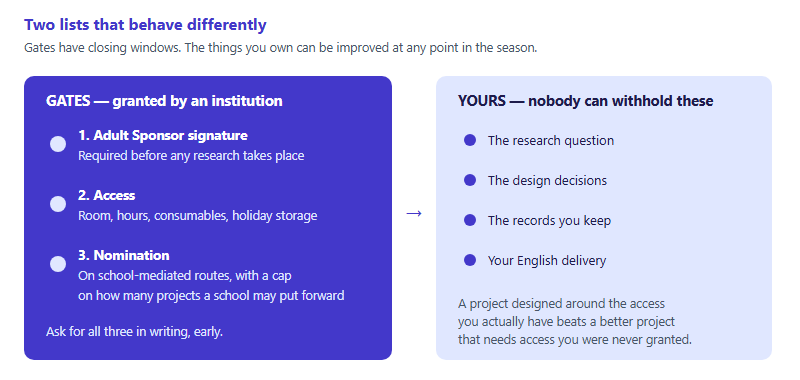
Three things in an ISEF season are not yours to supply. An Adult Sponsor has to sign your paperwork before any research takes place. Somebody has to give you space, time and equipment. And on several mainland-China routes the nomination itself passes through a school. Your research question is entirely under your control; the institutional layer around it is not — and September is when that layer gets settled.
The three gates a school controls, and the four things it cannot touch
Students plan a season as though it were one long private project. It is not. Roughly speaking, an ISEF season splits into what you own and what an institution grants you, and the two lists behave completely differently: the things you own can be improved at any point, while the things an institution grants have windows that close.
If the structure of the competition itself is still unfamiliar, read what ISEF is first — the short version is that no student applies to the final, so the route to it runs through bodies other than you.
Gate one: the signature that sets your calendar
Every project needs an Adult Sponsor, and the timing rule attached to the paperwork is stricter than most students assume. Checked on societyforscience.org on 31 August 2026, the 2027 forms page states that “the forms should be filled out and signed before any research takes place,” noting that only a small set of documents — including the abstract — are completed afterwards. The rules also make the assessment a joint one: “It is the responsibility of the student and the Adult Sponsor to evaluate the study to determine which forms are required.”
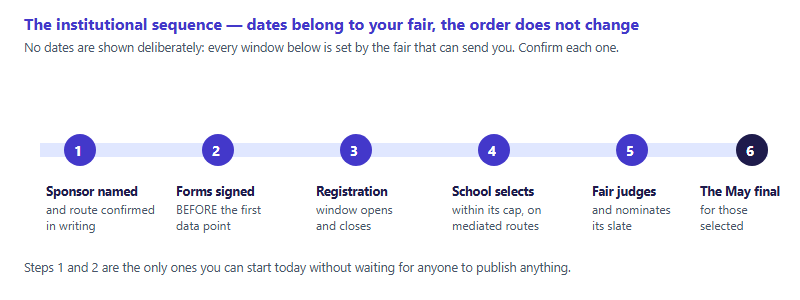
Read “before any research takes place” literally. It does not mean before the fair, or before you write things up. It means before your first data point. A student who spends October running pilot experiments and finds a sponsor in December has a paperwork problem that no amount of good data repairs, because the sequence itself is part of the rule. This site covers the form set and the approval categories separately; the point here is narrower and organisational — you cannot even work out which forms you need until an adult has agreed to look at your plan with you. That makes “who is my Adult Sponsor?” the first question of the season, not a piece of admin for later.
Two practical notes. First, an Adult Sponsor is not the same role as a research mentor and does not need to be a subject expert in your topic — a science teacher who understands the rule set is more useful than a distant professor who never reads a form. Second, whoever helps you technically has to be visible in the paperwork: the rules state that where a mentor is involved, “the research plan should delineate what parts of the project were done by the student and which parts of the project were done by the mentor.” A teacher who runs the equipment for you is not a secret; they are a line in your research plan.
Gate two: access is a timetable problem before it is a laboratory problem
Students describe this gate as “my school has no lab.” In our editorial experience the more common blocker is smaller and duller: the lab exists, but nobody is allowed in it after 16:30, or it is booked for IB practicals every Wednesday, or samples cannot be stored over the winter holiday because the fridge is emptied. Those constraints decide what project is possible far more often than equipment does.
So put the access question in numbers before you finalise a design:
- Hours. How many supervised hours per week, and in which weeks? A protocol requiring daily measurement for 21 consecutive days is impossible if the room closes at weekends.
- Continuity. What happens to living cultures, plants or samples during holidays and exam weeks? Ask before you buy anything.
- Consumables. Who pays, and through which budget line? A school that will not spend money may still let you bring your own.
- Storage. Where does your equipment sit between sessions, and who else uses the space?
A design built around confirmed access nearly always beats a more ambitious design built around access you hope to negotiate later. This is also where your subject choice starts to interact with the department that can actually supervise you, which is worth thinking about while you are still choosing your ISEF category.
Gate three: the internal contest nobody warns you about
This is the gate students discover last and resent most. Because there is no direct entry to the final — every finalist is selected by an affiliated fair, as our walkthrough of how ISEF works explains — the route runs through selections that are often mediated by schools rather than open to individuals.
Our operator briefing of 1 August 2026 names four mainland-China selection routes for this cycle, and the shape of them matters more than the names: a fair serving students at schools for children of foreign nationals, which produced five direct places this year; the Shanghai science-seed selection, which recommends its award-winning projects; a Chongqing selection choosing five projects from students in the province, vocational schools included; and the Beijing-Tianjin-Hebei Youth Science Fair, which selects ten projects. Hong Kong runs its own regional preselection, Singapore's sole official route is SSEF, and Canada runs through the Canada-Wide Science Fair. Those are our own records rather than a Society listing, and quotas and eligibility move from year to year — confirm current arrangements with each fair.
Two consequences follow. Slates are small, in fives and tens. And where a route asks schools to recommend projects, your school has a cap of its own: some routes cap how many projects a single school may put forward, and the number changes from cycle to cycle. Treat the mechanism as real and the figure as unknown, and ask your own fair what this cycle's number is. Either way, the planning implication is the same — the first competition you enter may be against classmates, judged by teachers, months before any external panel sees your work.
How to ask: one page, in writing, with the questions that matter
Teachers say no to vague enthusiasm and yes to a plan that costs them little. The most effective approach we see is a single page delivered in person and then sent by email, so there is a written record of what was agreed. Keep it to five items.
| What you are asking for | Who normally grants it | Put this exact question in writing | If the answer is no |
|---|---|---|---|
| Adult Sponsor | A science teacher, head of department or research coordinator | “Would you be willing to act as Adult Sponsor so we can work out together which forms my project needs before I begin?” | Ask whether another teacher, a school librarian with science background, or a departmental technician could take the role instead |
| Route confirmation | Science coordinator, or the fair itself | “Which affiliated fair or selection covers students at this school, and who is its contact?” Ask for a name, not reassurance | Write to the nearest selection yourself and ask whether students at your school type are eligible |
| Access | Lab technician, head of department, timetabler | “Which hours can I use the room between September and February, and what happens to samples during holidays?” | Redesign the project for the access you do have — field, computational or home-safe methods |
| Nomination | Head of school or the coordinator who submits | “How many projects may this school put forward this cycle, and how will they be chosen?” | Ask what would make a project selectable next cycle, and start that project now |
| A decision date | Whoever you asked | “When can I expect an answer? I need it before I begin experimenting.” | A slow no is still information — use it to switch route or design early |
What makes a school say yes is usually not the science. It is the sense that supporting you will not generate work. Say who supervises, when you will be in the building, what you will pay for yourself, and what you will hand back — a short mid-season written update to your sponsor costs you an hour and makes the next request far easier.
When the school has never done this — or says no
Both are common, and neither is fatal. What is fatal is inventing a route around them.
- No science-fair culture. Bring the rule set to the meeting rather than asking the teacher to find it. Print the current forms page from societyforscience.org and mark the one signature you need now. Teachers refuse ambiguity far more often than they refuse work.
- No eligible route for your school type. Ask the fair directly, in writing, and keep the reply. If no route covers you this cycle, that is a real answer: plan for the next one, or ask whether your school can seek eligibility for future cycles. Do not assume you can enter whichever selection looks least competitive — routes usually follow enrolment.
- A firm no on supervision. Shift to a design that needs less institutional support: field observation, publicly available data, simulation, or a build you can run and document safely at home. Constraint-driven designs are not consolation prizes; the judging criteria reward inventiveness in method, and a documented workaround is inventive.
- The opposite problem — too much help. A school that hands you a finished protocol and a technician who runs it creates a different risk. The published interview criteria include “degree of independence in conducting project,” and the rules require that the project “reflect independent research done by the student(s) and presented in their own words.” Support you cannot explain in an interview is not support.
One last note on tone, aimed at families as much as students. Approaching a school with a competition name and a deadline rarely works. Approaching a teacher with a question you find genuinely interesting, a plan that fits their timetable, and a promise to keep records they can inspect works surprisingly often — and it is the same behaviour the judging criteria reward eight months later.
Frequently asked questions
Who can be my Adult Sponsor?
Rules describe it as an adult who works with you on the project and helps determine required forms. Confirm the current definition on societyforscience.org.
When do the forms need signing?
The Society states forms should be filled out and signed before any research takes place, with only a few items completed afterwards.
Can I enter a fair without my school?
It depends on the fair. Some selections are school-mediated and some are not, so ask the fair itself in writing before you plan.
My school can only nominate a few projects. What now?
Ask how many and how they are chosen, then make your project legible early with a short written brief and a mid-season update.
This is an independent guide operated by Hanlin Education for China-based international-school students. We are not affiliated with, endorsed by, or sponsored by the Society for Science or Regeneron ISEF. Forms, sponsor requirements, judging criteria, route eligibility, quotas, deadlines and fees change between cycles: confirm current details on societyforscience.org and directly with the fair you intend to enter. Rules quoted here were checked on 31 August 2026; mainland-China and regional route detail is attributed to our own operator briefing of 1 August 2026, and school-recommendation caps vary by route and cycle: confirm the current number directly with your fair. Errors reported to our editorial desk are corrected within 7 working days.