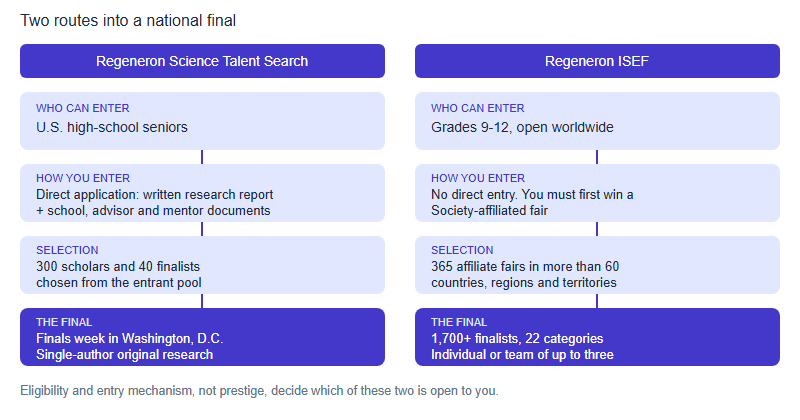
Both are run by Society for Science, and students constantly confuse them. The difference that matters is not prestige — it is access. The Science Talent Search (STS) is for U.S. high-school seniors and you apply to it directly. Regeneron ISEF is open worldwide in grades 9–12, but there is no direct entry at all: you have to win a Society-affiliated fair first. That single sentence decides which one is even available to you.
The eligibility line, stated plainly
Before anyone compares award money or reputation, they should compare doors.
- STS is for U.S. high-school seniors. It is the single most important fact on this page. A student enrolled at a school in mainland China cannot enter STS. The realistic route for that student is ISEF, through an affiliated fair. Students on a U.S. high-school path — including Chinese students studying at U.S. high schools — are the ones for whom STS is genuinely in scope.
- ISEF has no direct entry. Society for Science states that finalists earned the right to compete by winning at a Society-affiliated local, regional, state or national science fair. You cannot skip that step, however strong the project is. Your real deadline is your fair's deadline, not ISEF week.
So the honest framing is not “which is better” but which of these two doors is unlocked for me, and what is the key. For most students reading this site, the answer is ISEF, and the key is an affiliated fair. If you are on a U.S. senior-year path, you may have both doors — and that changes how you should plan the next twelve months.
What each competition actually is
The Science Talent Search has run since 1942 and is a programme of Society for Science; its own program books describe it as the nation's oldest and most highly regarded science competition for high-school seniors. Its title sponsors have run in sequence — Westinghouse, then Intel, then Regeneron — with Regeneron's commitment described as ten years and $100 million. Entry is an extensive written application: a research report plus supporting documentation from schools, advisors and mentors. Evaluators and judges then select 300 scholars and 40 finalists from the entrant pool, and the top 40 attend a finals week in Washington, D.C., where they display their research publicly. In 2026, finalists competed for more than $1.8 million, within a total annual distribution of $3.1 million.
Regeneron ISEF has run since 1950 and works on a completely different mechanism: a global qualifying network. The 2026 fair ran 9–15 May in Phoenix and brought together more than 1,700 young scientists, engineers, entrepreneurs and inventors, selected from 365 affiliate fairs in more than 60 countries, regions and territories, competing across 22 different scientific categories. Entries may be individual or a team of up to three. For the fuller picture of the competition itself, start with what ISEF is and then how ISEF actually works.
Side by side: the two flagships compared
| Dimension | Regeneron Science Talent Search | Regeneron ISEF |
|---|---|---|
| Run by | Society for Science | Society for Science |
| Running since | 1942 | 1950 |
| Title sponsors over time | Westinghouse, then Intel, then Regeneron (commitment described as ten years and $100 million) | Regeneron |
| Who can enter | U.S. high-school seniors | Grades 9–12, open worldwide |
| How you get in | Direct application. No qualifying fair | No direct entry. Win a Society-affiliated local, regional, state or national fair |
| What you submit / present | Extensive application: written research report plus supporting documentation from schools, advisors and mentors | Project presented at the fair; finalists compete across 22 scientific categories |
| Authorship | Single-author original research project | Individual or a team of up to three |
| Scale of the final | 300 scholars and 40 finalists selected from the entrant pool | More than 1,700 finalists (2026), from 365 affiliate fairs in 60+ countries, regions and territories |
| Where the final happens | Finals week in Washington, D.C.; the top 40 display their research publicly | 2026: 9–15 May, Phoenix. 2027: reported to return to Los Angeles in May (see below) |
| Category structure | Our own compilation assigns a field to each finalist from how the program books describe the research; confirm any official structure on societyforscience.org | 22 different scientific categories |
| Award figures we can verify | 2026: finalists competed for more than $1.8 million; total annual distribution $3.1 million | Confirm current award tiers on societyforscience.org |
| How many times you can try | Senior year only, so in practice one cycle | Grades 9–12, so more than once if you keep winning at your fair |
Which one is even available to you? A short decision path
Work down this list and stop at the first line that describes you.
- You are a senior at a U.S. high school. Both doors are open. STS is in scope this year, and ISEF is too if you can still win a place through an affiliated fair. This is the only situation in which the “which is better” question is real rather than theoretical.
- You are in grade 9, 10 or 11 at a U.S. high school. STS is not in scope yet — it is a senior-year competition. ISEF is your live option now, and the work you do in these years is exactly the work you would write up as a senior. Plan for the sequence, not for one event.
- You are at an international school in mainland China, or anywhere outside the U.S. high-school system, in grades 9–12. STS is not available to you. Do not spend a season building a plan around it. ISEF is available, through a Society-affiliated fair — find the fair that serves your school or region first, and confirm its calendar before you design the project.
- You are unsure which system your school sits in — for example an international school with a U.S.-accredited track. Do not guess. Confirm your own eligibility on societyforscience.org before you commit a research year to either competition.
The blunt version: there is no prestige in a competition you cannot enter, and every hour spent aspiring to a closed door is an hour not spent on the open one. If you land on line 3, your entire competitive calendar is set by your affiliated fair. That is the clock to plan against — see what is confirmed for the 2026–27 season. If you want the wider three-way view that also covers JSHS, we have a separate comparison.
Two different clocks: what this means for planning
Because STS is senior-year and single-author while ISEF starts in grade 9 and allows teams of up to three, the two reward different project timelines. This is the practical consequence most students miss.
- ISEF rewards an iterated project. A grade-9 or grade-10 entry can be a genuine first attempt: you learn what a fair judge asks, what a display board has to carry, and where your methods are thin. You can come back the following year with a better version, or a different question entirely. The grade band is four years wide for a reason.
- STS rewards an accumulated, individually owned body of work. The submission is an extensive written application — a research report plus documentation from schools, advisors and mentors. That documentation requirement means your teachers and mentors have to be reachable and willing in your senior autumn, which is also the busiest term of a U.S. applicant's year. Line those people up early; do not discover in October that your mentor has moved institutions.
- The two nest, but only if authorship stays clean. On a U.S. path, grades 9–11 ISEF work is the natural raw material for a senior-year STS report. The catch is structural: ISEF permits a team of up to three, while each STS finalist entry is a single-author original research project. A three-person team project is awkward to convert into a single-author application. If STS is anywhere in your plan, make sure at least one strand of work is unambiguously yours — your question, your design, your analysis.
- Outside the U.S. system, only one clock exists. Your affiliated fair sits months ahead of ISEF week, and its deadline is the one that can end your season. Work backwards from the fair, not from May.
What eleven years of STS finalist fields look like — our own compilation
Here is something you cannot look up elsewhere, with its limits declared up front. We read the official Regeneron STS program books and classified each finalist's research into a field, using the phrasing the books themselves use. This is our classification, not a Society statistic, and we are not reproducing any of the books' write-ups. Three honest caveats:
- Coverage varies by year. We could confidently classify between 29 and 40 of each year's 40 finalists — 29 of 40 in 2015, but 40 of 40 in both 2025 and 2026. Year-on-year comparisons are therefore rough, not exact.
- 2019 is a gap. We have no program book for that year in our set, so 2019 is absent entirely rather than estimated.
- Field labels blur. A project on biological data could reasonably sit in Computational Biology & Bioinformatics or in Computer Science. We picked one; someone else might have picked the other.
Across 371 classified finalists, these are the twelve largest fields. The remaining classified finalists sat in smaller fields such as Neuroscience, Space Science, Plant Sciences and Genomics, so the twelve bars below do not add up to 371.
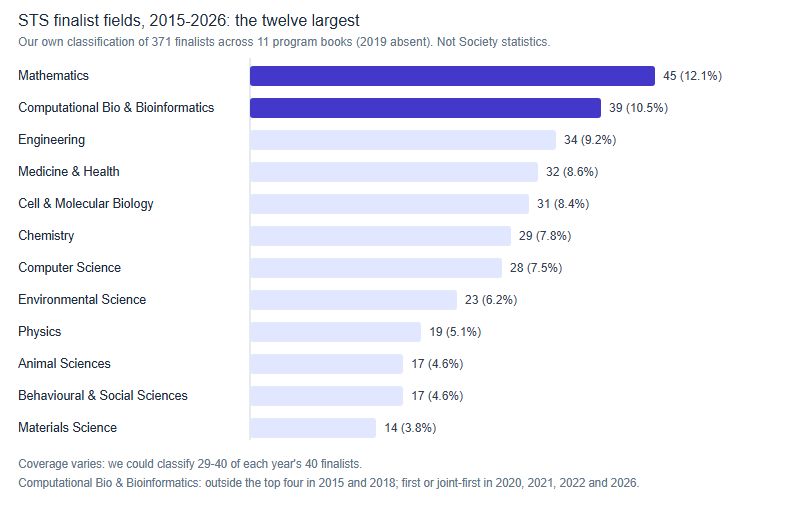
Two patterns are worth naming. First, Mathematics leads the eleven-year total at 45 finalists (12.1%), which surprises people who assume a written research competition must favour wet-lab biology. Second, and more interesting, is the computational shift: Computational Biology & Bioinformatics sat outside the top four in 2015 and in 2018, but finished first or joint-first in 2020, 2021, 2022 and 2026, ending the period second overall on 39 finalists (10.5%). Within our classification, work that applies computation to biological and medical data has gone from a side stream to one of the two largest streams reaching the final.
Read this as description, not prescription. It shows what got through; it is not a shopping list, and choosing a field to game a competition is a bad way to pick a research question. What it does suggest — and this carries over to ISEF students too, who choose among 22 categories rather than these labels — is that computational methods have widened the range of serious projects a school-age researcher can actually complete without institutional wet-lab access.
The 2027 question, and what to confirm yourself
We are told the fair returns to Los Angeles in May 2027. As of 5 August 2026, Society for Science had not posted a 2027 host city, so treat this as an early, attributed signal rather than a settled fact, and confirm it on societyforscience.org before anyone books anything. Our full read of what is and is not confirmed for the season sits in the 2026–27 season briefing.
Whichever competition applies to you, confirm these five things at source rather than taking any guide's word for it, including ours: your own eligibility; your affiliated fair's registration deadline; the current category list and any rule changes; award structures; and the dates of the relevant final. Rules move year to year, and a guide that reads confidently is not the same as a guide that is current.
Frequently asked questions
Can a student at a school in mainland China enter the Science Talent Search?
No. STS is for U.S. high-school seniors. The realistic route for that student is ISEF, through a Society-affiliated fair.
Can I apply to ISEF directly?
No. There is no direct entry. You must first win a Society-affiliated local, regional, state or national fair; 365 of them feed ISEF.
Can STS and ISEF projects be team projects?
ISEF allows an individual or a team of up to three. Each STS finalist entry is a single-author original research project.
Where will ISEF 2027 be held?
Reported to return to Los Angeles in May 2027, but the Society has not posted it as of 5 August 2026. Confirm on societyforscience.org.
This is an independent guide operated by Hanlin Education for China-based international-school students. We are not affiliated with, endorsed by, or sponsored by the Society for Science, the Regeneron Science Talent Search or Regeneron ISEF. The finalist-field figures on this page are our own compilation from the official program books and are not Society statistics; our set covers 2015–2026 with no book for 2019, and classifies 29–40 of each year's 40 finalists. Confirm current rules, dates and eligibility on societyforscience.org. Errors reported to our editorial desk are corrected within 7 working days.