A literature review is the step between having a question and being allowed to design an experiment: you find out what is already known, borrow the methods other people spent years refining, and write the two or three sentences that explain what your project adds. Done properly it takes about ten focused hours, and you can do all of it from China without a university library login.
Why the reading comes before the experiment, not after
Most students do this backwards. They pick a question in July, spend August building apparatus, collect data through the autumn, and only then go looking for papers — usually the night before the research plan is due, and usually to decorate a bibliography that was written to fill a form.
The cost of that order is invisible until it is expensive. Three things go wrong:
- You answer a question that was settled in 1994. Not a disaster on its own, but you will find out in the judging interview rather than in August, and you will have no answer when a judge says “how does your result compare with the published values?”
- You reinvent a method badly. Somebody has already worked out how to keep that assay stable, how long the incubation needs to be, what the sensor drifts by. That information is free and sitting in a methods section.
- You cannot say what is new. Novelty is not something you feel — it is a claim you make relative to specific prior work. If you have not read the prior work, you cannot make the claim, and vague claims are the ones judges test hardest.
Reading first also protects your season calendar. If you are starting a project this summer for a fair season that ends with the international finals in May, ten hours of reading in August can save you a wasted month in October. For how the season fits together from an affiliated fair up to the finals, see our guide on how ISEF works.
Getting the papers legally, without a university subscription
The single biggest myth among China-based students is that serious papers are locked behind paywalls they cannot reach. A large share of current research is legally free, and for most of the rest there is a legitimate route. Never use pirate mirrors — apart from the legal problem, a research plan built on sources you cannot cite openly is a research plan you cannot defend.
| Route | What it gets you | Cost | Watch out for |
|---|---|---|---|
| PubMed Central (PMC) | Free full text of a large body of life-science and biomedical literature deposited under public-access policies | Free | A PubMed record is not the same as free full text; check for the PMC link |
| arXiv, bioRxiv, medRxiv | Preprints in physics, maths, computer science, biology and medicine — often the newest work in the field | Free | Preprints have not been peer reviewed. Say so when you cite them |
| DOAJ | An index of open-access journals across every discipline | Free | Journal quality varies enormously; judge the venue, not just the abstract |
| Google Scholar | Broad index, plus an “All versions” link that often surfaces a free author copy | Free | It indexes weak venues and predatory journals alongside good ones |
| Institutional repositories and author pages | Accepted manuscripts deposited by the authors themselves | Free | The deposited version may differ slightly from the published one |
| Emailing the corresponding author | The actual PDF, frequently within a few days | Free | Send a short, specific, polite email. Researchers answer students more often than students expect |
| Your school library or consortium | Some international schools hold real subscriptions or database access | Varies | Ask the librarian before assuming you have nothing — many students never ask |
One practical note for readers in mainland China: build your reading list first and download in batches when you have a stable connection, and keep every PDF in a single folder named by author and year. You will be citing these files eight months later, and hunting for a paper you once read is the most annoying possible use of March.
A ten-hour search protocol you can actually finish
The reason literature reviews sprawl is that there is no natural stopping point. So impose one. This protocol has five stages, a time box for each, and a defined output — when you have the output, you move on even if you feel underread.
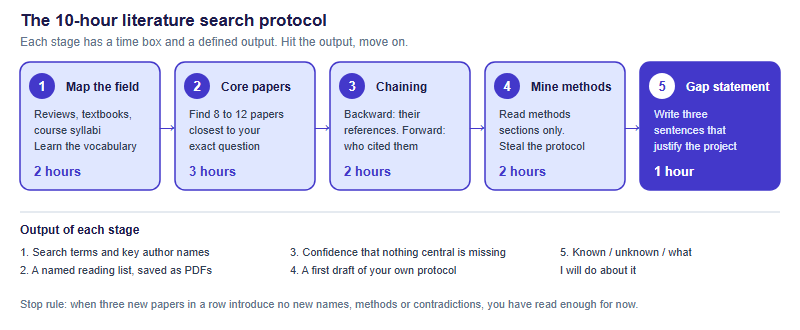
Two details make the difference between doing this and pretending to do it. First, citation chaining in both directions: every good paper hands you its own ancestors in the reference list, and a citation index hands you its descendants — the newer work that responded to it. Second, reading methods sections rather than whole papers. At stage four you are not reading for understanding, you are reading for instructions: sample sizes, timings, instruments, controls, what the authors said went wrong.
Five honest ways a high-school project can be new
Novelty at this level almost never means discovering an unknown mechanism. It means occupying a specific position relative to work that exists. Judges are experienced enough to recognise an honest, narrow novelty claim and to distrust a grand one, so the strategic move is to claim less and defend it completely.
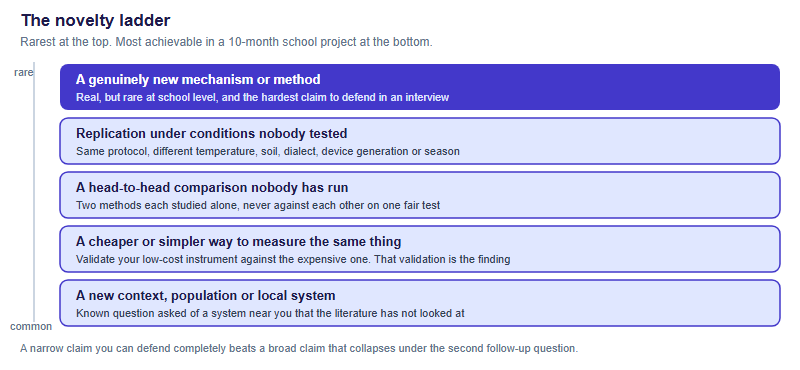
Notice what the bottom rung gives students based in China: proximity to systems that the English-language literature has largely ignored. A soil, a waterway, a building stock, a local crop variety, a Mandarin-language dataset, a device that is common here and rare elsewhere. That is not a consolation prize — it is a real gap, and it is one you can reach on a bicycle.
Turning the reading into three sentences and a bibliography
The output of stage five is a paragraph you will reuse for the rest of the season. It has exactly three moves:
- What is known. Two or three sentences summarising the settled picture, each anchored to a specific citation, not to “studies show”.
- What is not known. The gap, stated as narrowly as you can make it. “X has been measured in laboratory conditions but not in field conditions at low temperature” is a gap. “More research is needed” is not.
- What this project does about it. One sentence linking your question directly to that gap.
Those three sentences become the background section of your research plan, the opening of your abstract — which is capped at 250 words, so the discipline is useful practice — the first thing on your board, and the answer to the first question every judge asks. The research plan also asks you to document your sources in a bibliography; confirm the current required format and the minimum number of references on societyforscience.org, because form requirements are revised between seasons.
Keep a running reference file from day one, with the full citation, the link, and one line on why the paper matters to you. Reconstructing that in April, from memory, across forty PDFs, is a genuinely miserable weekend.
The five failure modes worth naming
- Reading only reviews and news articles. Review papers are the right place to start and the wrong place to stop. They tell you what the field concluded; they do not tell you how anyone actually did the work.
- Citing sources that cannot bear weight. Popular science sites, encyclopaedias and unattributed blog posts belong in your own learning, not in a research plan. Trace the claim back to the paper it came from and cite that.
- Claiming to be first. “No one has ever studied this” is almost always false, and it invites a judge to name the person who did. “I could not find prior work on this specific combination, and here is where I searched” is honest, checkable and stronger.
- Reading after designing. If your protocol is already built, you will unconsciously read for confirmation rather than for correction.
- Letting the review pick the category. Your reading will tell you which field owns your question, which is useful, but the category decision has its own logic — we work through that separately in how to choose your ISEF category. If you are still deciding whether this competition is the right target at all, start with what ISEF is.
Ten hours in August. It is the cheapest insurance available on a ten-month project, and it is the only part of the process that costs nothing but attention.
Frequently asked questions
How many papers do I actually need to read for an ISEF project?
There is no fixed number. Aim for 8 to 12 papers close to your exact question, and stop when new papers stop introducing new methods or names.
Can I use preprints from arXiv or bioRxiv in my bibliography?
Yes, but label them as preprints. They have not been peer reviewed, and a judge will respect you for flagging that difference yourself.
What if I find a paper that already did my exact project?
Good news, found in August rather than May. Change one axis — population, condition, measurement or comparison — and cite that paper as your starting point.
Is it acceptable to email a researcher and ask for their paper?
Yes. A short, specific, polite email is normal academic practice, and many authors reply to students within days.
This is an independent guide operated by Hanlin Education for China-based international-school students. We are not affiliated with, endorsed by, or sponsored by the Society for Science or Regeneron ISEF. Rules, forms, categories and dates are revised between seasons — confirm current details on societyforscience.org before acting on anything here. Factual errors reported to us are corrected within 7 working days.