Three names dominate US high-school science research: the Regeneron International Science and Engineering Fair (ISEF), the Regeneron Science Talent Search (STS), and the Junior Science and Humanities Symposium (JSHS). They are not interchangeable. They differ in who can enter, how you qualify, and what they reward — and for a China-based international-school student, the most important difference is simply which door is actually open. This comparison sorts that out, with every eligibility point flagged for confirmation on the official sources.
The one difference that decides everything: eligibility
Before comparing prestige or prize money, compare access — because access is where these three diverge most sharply for international students.
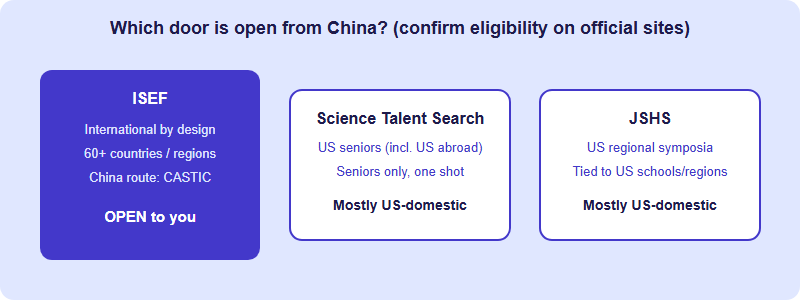
- ISEF is international by design. It draws finalists from hundreds of affiliated fairs across more than 60 countries, regions, and territories. Eligibility is grades 9–12 (or equivalent) and under age 20 by May 1 preceding the fair. For a student in China, the route typically runs through a national/affiliated selection process commonly referenced as CASTIC. This is the path built for you.
- The Regeneron Science Talent Search (STS) is widely understood to be limited to US high-school seniors (including US students abroad in many cases), making it generally not open to most non-US international-school students in China. Confirm the exact eligibility on the official Society for Science page before assuming you qualify.
- JSHS operates primarily through US regional symposia tied to US schools and regions, which similarly limits access for students based in China. Treat it as a US-domestic pathway unless its official site states otherwise for your situation.
In short: of the three, ISEF is the competition genuinely designed to be reachable from China, which is why it anchors most international students’ research ambitions. The other two are worth understanding so you do not waste a season chasing a door that is closed. For the full ISEF picture, start with what ISEF is.
Format and reward: same goal, different game
Even where they overlap in spirit — celebrating original pre-college research — the three differ in how you compete and what you can win. The table summarises the contrast; treat dollar figures and structures as ISEF-confirmed where cited and “confirm on official site” elsewhere.
| Dimension | ISEF | Science Talent Search (STS) | JSHS |
|---|---|---|---|
| Who runs it | Society for Science | Society for Science | US DoD / sponsoring partners |
| Open to China-based students? | Yes, via affiliated fair / CASTIC | Generally no (US seniors) | Generally no (US regions) |
| How you compete | Display board + live judge interviews | Written application + research report | Research paper + oral presentation |
| Eligibility band | Grades 9–12, under 20 by May 1 | High-school seniors | High-school students (via region) |
| Categories | 22 categories | Judged as a whole field | Several STEM disciplines |
| Top award (ISEF, confirmed) | Yancopoulos Innovator Award $100,000 | Confirm on official site | Confirm on official site |
| Grand Award 1st place (ISEF) | $6,000 ($2,400 / $1,200 / $600 for 2nd–4th) | — | — |
The structural takeaway: ISEF rewards live defence of a project across 22 categories with a large, published award stack — beyond the per-category Grand Awards, first-place winners compete for top honours including two Regeneron Young Scientist Awards of $75,000 each and the $100,000 Yancopoulos Innovator Award. STS rewards the written depth of a single senior’s body of work; JSHS rewards paper-plus-presentation through US regional rounds. If you thrive explaining your work out loud, ISEF’s interview format plays to your strength — and it is the one you can actually enter. For how that judging works in practice, see how ISEF works.
A decision framework: which should a China-based student target?
Reduce the noise to a short sequence of questions. Answered honestly, they almost always point a China-based international-school student to the same starting line.
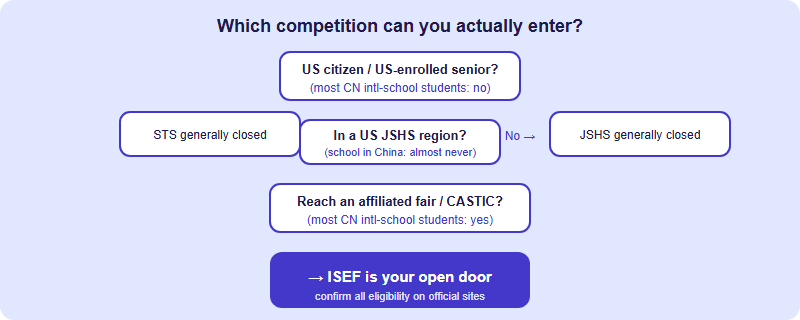
- Are you a US citizen or US-enrolled senior? If no, STS is generally off the table — and most students in Chinese international schools are not. That removes the highest-profile written competition from your plan immediately.
- Is your school tied to a US JSHS region? Almost never for a school in China. If not, JSHS is effectively closed too.
- Can you reach an ISEF-affiliated fair, including via the CASTIC selection route? For most international-school students in China, yes — this is the open door.
- Do you have a research idea you could pursue for roughly a year, with an adult sponsor and ethical review? If yes, you have the raw material for an ISEF project regardless of the other two.
The framework is deliberately blunt because students waste months on aspiration rather than access. There is no prestige in a competition you cannot enter. Put your energy into the one that is built to be reached from China, and make that project as strong as possible.
If ISEF is the answer, here is how the China route actually starts
Choosing ISEF is the easy part; the year of work behind it is the real commitment. The honest sequence for a China-based student looks like this, with each step confirmed against official guidance:
- Find your affiliated-fair pathway. ISEF finalists come up through affiliated fairs; for students in China this commonly means the CASTIC selection track. Identify your route early in the school year, because qualifying rounds have their own deadlines.
- Lock an adult sponsor and a research question that fits one of the 22 categories and can be ethically reviewed. This is where most timelines either succeed or quietly fail.
- Run the project with paperwork first. Approval before experimentation, a dated logbook, and an honest record of help — the same rigour judges later reward.
- Build the deliverables last: the ≤250-word abstract, a fold-flat display board within the size limits, and a rehearsed interview.
This is not a one-term sprint; the strongest entries treat it as a year-long arc. The upside is that every piece of that arc — the question, the ethics review, the data, the live defence — is a transferable research credential, whether or not you place. Begin by understanding the competition end to end in what ISEF is, then map your category early.
What this means for your admissions signal
Students often ask which competition “looks best” to universities. The honest answer: no competition guarantees admission, and a US admissions reader values demonstrated research ability and authentic intellectual curiosity over a logo. What a strong ISEF result signals is concrete and credible — that you ran an original, ethically-reviewed project and could defend it to expert judges. That is a transferable signal whether or not you medal, and it is one you can earn from China.
A few realistic framing points:
- Reachability beats prestige you cannot access. An ISEF affiliated-fair run you can actually enter is worth more to your application than admiring an STS finalist list you are ineligible for.
- The process is the signal. The research notebook, the SRC/IRB approval, the abstract, the live defence — these demonstrate scientific maturity. Universities read the depth, not just the placement.
- Fit matters. If your strength is sustained written work over years, you might envy the STS format; channel that depth into a rigorous ISEF project instead, since that is the open door.
Choose where to invest your year based on access first, then format fit. For most China-based international-school students, that points clearly to ISEF — and from there, to picking the right of the 22 fields for your work, covered in how to choose your category. Confirm every eligibility rule, deadline, and award figure on societyforscience.org and each competition’s official site before committing, because all three review their rules annually.
FAQ
Can a student in China enter the Regeneron Science Talent Search?
Generally no — STS is widely limited to US high-school seniors. ISEF, via an affiliated fair and the CASTIC route, is the path designed to be open from China. Confirm on societyforscience.org.
Is ISEF or STS more prestigious?
Both are highly regarded, but they have different eligibility and formats. For most non-US students the practical answer is ISEF, because STS is generally not open to them.
What is JSHS and can international students enter?
JSHS is a US research symposium run through regional rounds tied to US schools, so it is generally a US-domestic pathway. Verify eligibility on its official site.
Does winning ISEF guarantee university admission?
No. No competition guarantees admission. A strong ISEF project signals real research ability and the capacity to defend it, which admissions readers value.
This is an independent guide operated by Hanlin Education for China-based international-school students. It is not affiliated with, endorsed by, or sponsored by the Society for Science or Regeneron ISEF. Eligibility rules, deadlines, and award figures for ISEF, the Science Talent Search and JSHS are reviewed annually; confirm current details on societyforscience.org and each competition’s official site. Errors are corrected within 7 working days.