Here is the honest state of the 2026–27 ISEF season as of 5 August 2026. Society for Science has published its 2026 numbers: more than 1,700 finalists, 365 affiliated fairs, 22 categories, Phoenix, 9–15 May. It has not yet posted a 2027 host city. We are told the fair returns to Los Angeles in May 2027 — and this article tells you exactly how we know, so you can weigh it yourself.
What the Society has actually published
Everything in this section comes from societyforscience.org and was checked on 5 August 2026. Treat it as settled.
- The 2026 fair ran 9–15 May in Phoenix.
- It drew more than 1,700 young scientists, engineers, entrepreneurs and inventors.
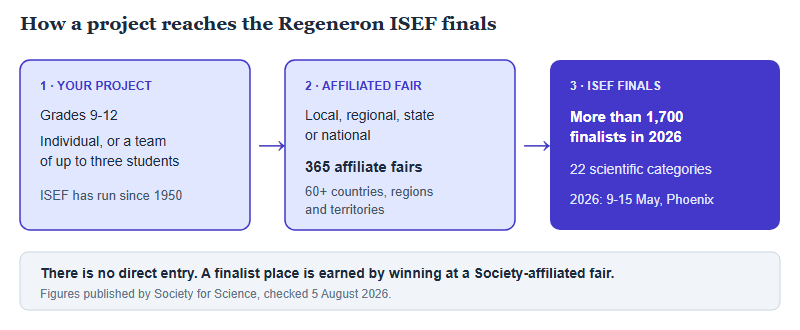
- They came from 365 affiliate fairs in more than 60 countries, regions and territories.
- Finalists compete across 22 different scientific categories.
- Every one of them earned the right to compete by winning at a Society-affiliated local, regional, state or national science fair.
That last line is the load-bearing one and it is worth reading slowly, because it is the difference between a plan that can work and a plan that cannot. ISEF is not something you apply to. It is something you are sent to. If you are new to the structure, start with our overview of what ISEF is and then come back — the rest of this piece assumes you know that a finalist place is won upstream.
Two other things sit in our site canon and have not changed: ISEF has run since 1950, and entrants are in grades 9–12 working individually or in a team of up to three. Abstract rules, project-board specifications and the judging rubric are all published by the Society and they do change between editions, so do not plan against last year's copy of anything — pull the current documents when the cycle opens.
What we are told about 2027, and how we are labelling it
This is the part of the article that is ahead of the official page, which means it is also the part where you are entitled to know precisely where the information came from.
The 2027 fair is reported to us as returning to Los Angeles, in May 2027. That comes through our own organisation's channels, not from a Society announcement. As of 5 August 2026, societyforscience.org names no 2027 host city. We are publishing it because a host city eight or nine months out is genuinely useful for families who plan travel early — and we are flagging it because an unannounced venue is not a booking-grade fact. Do not buy a flight or a hotel on the strength of this paragraph. Confirm on societyforscience.org first.
Three further items sit in the same category — reported to us, not yet posted by the Society at the time of writing:
- The 2026 fair ran under the theme “Future Forward”, and the 2026 programme included a “The Future of AI” conversation.
- The 2025 fair had 1,657 finalists from 62 countries and regions. Set against the Society's verified 2026 figure of more than 1,700, that reads as modest growth in finalist numbers. Country coverage looks broadly flat, though the Society reports 2026 as “more than 60” rather than an exact count, so resist the temptation to compute a change.
- Per the same briefing, 2026 projects skewed noticeably toward AI-native work, robotics, sustainability, precision medicine, and quantum and space computing.
That last observation is worth more to you than the venue. If the centre of gravity really is moving that way, the competitive question is not “should I do an AI project” — it is the opposite. In a field where a large share of entries now involve a model, a project that applies a method carefully to a problem nobody else has framed will read as more original than one that reaches for the fashionable tool first. Direction of travel is a reason to think harder about differentiation, not a reason to follow the crowd.
| Claim | Where it comes from | How to treat it |
|---|---|---|
| 2026: 9–15 May, Phoenix; 1,700+ finalists; 365 affiliate fairs; 60+ countries, regions and territories; 22 categories; qualification via an affiliated fair | Society for Science, societyforscience.org, checked 5 Aug 2026 | Settled. Plan against it. |
| 2027 finals return to Los Angeles, May 2027 | Reported to us through our own channels; not posted by the Society at time of writing | Useful for early planning. Confirm before booking anything. |
| 2026 theme “Future Forward”; “The Future of AI” session | Same briefing; not posted by the Society at time of writing | Context, not a commitment for 2027. |
| 2025: 1,657 finalists, 62 countries and regions | Same briefing; not posted by the Society at time of writing | Comparison only. Do not quote as an official statistic. |
| Abstract rules, board specifications, judging rubric | Published by the Society, revised between editions | Pull the current edition. Never reuse last year's. |
Your real deadline is not in May
Students consistently plan backwards from the finals. That is the wrong anchor. Because there is no direct entry, the date that governs your season is the date of the affiliated fair that can send you — and a selection fair has to run early enough to name its finalists before May.
Look at the scale for a moment. In 2026, 365 affiliated fairs across more than 60 countries, regions and territories produced more than 1,700 finalists. Average that out and each fair sends a small handful. That is not a discouraging number; it is a clarifying one. It tells you that the decisive competition happens in a room in your own region, judged by people from your own region, months before anyone flies anywhere. Our walkthrough of how ISEF works covers that pyramid in detail.
Finding a route from China, Hong Kong and nearby
If you are at a school in mainland China, the practical question is not “how do I get to ISEF” but “which affiliated fair will accept a student at my school, and when does it close?” The honest answer is that the number of routes is small, and eligibility is often tied to school type or geography rather than to how good your project is.
The table below is our own compilation, not a Society listing. Slot numbers move year to year and some routes are school-nominated rather than open. Use it to know what to search for, then confirm the details with each fair directly — and cross-check against the affiliated-fair listing on societyforscience.org.
| Where you study | Route in our compilation | What to confirm first |
|---|---|---|
| Mainland China — schools for children of foreign nationals | A Sichuan fair open to students at schools for children of foreign nationals | Whether your school type qualifies, and this cycle's entry window |
| Mainland China — Shanghai | A Shanghai science-seed selection programme | Whether entry is individual or must come through your school |
| Mainland China — Chongqing | A Chongqing selection fair | Regional eligibility and how many places it carries this year |
| Mainland China — Beijing, Tianjin, Hebei | The Beijing-Tianjin-Hebei youth science fair (BTHYSF) | Which of the three areas your school is counted under |
| Hong Kong | Hong Kong runs its own ISEF regional selection | Timeline and whether the school must nominate you |
| Singapore | The Singapore Science and Engineering Fair — the sole official route | School-level entry requirements and internal deadlines |
| Canada | The Canada-Wide Science Fair | Which regional fair feeds it from your province |
One piece of advice that costs nothing and saves seasons: identify your fair before you finalise your project, not after. Some routes restrict category, team size or the type of school that may enter. Discovering that in March, with a finished project, is the most avoidable failure in this whole process.
The 22-category decision, and when it actually gets made
Finalists compete across 22 categories — that figure is published by the Society. What students misread is when the category choice happens. It feels like a form-filling step in spring. In practice, it is set by the design decisions you make in autumn, because the category determines which panel of judges reads your work and what they consider a contribution.
Two projects can study the same phenomenon and belong in different categories depending on what the student actually contributed. A study that asks a biological question and answers it with a model may sit in one place; a study that builds a new computational method and demonstrates it on biological data may sit in another. Neither is safer. What matters is that the category matches the contribution you can defend in an interview, and that you pick it early enough for it to shape the experiment rather than merely label it. Our breakdown of the 22 categories walks through the boundaries case by case.
Given the reported drift toward AI-native and computational work, the crowding question is worth asking honestly: if a category is where everyone is heading, the bar to stand out inside it rises. That is not a reason to avoid it. It is a reason to be specific about what part of the work is yours.
A realistic runway from August to a May finals
Below is the shape of a season that ends in May rather than one that runs out of time in February. It is a planning template, not an organiser timetable — the fixed points in your own calendar are your fair's deadline and the approvals your project needs before you begin experimenting.
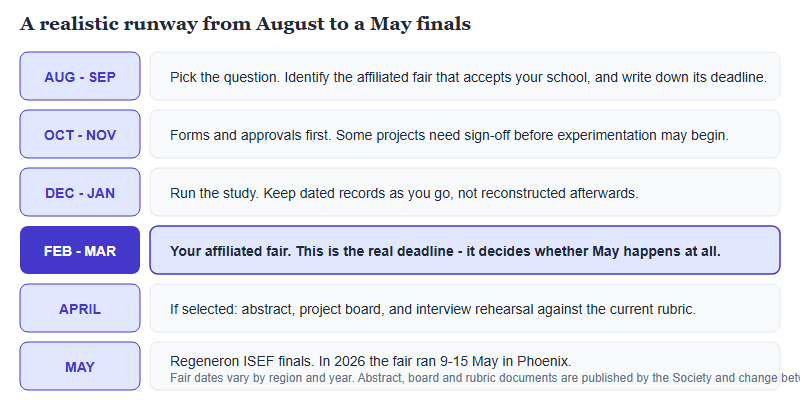
Notice what the runway does not assume. It does not assume you know the 2027 venue — because nothing you do between August and March depends on it. It does not assume you have a university laboratory. It assumes only two things: that you start the paperwork before the experiment, and that you treat February or March as the moment the season is decided.
If you take one thing from this piece, make it that. The 2027 host city is a nice thing to know early and we have told you what we know and where it came from. But the number that will actually determine your season is the closing date of one regional fair — and you can find that out today.
Frequently asked questions
Where will ISEF 2027 be held?
We are told it returns to Los Angeles in May 2027. The Society had not posted a host city at the time of writing — confirm on societyforscience.org.
Can I apply to ISEF directly?
No. Every finalist earns the place by winning at a Society-affiliated local, regional, state or national fair. There is no direct entry route.
How many students actually reach the finals?
More than 1,700 competed at the 2026 fair, selected from 365 affiliate fairs in more than 60 countries, regions and territories.
When should a student in China start for a May finals?
Now. Your affiliated fair sits months before the finals, and forms and approvals come before experiments — so August work sets up a May finish.
This is an independent guide operated by Hanlin Education for China-based international-school students. We are not affiliated with, endorsed by, or sponsored by the Society for Science or Regeneron ISEF. Items in this article marked as reported to us had not been published by the Society at the time of writing — confirm current dates, venues, rules and eligibility on societyforscience.org before acting on them. Any factual error reported to our editorial desk is corrected within 7 working days.