Every ISEF project is entered in exactly one of 22 categories (for 2026), and that choice decides who judges your work. This is a plain-English reference to all 22 — what each covers and the kind of project that fits — including the new Technology Enhances the Arts category added in 2026. Use it to locate where your research belongs, then read our guide on choosing your category by strength.
How the 22 categories break down
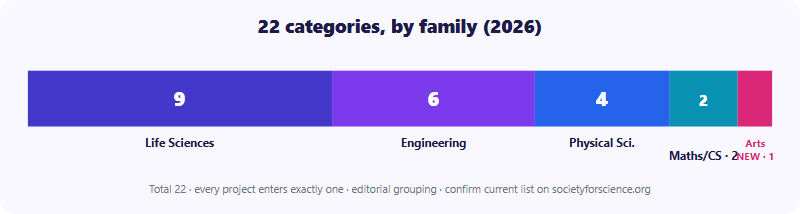
The official list is flat, but it helps to see it as five families. The largest by far is the life sciences; engineering is the next biggest; and 2026 adds a single new cross-disciplinary category for technology in the arts.
Life Sciences (9 categories)
| Category | What it covers · example project |
|---|---|
| Animal Sciences | Animal biology, behaviour, physiology and development. e.g. how a stressor changes zebrafish behaviour. |
| Behavioral & Social Sciences | Human and animal behaviour, psychology, cognition, society. e.g. a controlled study of sleep and memory. |
| Biochemistry | The chemistry of living systems — proteins, enzymes, metabolism. e.g. an enzyme’s activity under different inhibitors. |
| Biomedical & Health Sciences | Disease, health, diagnostics and epidemiology. e.g. a low-cost screen for a disease biomarker. |
| Cellular & Molecular Biology | Cells, genes and molecular mechanisms. e.g. gene-expression changes in a cell line. |
| Computational Biology & Bioinformatics | Computational methods applied to biological data. e.g. an ML model predicting protein function. |
| Microbiology | Bacteria, viruses, fungi and antimicrobials. e.g. a plant extract tested for antibacterial effect. |
| Plant Sciences | Plant biology, growth and agriculture. e.g. drought tolerance across crop varieties. |
| Translational Medical Science | Turning research toward medical application (bench to bedside). e.g. a prototype drug-delivery method in a model. |
Physical Sciences (4 categories)
| Category | What it covers · example project |
|---|---|
| Chemistry | Composition, reactions and materials chemistry (non-biological). e.g. a catalyst for a greener reaction. |
| Earth & Environmental Sciences | Geology, climate, water and ecosystems. e.g. microplastic levels across a watershed. |
| Materials Science | Designing and characterising materials. e.g. the strength of a bio-based composite. |
| Physics & Astronomy | Physical laws, optics, astrophysics. e.g. modelling an exoplanet transit signal. |
Engineering (6 categories)
| Category | What it covers · example project |
|---|---|
| Biomedical Engineering | Engineering for medicine — devices, prosthetics, instrumentation. e.g. a low-cost prosthetic-hand controller. |
| Embedded Systems | Microcontrollers, sensors and firmware (hardware + code). e.g. an air-quality sensor node. |
| Energy: Sustainable Materials & Design | Energy generation, storage, efficiency and sustainable design. e.g. an improved small solar-cell design. |
| Engineering Technology: Statics & Dynamics | Mechanical, structural and transport engineering. e.g. an optimised wind-turbine blade. |
| Environmental Engineering | Engineered solutions to environmental problems. e.g. a low-cost water-filtration unit. |
| Robotics & Intelligent Machines | Robots, automation, control and machine intelligence in hardware. e.g. an autonomous navigation robot. |
Maths & Computer Science (2 categories)
| Category | What it covers · example project |
|---|---|
| Mathematics | Pure and applied mathematics, proofs and modelling. e.g. a new bound on a combinatorial problem. |
| Software Design | Software, algorithms and applications where the software is the contribution. e.g. an algorithm with measured performance gains. |
New for 2026 (1 category)
| Category | What it covers · example project |
|---|---|
| Technology Enhances the Arts | Technology in service of artistic and creative work — newly added for 2026. e.g. a tool that generates or augments visual or musical art. |
No category is “easier” — fit beats prestige
A natural question is whether some categories are softer routes to an award. They are not: each is judged by experts who expect real depth in that field, and Grand Awards are decided within each category against other projects there. The winning move is to place your project where its genuine contribution is best understood — see how to choose your category by strength — and then build the project to the standard those judges expect, as covered in what ISEF judges look for. New to ISEF overall? Start with our complete ISEF guide.
Frequently asked questions
How many ISEF categories are there in 2026?
There are 22, grouped here into five families: nine life-science categories, six engineering, four physical-science, two maths/computer-science, and one new cross-disciplinary category, Technology Enhances the Arts.
What is the new 2026 category?
Technology Enhances the Arts, which recognises projects where technology serves artistic or creative work. It brought the total from the previous count up to 22 for 2026.
Do subcategories exist within each category?
Yes — most categories list subcategories that help judges route your project. Check the official category pages for the current subcategory breakdown when you register.
Can the category list change year to year?
Yes, categories are occasionally renamed, merged or added (2026 added one). Always confirm the current list on the official site before you finalise your entry.
This is an independent guide to the Regeneron International Science and Engineering Fair, operated by Hanlin Education for China-based international-school students. We are not affiliated with, endorsed by, or sponsored by the Society for Science or Regeneron ISEF. Category names and definitions change by year — always confirm the current list and subcategories on the official Society for Science / ISEF site. Confirmed errors are corrected within 7 working days.