ISEF judges reward work they can trace, question, and believe. Behind almost every strong project is an unglamorous asset: a clear record of what you did, when, and what actually happened. A dated notebook, your raw data, and a method someone else could repeat are what turn “interesting result” into “credible result.” This guide shows China-based students how to build the records judges trust — starting the day you begin your project, not the week before the fair.
Why records decide credibility
Students often imagine judging as a test of how impressive the result sounds. In practice, judges are checking something quieter: do you understand your own project, and can you back up your claims? If you have read our walk-through of how ISEF works, you will remember that the conversation with judges is where projects are really won or lost. Records are what let you answer hard questions calmly instead of guessing.
Think of it this way. Two students report the same finding. One can show a dated log of every trial, the raw numbers, and the exact steps. The other has a polished board and a good story but no trail. The first student is believable; the second invites doubt. Nothing about the second project is necessarily wrong — but a judge cannot verify it, and unverifiable work loses to verifiable work. Records are not bureaucracy; they are your credibility, written down.
The evidence trail judges follow
Every claim in a strong project can be traced backward, step by step, from the headline result to the raw observation that supports it. Judges instinctively follow this chain. If it breaks anywhere — a result with no data behind it, a method too vague to repeat — confidence in the whole project drops.
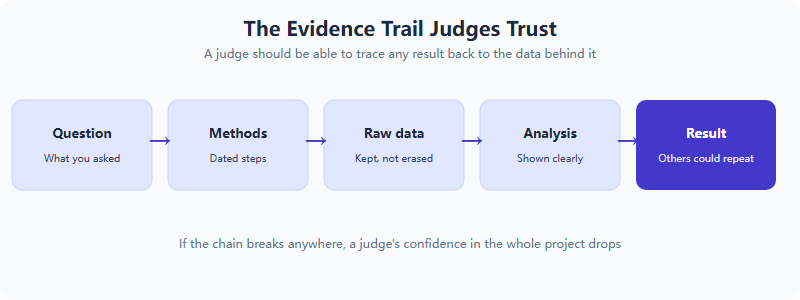
This is also why last-minute “cleaning up” is dangerous. When students delete messy early trials or overwrite raw files to make results look neat, they destroy the very trail that would have proved their honesty. Keep the mess. A judge who sees an early failed run and a clear note about how you fixed it trusts you more, not less.
What belongs in your lab notebook
A lab notebook — paper or digital — is simply a dated, chronological record of your work. It does not need to be beautiful. It needs to be honest, specific, and written as you go, not reconstructed from memory afterward. The strongest entries capture enough that you in three months, or a judge in May, could understand exactly what happened.
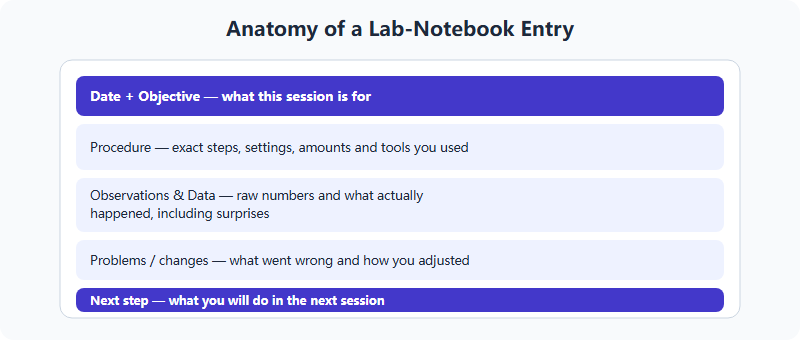
Two rules make notebooks trustworthy. First, write in real time. Entries reconstructed weeks later drift from the truth and read as vague. Second, never edit history. If you made a mistake, add a dated correction rather than erasing the original. That discipline is exactly what separates a record a judge believes from a story a judge doubts.
Data you should keep — and never delete
Your notebook narrates the work; your data is the evidence itself. Keeping it well is not optional. Below is a practical view of what to preserve and why it matters when a judge starts asking questions.
| Record type | Why judges value it | Good practice |
|---|---|---|
| Raw data (originals) | Proves your results are real, not adjusted to look good. | Keep untouched originals; analyse on copies. |
| Dated notebook entries | Shows the work happened over time and how thinking evolved. | Write as you go; date everything; never backdate. |
| Method details | Lets a judge (or you) repeat the study exactly. | Record settings, amounts, tools, and versions. |
| Failed / discarded trials | Signals honesty and scientific maturity. | Keep them and note why you set them aside. |
| Analysis steps | Connects raw data to the final claim without gaps. | Save the code or the exact calculations you ran. |
| Data sources (if public) | Establishes provenance and limitations. | Record where each dataset came from and when. |
A simple safeguard: back up your data in more than one place from day one. Losing a term of measurements to a broken laptop is a heartbreak no board design can fix. And if your project involves people, animals, or regulated materials, remember that consent forms and approvals are also part of your record — confirm the current documentation rules on societyforscience.org.
Reproducibility: the quiet test top projects pass
Reproducibility means someone else, following your write-up, could run your study and get comparable results. It is the deepest form of credibility, and it is quietly what separates memorable projects from forgettable ones. You do not need a perfect result to be reproducible — you need a transparent one.
Test yourself before the fair. Hand your method section to a friend who was not involved and ask: “Could you run this from what I wrote?” Wherever they hesitate, your method has a hidden gap that a judge will find. Fixing those gaps is often the single highest-value thing you can do in the final month — more valuable than another decoration on the board. When you eventually write your abstract and prepare your display, this same trail is what lets you summarise honestly; if you want the bigger picture of what the finals reward, revisit what ISEF is and how deeply projects are examined.
Build the habit this summer
Records are a habit, and summer — project-start season — is when the habit is cheap to build and expensive to skip. From working with China-based students, the pattern is stark: the ones who start a notebook in June rarely panic in spring, because their whole project is already documented. The ones who “will write it up later” spend the final weeks reconstructing what they can barely remember.
- Open your notebook on day one — the day you pick your question, not the day you get results.
- Date every entry and write it while the work is fresh.
- Keep raw data untouched; only ever analyse copies.
- Save your failures with a note on what they taught you.
- Back up everything twice from the start.
None of this requires talent or money. It requires a habit — and the students who build it walk into judging able to answer anything, because the answer is already written down.
Frequently asked questions
Do I need a lab notebook for ISEF?
A dated record of your work is strongly expected. Judges use it to verify what you did, and required forms may involve documentation — confirm current rules officially.
Should I keep my failed experiments?
Yes. Keeping failed or discarded trials, with a note on why, shows honesty and scientific maturity, and it strengthens rather than weakens your credibility.
Can I clean up my data before the fair?
Never alter raw data. Keep untouched originals and analyse on copies, so a judge can trace every result back to real evidence.
What does reproducibility mean for a student project?
It means someone could follow your method and get comparable results. Transparent records and a clear method are what make a project reproducible.
This is an independent guide operated by Hanlin Education for China-based international-school students. It is NOT affiliated with, endorsed by, or sponsored by the Society for Science or Regeneron ISEF. Documentation, forms, and judging rules change — confirm all current details on societyforscience.org. Any error will be corrected within 7 working days.