Not every ISEF project needs committee approval — but some do, and for those the approval must be dated before your first experiment. Society for Science requires projects involving human participants, vertebrate animals, potentially hazardous biological agents or tissue to be reviewed and approved by a local or regional SRC or IRB prior to the start of experimentation. Deciding which group you are in is a July task.
The rule that settles eligibility before a judge sees your work
Most students meet ISEF through its outcomes — finals week in May, the categories, the awards. If that is where you are starting, our overview of what ISEF is and how it is structured is the better first read. But the constraint that most often removes a project from competition has nothing to do with results. It is a sequencing rule, and it is enforced with dates.
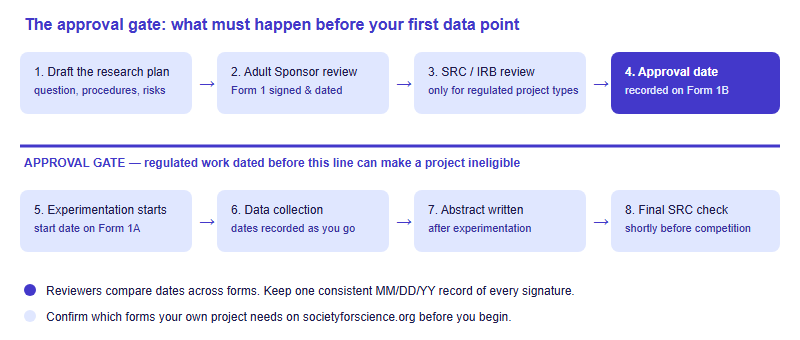
Two words carry the weight: prior to. Approval is not retroactive. Reviewers verify it by comparing dates — the approval signature against the start date you wrote yourself on the Student Checklist. Society for Science asks for MM/DD/YY format on all forms, precisely because the order of dates is the evidence.
This bites hardest in late July. Summer is when serious ISEF projects begin, because a strong project usually needs close to ten to twelve months before a May finals week. It is also when a motivated student is most tempted to collect “just a little pilot data” while paperwork moves. For any regulated project type, that instinct is the most expensive mistake available in the whole ISEF process, because there is no repair for it.
The flip side matters just as much: many projects need no committee pre-approval at all. A computational study, a materials test with ordinary substances, or a pure mathematics project may go straight to an Adult Sponsor review. What every project needs, without exception, is an adult who has reviewed the plan and a written research plan that exists before experimentation starts.
Which project features trigger committee review
The practical July question is narrow: does my idea require a signature before I begin? The rules flag four research areas for pre-approval — human participants, vertebrate animals, potentially hazardous biological agents, and human or animal tissue — plus a separate safety route for hazardous chemicals, activities and devices through the Risk Assessment Form.
Two of these catch Chinese international-school students repeatedly. The first is surveys. A questionnaire given to classmates about sleep, screen time or exam stress is a human participants study and follows the human participants route, including informed-consent documentation — not because a survey is dangerous, but because the rules define the category by who is studied, not by how risky it feels. The second is school-lab microbiology. Culturing bacteria from a phone screen or a canteen surface engages the hazardous biological agents rules, which require approval before you start and, at biosafety level 2, supervision by a Qualified Scientist — someone with a doctoral or professional degree in a related discipline, or extensive experience and expertise in your area of research.
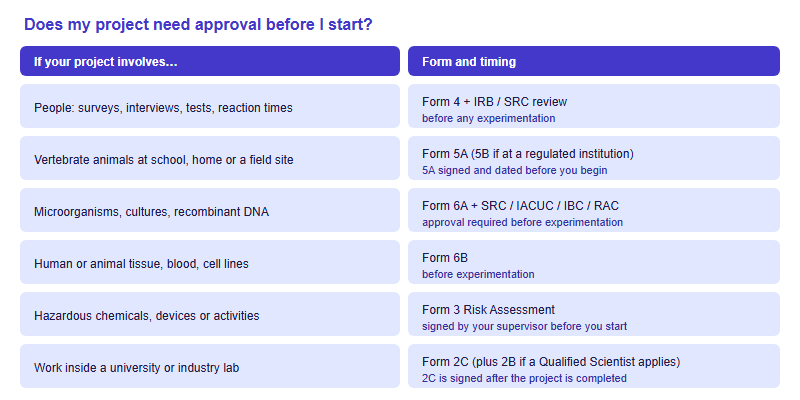
One clarifying point about who decides. The rules place the initial judgement on you and your Adult Sponsor together: you evaluate the study, determine which forms are required, and determine whether committee approval is needed before experimentation. That is why the sponsor conversation cannot wait until the study is designed in detail — the sponsor is part of designing it.
The full form set, and when each one is dated
Society for Science publishes the complete form set for each rules year. The table below maps the current forms to what they cover and when the date on them should fall. Use it to work out what your project needs; download the actual forms and instructions for your own ISEF year before filling anything in, and see how the approval stage fits into the wider build on our ISEF project preparation guide.
| Form | Official title | What it is for | When it is dated |
|---|---|---|---|
| 1 | Checklist for Adult Sponsor / Safety Assessment | Sponsor confirms the plan and flags which further forms apply | The date the sponsor first reviews the plan — before experimentation |
| 1A | Student Checklist / Research Plan | Your checklist, proposed dates, work site and attached research plan | Before experimentation |
| 1B | Approval Form | Carries the SRC / IRB approval signature; each team member submits one | Mostly before experimentation; a final SRC check happens shortly before competition |
| 2A | Student Support Disclosure Form | Disclosure of the assistance you received on the project | Per the current form instructions — confirm on the official site |
| 2B | Qualified Scientist Form | A scientist with a doctoral or professional degree, or extensive experience and expertise in your research area, approves and oversees the plan | Before experimentation |
| 2C | Regulated Research Institution Form | Supervision and conditions when you work in a university or industry lab | Signed after the project is completed |
| 3 | Risk Assessment Form | Hazardous chemicals, activities or devices — risks and precautions | Completed and signed by your supervisor before you start |
| 4 | Human Participants | Surveys, tests, interviews, any study with people | Before any experimentation |
| 5A | Vertebrate Animal Form (school, home or field site) | Non-regulated-site vertebrate animal work | Signed and dated before experimentation begins |
| 5B | Vertebrate Animal Form (Regulated Research Institution) | Describes animal work done in a regulated institution | Completed after the research (descriptive) |
| 6A | Potentially Hazardous Biological Agents | Microorganisms, recombinant DNA and related agents | Committee approval before experimentation |
| 6B | Human and Vertebrate Animal Tissue | Tissue, blood, cell lines and similar material | Before experimentation |
| 7 | Continuation Projects Form | Explains how this year differs from your prior work | After experimentation; displayed at the project booth |
The failures reviewers report most often
Society for Science publishes a list of the problems SRC reviewers encounter most. It is one of the most useful documents in the ISEF ecosystem, because it tells you exactly where projects break rather than where students fear they might. The recurring items include:
- An incomplete Form 1A or research plan — missing proposed or actual dates, an underspecified plan, or no work-site information.
- A missing SRC signature on Form 1B, which is the evidence that the project actually went through review.
- Abstract problems — wrong format, acknowledgements included, previous years’ work described, or wording that is not the student’s own.
- A missing Risk Assessment Form 3 where chemicals, equipment or hazards were involved, or one that is vague about precautions.
- Continuation projects without prior-year documentation, even when this year’s progress is real.
Regional reports add two pure sequencing errors: failure to obtain prior SRC approval, and signatures dated in the wrong order. Neither can be repaired afterwards. Reviewers also note that projects with unresolved questions about eligibility — number of students, research duration, participant age — get pulled into interviews rather than quietly waved through.
The editorial lesson we would draw from working with students in Chinese international schools is blunt: the paperwork is not administration bolted onto the science. It is the scientific method as ISEF defines it — a written plan, reviewed by someone competent, hazards assessed, dates recorded, before anything is touched.
Sequencing a late-July start
If you are beginning now for a May finals cycle, this order of operations keeps you inside the rules. Fair-level review calendars vary, and for students based in mainland China the domestic route runs through the CASTIC selection system, so confirm your own fair’s deadlines early — our explainer on how projects travel from an affiliated fair to the ISEF finals sets out that chain.
- Days 1–7: fix the question and the category. You cannot classify your project’s regulatory status until you know exactly what you will measure and on what. Category also shapes methodology expectations — see our guide to choosing the right ISEF category.
- Days 3–10: run the trigger test. Walk your procedure line by line against the map above. People? Animals? Live cultures? Tissue? Hazardous chemicals or devices? Any “yes” means approval precedes experimentation.
- Days 7–12: line up the adults. Adult Sponsor first, then decide whether a Qualified Scientist is required. The sponsor signs Form 1 on the date they first review the plan.
- Days 10–20: submit for review. Send the package to your fair’s SRC or IRB and build in waiting time. Committees meet on schedules, not on demand.
- Only after the approval date: begin. Record dates from day one of experimentation. A project data book is not required, but Society for Science strongly recommends one for judging purposes — and it is the cleanest defence of your own timeline.
A closing sequencing note that surprises people every year: the abstract is written after experimentation, in your own words, covering the current year only, within a 250-word maximum. Do not draft it in August as a project summary and recycle it in March.
Frequently asked questions
Does every ISEF project need SRC or IRB approval before starting?
No. Pre-approval applies to regulated project types such as human participants, vertebrate animals, hazardous biological agents and tissue. All projects still need sponsor review and a written plan first.
Can I get approval after I have already collected data?
No. For regulated project types the approval must precede experimentation, and reviewers check the dates recorded across your forms.
Is a classmate survey really a human participants study?
Yes. The rules classify by who is studied, not by perceived risk, so questionnaires follow the human participants route including consent documentation.
Is a project data book compulsory?
Not required. Society for Science strongly recommends one for judging purposes, and it is your clearest record of when work actually happened.
This is an independent guide operated by Hanlin Education for China-based international-school students. We are not affiliated with, endorsed by, or sponsored by the Society for Science or Regeneron ISEF. Rules, forms and deadlines change each cycle — confirm current details on societyforscience.org. Any factual error reported to our editorial desk is corrected within 7 working days.