You do not need a university lab, a professor, or expensive equipment to build a competitive ISEF project. Some of the strongest projects each year are computational, field-based, or engineering builds that a student ran with a laptop, a phone, public datasets, or a school workshop. What matters to judges is a sharp question, honest method, and evidence you understand your own work — not the price of your equipment. Here is how China-based students can start from what they already have.
You do not need a university lab
The “no lab access” worry stops many capable Chinese students before they begin. It rests on a false assumption: that ISEF rewards wet-lab biology and chemistry above everything else. It does not. ISEF spans 22 categories, and a large share of them are won by projects that never touched a fume hood — mathematics, computational work, environmental field studies, engineering prototypes, and behavioural or data-driven research. If you are unsure what the finals even reward, our overview of what ISEF is is a useful first stop.
The real constraint is rarely equipment. It is a well-chosen question you can actually answer with the resources around you, plus the discipline to document it. That reframes the whole planning problem: instead of asking “what lab can I get into,” ask “what can I measure, model, build, or analyse with what I already own?”
Five project routes that fit real resources
Broadly, five routes let a student produce ISEF-grade work without institutional lab access. None requires a university affiliation; several require nothing more than a laptop and persistence. Two involve people or animals and therefore need ethics review before you start — flag those early.
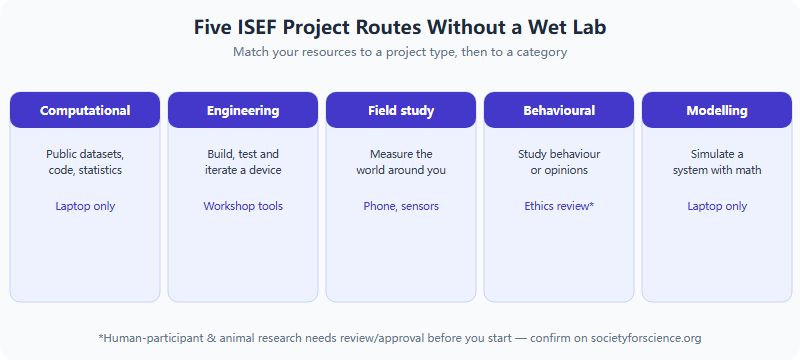
Notice that four of the five routes cost almost nothing. A public-data project needs only a laptop and the patience to clean messy data. A modelling project needs a laptop and a maths idea. A field study needs a phone, a simple sensor, and somewhere real to observe. Only the engineering route needs tools, and a school makerspace or a home workbench is often enough.
Match what you have to what you can build
The fastest way to find your project is to inventory your actual resources first and let the project type follow. Do not start from “I want to win biomedical”; start from “here is what I can access this summer.”
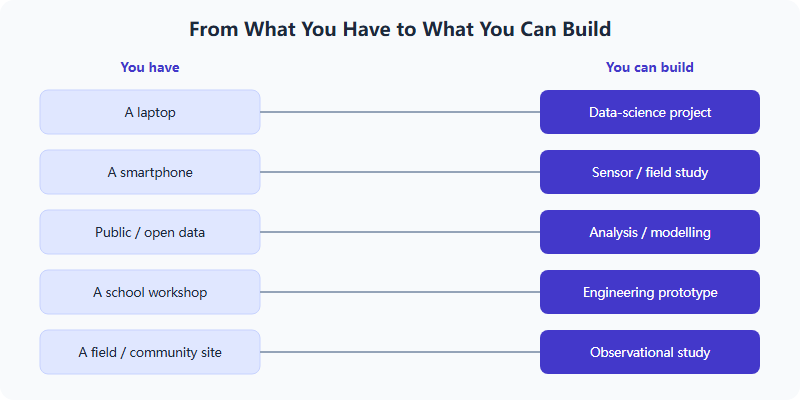
| Route | Typical resources | Illustrative project types | Watch-outs |
|---|---|---|---|
| Computational / data | Laptop, open datasets, code | Data-science, bioinformatics-style analysis, statistics | Cite data sources; document cleaning steps honestly. |
| Engineering build | Workshop or home tools, cheap parts | Prototype device, tested and iterated | Show measured performance, not just a working demo. |
| Field / observational | Phone, low-cost sensors, a real site | Environmental monitoring, ecology, air/water measurement | Standardise how and when you sample. |
| Survey / behavioural | Questionnaire tools, participants | Behavioural, social, or psychology-style studies | Needs ethics review before you start — confirm officially. |
| Modelling / simulation | Laptop, a maths or physics idea | Mathematical models, simulations | Validate the model against something real. |
Pick a category that rewards your route
Once you know your route, choose your category deliberately so your work is judged by the right people against the right expectations. A computational study framed as a wet-lab project will disappoint judges expecting bench data; the same study framed correctly can shine. This is exactly why category choice is a strategic decision, not paperwork — walk through how to choose your ISEF category before you lock your project in, and remember the official list has 22 categories that can be revised, so confirm the current names on societyforscience.org.
A good habit: write your one-line research question, then ask “which category's judges most want to hear this answered?” If two categories fit, the tie-breaker is where your evidence is strongest — not where competition looks easiest.
The honest trade-offs of a no-lab project
No-lab routes are powerful, but they are not free of difficulty — they simply move the difficulty somewhere you can control. Be clear-eyed about the trade-offs:
- Rigour still has to be real. A laptop project can be as sloppy as any other. Judges probe your assumptions, your data quality, and whether your conclusion actually follows. Cheap tools do not lower the bar.
- Data provenance matters more. If you use public datasets, you must know where they came from, their limitations, and how you cleaned them. “I downloaded a file” is not a method.
- People and animals add rules. Survey and behavioural work needs the required review and approval before you collect anything. Skipping this can disqualify strong work — confirm the current requirements officially.
- Novelty comes from the question, not the gear. Because your equipment is ordinary, your originality has to live in what you ask and how carefully you answer it.
The upside is significant: you control the timeline, you can start today, and you are not waiting on a lab that may never say yes. Understanding how ISEF projects are actually judged will convince you that clear reasoning beats expensive apparatus more often than students expect.
A summer starting plan with the tools you already own
Summer is when the strongest projects begin, so use these weeks to remove the “no lab” excuse entirely:
- Week 1-2: Inventory your real resources and pick a route from the five above.
- Week 2-4: Read around your topic, find a genuine gap, and write a one-line question you can answer with your resources.
- Week 3-5: Design a method and check whether it needs ethics approval; if it does, plan that in now.
- Week 5-8: Run a small pilot — a first dataset, a rough prototype, a first simulation — and document everything.
- Week 8-10: Review what the pilot taught you, refine the method, and plan the full study for the autumn.
Ten weeks with a laptop and a clear question puts you ahead of most students who spent the summer waiting for a lab. The barrier was never the equipment; it was starting.
Frequently asked questions
Do I need a university lab to reach ISEF?
No. Many competitive projects are computational, field-based, or engineering builds that need only a laptop, a phone, or a school workshop, not a university lab.
What is the easiest ISEF project to run from China?
There is no official “easiest,” but computational and modelling projects need the fewest resources — often just a laptop, public data, and a clear question.
Can I use public datasets in an ISEF project?
Yes, if you document their source, limitations, and how you processed them. Judges value honest data provenance over fancy equipment.
Does a survey or behavioural project need approval?
Research with human participants generally needs review and approval before you begin. Confirm the current requirements on societyforscience.org.
This is an independent guide operated by Hanlin Education for China-based international-school students. It is NOT affiliated with, endorsed by, or sponsored by the Society for Science or Regeneron ISEF. Category names are illustrative, and rules on eligibility, ethics review, and formatting change — confirm all current details on societyforscience.org. Any error will be corrected within 7 working days.