ISEF is not only a “science” fair: engineering projects compete across its 22 categories on equal footing, but they run on a different logic. A science project asks a question about how the world works and answers it with evidence; an engineering project defines a need, sets measurable design criteria, and iterates a solution against them. Framing your project in the wrong one — testing a gadget like a hypothesis, or dressing a question up as a device — is a quiet but common way strong ideas underperform. Here is how to tell which frame fits yours.
Two logics, one fair
The Society for Science publishes judging guidance recognizing both research questions and engineering goals — judges evaluate a project against the logic it declares (see societyforscience.org for the current judging criteria). That means the first strategic decision of your project, made in the summer long before any fair, is which logic you are committing to:
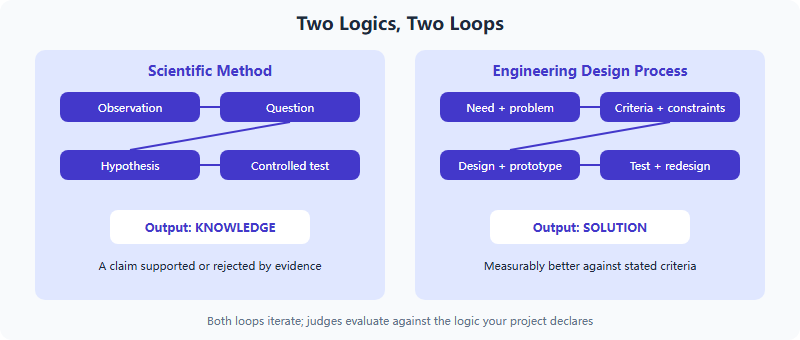
- The scientific method moves from observation to question to hypothesis, then designs a controlled test whose outcome could falsify the hypothesis. Its product is knowledge: a supported or rejected claim about how something works. Success can mean a negative result honestly interpreted.
- The engineering design process moves from a need to a problem definition with measurable criteria and constraints (cost, weight, accuracy, response time), then through design, prototype, test, and redesign cycles. Its product is a solution: a device, algorithm, material, or process demonstrably better against the stated criteria.
Both are iterative, both demand rigor, and both can win. But they are graded against different expectations: a science project lives or dies on the validity of its comparison; an engineering project lives or dies on whether its criteria were meaningful and its testing against them was honest. If you are still choosing a topic area, this decision pairs naturally with category selection — see our guide on how to choose your ISEF category.
A translation table: the same idea in both frames
The fastest way to feel the difference is to watch one idea change shape as it crosses frames. Every row below is the same underlying interest, expressed twice:
| Concept | Science framing | Engineering framing |
|---|---|---|
| Starting point | “Why does X happen?” / “Does A affect B?” | “Who needs what, and how badly does the current option fail?” |
| Commitment made up front | A falsifiable hypothesis | Numeric design criteria and constraints |
| Water quality example | “How does water pH affect the growth rate of duckweed?” | “Design a low-cost sensor that estimates a water-quality indicator within a target error bound” |
| Algorithm example | “Which linguistic features most predict misinformation sharing?” | “Build a classifier that beats a stated baseline at fixed compute cost” |
| What “controls” means | Controlled variables and comparison groups | Benchmarks: the existing solution you must beat, tested under identical conditions |
| A good result | A clean answer — including “no effect found” | Criteria met (or a documented iteration story explaining the gap) |
| Classic failure | Confounded variables, no real comparison | Vague criteria (“works well”), no baseline, demo instead of testing |
Read your own project idea against the “classic failure” row. If your planned “experiment” is really a demonstration that your device switches on, you are doing engineering without criteria. If your planned “invention” is really a comparison between two conditions, you are doing science with unnecessary hardware.
The four-question frame test
Run your idea through these questions before you write a research plan:
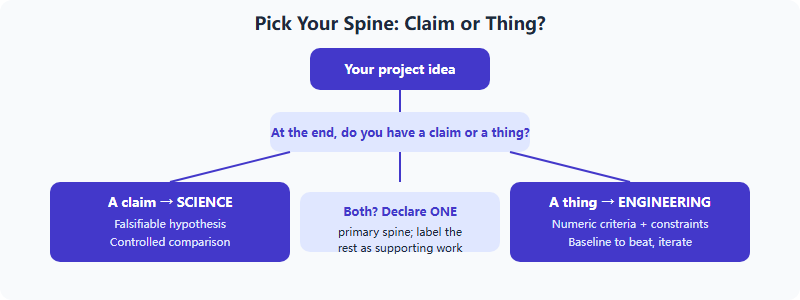
- What do you want to exist at the end — a claim or a thing? If your dream ending is “I showed that…”, you are science. If it is “I built something that…”, you are engineering.
- Could a negative result still be a success? In science, yes — “pH had no measurable effect” is a legitimate finding if the test was sound. In engineering, missing your criteria is only salvageable if your iteration and analysis of why are excellent.
- What would you compare against? Science compares conditions (control vs treatment). Engineering compares against a baseline or existing solution. If you cannot name your comparison, you have neither frame yet — you have an activity.
- Where will the intellectual depth live? Judges reward understanding, not construction hours. If your device is assembled from tutorials and the “research” is that it works, the depth is missing. If your engineering project’s depth is a novel design decision you can defend quantitatively, you are on solid ground.
Answering these early also shapes everything downstream — the research plan you write before starting, the data you log, the way your abstract (max 250 words) states its purpose, and the story your board tells at the fair. For how those stages connect from local fair to the May finals, see how ISEF works: affiliated fairs to the global finals.
The hybrid trap — and the legitimate hybrid
Many real projects contain both elements: you build an instrument, then use it to answer a question; or you run experiments to inform a design. That is fine — real research works this way — but at ISEF the primary frame must be unambiguous, because it tells judges what standard to hold you to.
The trap version looks like this: a student builds an air-quality monitor (engineering), collects two weeks of readings from one balcony (not a controlled study), and presents it as “investigating pollution patterns” (science framing). The result fails both standards at once — no design criteria were beaten, and no controlled comparison was made. Judges see this pattern constantly.
The legitimate hybrid declares its spine. Either: “This is an engineering project: I designed a monitor to meet accuracy criterion X at cost Y; the field deployment is validation,” or: “This is a science project: the question is whether factor A drives pollutant B; the monitor is instrumentation, and here is how I validated it before trusting its data.” One spine, one standard, supporting work honestly labeled as supporting work.
A practical tip for China-based students choosing between frames this summer: engineering and computational framings tend to be more robust to limited lab access, since benchmarking a design against criteria is often feasible at home or school, while some science framings need facilities you may not be able to secure. Choose the frame you can execute rigorously with the resources you actually have — rigor within your means beats ambition beyond them.
What this means for your summer start
If you are launching a project this summer — the natural window, since strong ISEF projects typically begin 10–12 months before the May finals — make the frame decision in your first two weeks, in writing. For a science frame, that means a hypothesis and a sketch of the comparison that could falsify it. For an engineering frame, that means numeric criteria, constraints, and a named baseline. Everything after — the research plan, any required approvals before experimentation, months of iteration, the affiliated-fair entry through your route (CASTIC for mainland China), and eventually the abstract and board — inherits its coherence from this one early choice. New to the competition itself? Ground yourself first with What Is ISEF? A complete 2026 guide for international students, then come back and pick your spine.
FAQ
Does ISEF accept engineering projects, or only science experiments?
Both. Engineering projects compete across the 22 categories, and official judging guidance recognizes engineering goals as well as research questions. Confirm current criteria on societyforscience.org.
Is one frame easier to win with than the other?
No frame is inherently favored. Projects underperform when they are judged against a standard they never committed to — vague criteria or uncontrolled comparisons — not because of the frame itself.
Can my project include both a built device and an experiment?
Yes, if you declare one primary frame and label the other part as supporting work — instrumentation for a science project, or validation for an engineering one.
Which frame is better if I have no lab access in China?
Engineering and computational framings are often more feasible, since benchmarking against criteria can be done at home or school. Choose the frame you can execute rigorously with real resources.
This is an independent guide operated by Hanlin Education for China-based international-school students. It is not affiliated with, endorsed by, or sponsored by the Society for Science or Regeneron ISEF. Judging criteria and rules change — always confirm current details on societyforscience.org. Factual errors reported to us are corrected within 7 working days.