You cannot apply to Regeneron ISEF directly. ISEF is an affiliated-fair competition: students earn a place by advancing through an official affiliated fair, and for mainland China that pathway runs through CASTIC — the China Adolescents Science and Technology Innovation Contest. This guide explains how the CASTIC route works, who is eligible, how the calendar fits the May finals, and which details you must confirm on official sources rather than assume.
You do not apply to ISEF directly
The most common misunderstanding among China-based students is treating ISEF like a scholarship or an online application you submit yourself. It is not. Regeneron ISEF sits at the top of a global network of affiliated fairs, and a student reaches the finals only by being selected through one of those fairs. If you have read our explainer on how the ISEF affiliated-fair system works, this will be familiar: the fair is the gatekeeper, not a form.
For students at international schools in mainland China, this changes the whole planning question. Your first job is not “how do I register for ISEF” — it is “which affiliated fair selects the mainland delegation, and how do I enter that fair?” The positioning across the ISEF network points to CASTIC as the mainland pathway. Because affiliated-fair arrangements can change year to year, always verify the current affiliated fair for your region on societyforscience.org before you build your plan around it.
If ISEF itself is still new to you, start with what ISEF actually is and then return here — the pathway makes far more sense once you understand what the finals are.
The CASTIC pathway, stage by stage
CASTIC is organised under CAST (the China Association for Science and Technology). In broad terms, students enter at a local level, advance through provincial selection, and a delegation is chosen at the national level to represent mainland China at ISEF. The exact number of students selected, the provincial rules, and the entry deadlines are set officially and can differ by year and by province — treat every specific figure below as something to confirm, not memorise.
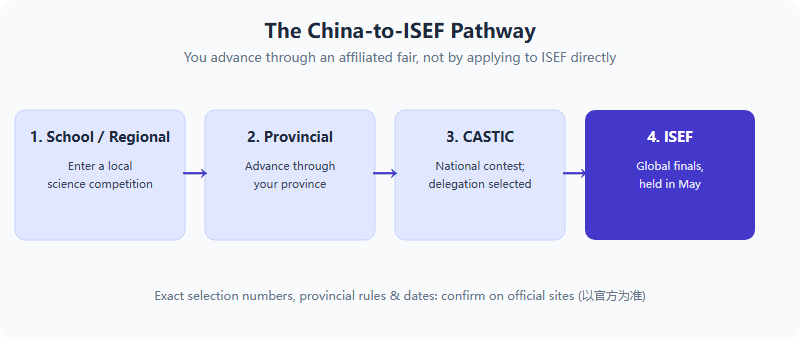
| Stage | What generally happens | What to confirm officially |
|---|---|---|
| School / regional entry | You submit a project to a local or school-level science competition that feeds the provincial round. | Whether your school enters students centrally, and the local deadline. |
| Provincial selection | Projects are judged; the strongest advance toward the national contest. | Your province's eligibility, quotas, and category rules. |
| CASTIC national | Selected projects compete nationally; a delegation is chosen for ISEF. | How many students are selected and against what criteria. |
| ISEF finals (May) | The delegation presents at the Regeneron ISEF finals abroad. | Current-year finals dates and location on societyforscience.org. |
The takeaway is structural, not numerical: you are climbing a ladder of fairs. Every rung has its own rules, and the people who advance are the ones who understood those rules months before their competitors did.
Who is eligible
ISEF sets baseline eligibility that applies no matter which affiliated fair you enter through. Broadly, finalists are secondary-school students in grades 9-12 whose project fits one of the 22 official categories. An age limit also applies, and both individual and team projects are permitted, with a cap on team members. Because these thresholds are the kind of “verifiable fact” that changes wording between seasons, confirm the current version rather than trusting a summary — including this one.
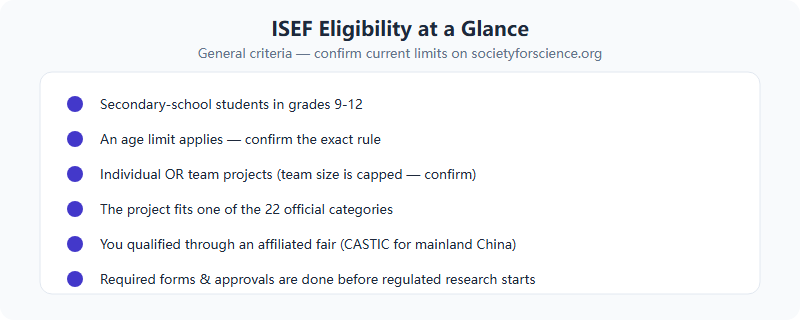
One eligibility point deserves emphasis because it derails otherwise strong projects: certain research needs review and approval before you begin — for example, studies involving human participants, vertebrate animals, or potentially hazardous biological agents. If your idea touches any of these, treat approval as a design constraint from day one. The specific forms and review bodies are defined officially; confirm the current requirements on societyforscience.org.
The China calendar versus the May finals
Here is where China-based planning genuinely differs from a US student's. The ISEF finals happen in May every year, but the mainland selection events that decide who goes run on CAST's own calendar, which does not necessarily mirror a US “spring fair” rhythm. That means you cannot simply reverse-engineer a schedule from May and assume your qualifying deadline is a couple of months earlier.
Practically, this creates two timelines you must hold at once. The research timeline — how long it takes to build a project strong enough to advance — is long; the strongest projects begin roughly 10 to 12 months out, which is why summer is the real starting line. The qualification timeline — when you must have a presentable project for local, provincial, and national rounds — is set by CAST and can fall well before May. If your qualifying round lands earlier than you expect, a “May-minus-a-few-months” plan leaves you scrambling. Confirm the current CASTIC and provincial dates early, then plan your research backward from the earliest checkpoint, not from the finals.
What international-school students in China often get wrong
From working with China-based international-school students, a few avoidable mistakes come up again and again:
- Assuming the school handles everything. Some schools enter students through a science department; others expect families to navigate the affiliated-fair system. Find out which is true for your school this term.
- Choosing a topic before checking approvals. A brilliant human-behaviour or animal-based idea can stall if the required review is not planned for. Pick a question you can actually run within the rules.
- Optimising for ISEF and ignoring the qualifier. You must clear the CASTIC ladder first. A project has to impress provincial and national judges before it ever reaches May.
- Treating category choice as an afterthought. The category shapes how your project is judged. Read how to choose your ISEF category early, not the week before submission.
- Waiting for perfect data. Judges reward clear thinking and honest results over grand claims. Start, iterate, and document.
Your CASTIC-route checklist for this summer
If you are reading this over the summer, you are in the ideal window to set the pathway up correctly. Work through this list:
- Confirm the current affiliated fair for your region on societyforscience.org.
- Confirm CASTIC and provincial entry rules and dates through CAST's official channels.
- Check whether your school enters students centrally or expects you to enter independently.
- Draft a research question you can run within the approval rules — flag anything involving people, animals, or hazards now.
- Map your research timeline backward from the earliest qualifying checkpoint, not from May.
- Pick a likely category early so your project is framed for the right judges.
Do these six things and you have converted a vague ambition (“get to ISEF”) into a concrete, verifiable plan built on the one route that actually works from mainland China.
Frequently asked questions
Can Chinese students apply to ISEF directly?
No. ISEF places are earned through an official affiliated fair; for mainland China that pathway is CASTIC. Confirm the current rules on societyforscience.org.
What is CASTIC?
CASTIC is the China Adolescents Science and Technology Innovation Contest, organised under CAST, and it is the affiliated pathway that selects the mainland ISEF delegation.
Who is eligible for ISEF?
Generally students in grades 9-12 with a project in one of 22 categories; an age limit and a team-size cap also apply. Confirm the current limits officially.
When is the ISEF final held?
The Regeneron ISEF finals are held in May. China's selection events run earlier on CAST's own calendar, so confirm exact qualifying dates officially.
This is an independent guide operated by Hanlin Education for China-based international-school students. It is NOT affiliated with, endorsed by, or sponsored by the Society for Science or Regeneron ISEF. Competition rules, eligibility, deadlines, and the current affiliated fair for your region change — confirm all current details on societyforscience.org and CAST's official channels. Any error will be corrected within 7 working days.