Should you enter ISEF as a solo researcher or as a team? Under the Society for Science’s rules, team projects are allowed — with a small maximum team size (up to three members under the published rules; confirm current details on societyforscience.org) — and teams compete in the same 22 categories as individuals. The real decision is strategic: teams multiply hands and skills, but every member must be able to defend the whole project in the judging interview. This guide lays out the rules in outline, the honest trade-offs, and a decision framework for China-based students planning a summer project launch.
What the rules actually say about teams — in outline
Before weighing pros and cons, get the structural facts straight. From the official International Rules (always verify the current edition on societyforscience.org before committing):
- Team size is capped. The published rules allow team projects with a small maximum membership — up to three students. A “team” of five collaborators cannot enter as one project.
- Every member must be individually eligible. The grades 9–12 eligibility window applies to each student, not just the lead. One ineligible member is a problem for the whole entry.
- Teams and individuals compete in the same categories. There is no separate “team division” with its own awards ladder — your team project sits in its category alongside solo projects.
- The team advances together through the fair pipeline. Like every project, a team entry must win its place through an affiliated fair — for mainland China students, the CASTIC route — before reaching the May finals. How that pipeline works end to end is covered in our guide to how ISEF works, from affiliated fairs to the global finals.
- Membership changes are constrained. Rules govern how and when team composition can change during a project cycle; do not assume you can swap members late. Confirm specifics in the current rules before you rely on them.
One more structural point that surprises students: the project has one abstract (subject to the same 250-word maximum), one board, one set of forms — and one shared result. There is no mechanism for a judge to award one team member more than another.
The honest trade-off table
Neither format is “better.” They fail in different ways. Here is the comparison we walk students through:
| Dimension | Solo project | Team project |
|---|---|---|
| Workload capacity | Everything is on you: reading, building, testing, analysis, board, interview | Two or three people can run parallel workstreams — more data, more iterations |
| Skill coverage | Limited to your own toolkit | Can combine, e.g., a coder + a wet-lab-comfortable student + a strong writer |
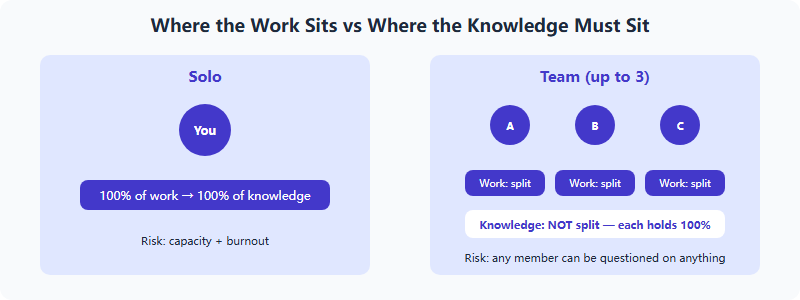
| Interview risk | You know every detail because you did every detail | Judges can question any member on any part; one weak member’s blank stare damages the whole team |
| Coordination cost | Zero | Real and recurring — schedules, standards, disagreements, unequal effort |
| Ownership story | Unambiguous | Must be deliberately engineered: who did what, documented honestly on your forms |
| Failure mode | Burnout, scope too big for one person | Free-riding, fragmented knowledge, a de facto “leader project” with passengers |
| Typical best fit | Tightly scoped question, single-method project, strong self-manager | Multi-component builds (hardware + software + testing), field studies needing many samples |
Notice that the team column’s advantages are all about production and its risks are all about accountability. That asymmetry is the core of the decision.
A three-question decision framework
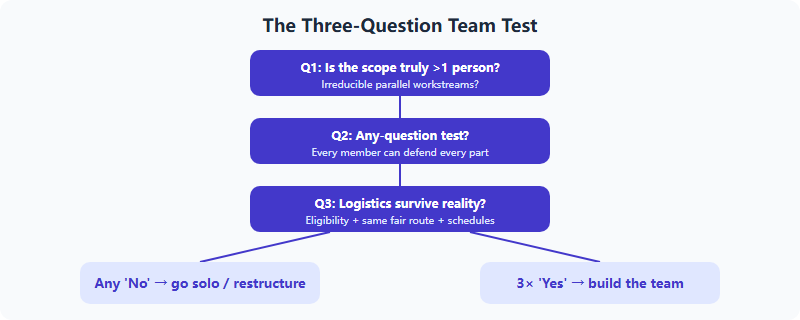
Strip the decision down to three questions, answered honestly:
Question 1: Does the project genuinely need more than one person? “Genuinely need” means the scope is irreducible — a device that requires simultaneous hardware and software development, a field study needing sample collection at multiple sites, an experiment with time-critical parallel procedures. If the honest answer is “one focused student could do this in 10 months,” a team adds accountability risk without production benefit. Judges have seen many two-person projects that are obviously one person’s idea with a helper attached.
Question 2: Can every candidate member pass the “any-question test”? Imagine the judging interview: a judge turns to your quietest teammate and asks them to explain the statistics, or why you rejected an alternative design. If you cannot picture each member handling that, the team is not ready — and hoping judges will “aim questions at the right person” is not a strategy. This is the single most common way team projects underperform at fairs.
Question 3: Do the logistics survive contact with reality? For China-based students specifically: are all members at the same school, or will you coordinate across cities? Do all members meet eligibility, and can all of you actually advance together through the same affiliated-fair route? A team split across schools or regions adds administrative friction at exactly the moment — fair registration — when you can least afford surprises. Confirm route-specific details with your fair and the official rules early.
Three yeses: team. Any no: solo, or restructure. And note that this decision interacts with your topic choice — some categories lend themselves to multi-component team builds far more than others, which is one more reason to read our guide on how to choose your ISEF category before recruiting anyone.
If you do form a team: structures that prevent the classic failures
Teams that work at ISEF level are engineered, not assembled. Four structures worth copying:
- Owner-plus-fluency model. Each member owns a workstream (e.g., experimental design, data pipeline, literature and writing) but the team holds a weekly “teach-back” where each owner teaches the others their week’s work. Ownership creates efficiency; teach-backs create the shared fluency judges demand.
- A written contribution log from day one. The official forms ask you to describe who did what, and honesty there is non-negotiable. A running shared log makes that documentation accurate instead of reconstructed — and settles “who actually did this” disputes before they fester.
- One integrated narrative, rehearsed by all. Build the project presentation as a single story any member can start, continue, or finish. In rehearsal, randomize who answers. If the same member keeps fielding the statistics questions, you have found your weak point while it is still fixable.
- Decide the disagreement rule early. Method disputes are normal in real research. Agree in advance how you resolve them (evidence memo + majority, or owner decides within their stream). Teams without a rule burn weeks on friction.
Also set expectations about credit from the start: awards recognize the project, and members share its outcome. If any member’s motivation depends on being singled out, that is a conversation to have in July, not at the fair.
The China-based angle: what changes and what doesn’t
For students at international schools in China, the team-vs-solo calculus has a few local twists. School-level support varies widely — some schools have research programs that naturally produce teams, others leave you to self-organize, and a same-school team is administratively far simpler than a cross-city one when fair registration arrives. The affiliated-fair stage (the CASTIC route for mainland China) is the gate every project must pass, team or solo, so verify early how team entries are handled in your specific route rather than assuming it mirrors what you have read about US regional fairs. And if you are still mapping the overall landscape — what ISEF is, who runs it, and what the May finals involve — start with our complete 2026 guide to what ISEF is before making structural decisions like this one.
The bottom line: choose team only when the science demands it and every member can stand alone under questioning. A strong solo project beats a hollow team project every time — and the reverse is equally true when the scope is real.
FAQ
How many students can be on one ISEF team project?
The published rules cap teams at a small maximum — up to three members. Every member must individually meet eligibility. Confirm the current rules on societyforscience.org.
Do team projects compete against individual projects?
Yes. Teams enter the same categories as solo projects and pass through the same affiliated-fair pipeline; there is no separate team division with its own awards ladder.
Can judges question any team member during the interview?
Yes — assume any member can be asked about any part of the project. Shared fluency across the whole project is the defining trait of successful teams.
Is a team project weaker for college applications than a solo one?
Neither format is inherently stronger. What matters is the depth of the work and your documented, defensible personal contribution to it.
This is an independent guide operated by Hanlin Education for China-based international-school students. It is not affiliated with, endorsed by, or sponsored by the Society for Science or Regeneron ISEF. Team rules and eligibility requirements change — always confirm current details on societyforscience.org. Factual errors reported to us are corrected within 7 working days.