Finding an ISEF research mentor as a China-based student means solving two problems at once: the official one — every ISEF project must have an Adult Sponsor, and some regulated research also requires a Qualified Scientist — and the practical one — you are usually far from a US-style research lab. This guide maps the three adult roles defined in the official rules, the mentor channels that actually exist for students in China, and the red flags that turn a mentored project into a disqualified one.
Why “mentor” is really three different jobs at ISEF
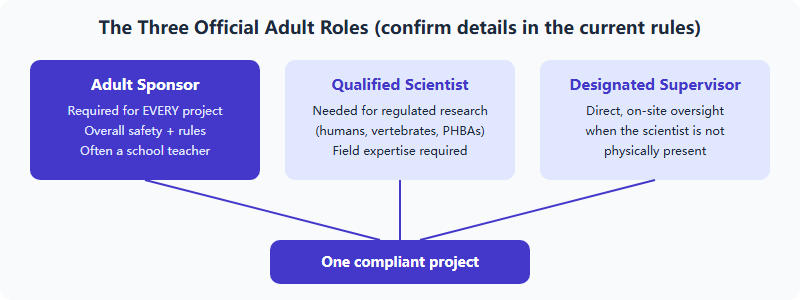
Students often say “I need a mentor” as if it were one role. Under the Society for Science’s International Rules, adult oversight is split into distinct, named functions — and confusing them is one of the most common paperwork mistakes we see from first-time China-based competitors. In outline (always confirm the exact definitions in the current International Rules and Guidelines on societyforscience.org):
- Adult Sponsor — required for every project. Often a teacher or parent-approved adult who takes overall responsibility for the student’s safety and for the project following the rules. This person does not need to be a scientist in your field.
- Qualified Scientist — required for certain regulated categories of research (for example studies involving human participants, vertebrate animals, or potentially hazardous biological agents, per the official rules). This person must have real expertise in the relevant area; the current rules set the qualification standard, so confirm there.
- Designated Supervisor — an adult who directly supervises hands-on work when the Qualified Scientist cannot be physically present, for example day-to-day lab or field procedures.
The person who gives you scientific ideas and feedback — what most students mean by “mentor” — may hold one of these roles or none of them. The rules care about oversight and safety; you additionally want intellectual guidance. Plan for both.
The realistic mentor channels for students in China
Most advice about finding mentors assumes you can walk into a nearby university lab. From a Chinese international school, your channels look different. Here is an honest map of what China-based students actually use, with the trade-offs of each:
| Channel | How it works | Strengths | Watch-outs |
|---|---|---|---|
| School science faculty | A physics/biology/CS teacher acts as Adult Sponsor and first reader | Easiest to secure; knows the fair paperwork; meets you weekly | May not have depth in your specific research topic |
| Chinese university outreach | Email professors or grad students at local universities; some labs host high-school visitors | Real lab equipment and methodology standards | Access varies a lot by city and lab; put agreements in writing; document exactly what you did yourself |
| Remote academic mentorship | Video-call guidance from a researcher abroad (family networks, alumni, structured programs) | Access to field expertise regardless of geography | Time zones; cannot serve as on-site Designated Supervisor for hands-on work |
| Paid research programs | Commercial programs pairing students with mentors | Structured timelines | Quality varies enormously; you must be able to defend every step yourself; disclose any assistance honestly on your forms |
| Independent + advisory | You run a data/computational project at home; a mentor reviews methodology monthly | Full ownership; strong in the judging interview | Needs discipline; still requires an Adult Sponsor |
Note the pattern: computational, data-science, behavioral-survey and engineering-build projects are far less dependent on physical lab access, which is why they dominate among successful China-based entrants who work without a university bench. If lab access is uncertain, factor that into your topic choice — our guide on how to choose your ISEF category covers this trade-off in depth.
A summer outreach plan that works backward from May
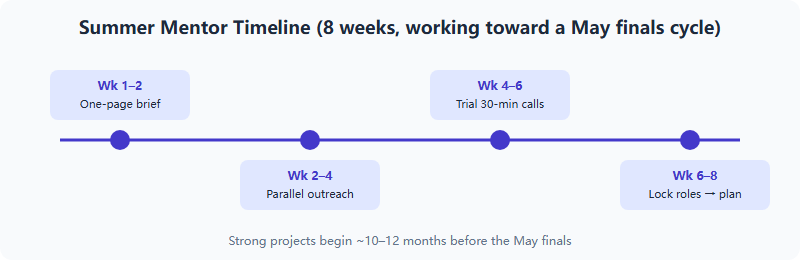
The strongest ISEF projects typically begin 10–12 months before the May finals, which makes July and August the natural mentor-hunting window. A realistic four-step sequence for a China-based student starting now:
- Weeks 1–2: Define before you ask. Write a one-page brief: the question you want to investigate, why it interests you, what you have already read, and what kind of help you need (methodology review? equipment? statistics?). Mentors respond to specific asks, not “I want to do research.”
- Weeks 2–4: Contact in parallel, not sequence. Approach one school teacher, two to three university contacts, and one remote option at the same time. Response rates to cold emails are low everywhere; parallel outreach is normal and not rude.
- Weeks 4–6: Trial conversation. Ask each interested adult for one 30-minute call. You are checking two things: do they engage with your actual question, and will they commit to a cadence (even 30 minutes a month is workable if you prepare).
- Weeks 6–8: Lock roles in writing. Confirm who is your Adult Sponsor, whether your project type needs a Qualified Scientist, and what each person will and will not do. Then start your research plan — before experimentation, not after, since some project types need review-committee approval first (see the official rules).
If you are new to the overall pipeline — affiliated fair, then finals — read how ISEF works from affiliated fairs to the global finals before you send a single email, so you can explain the competition credibly to a prospective mentor.
Red flags: when mentorship becomes a disqualification risk
ISEF is built around the principle that the student did the work. The official paperwork asks you to document who did what, and judges probe exactly this in the interview — they are experienced at detecting projects a student cannot actually explain. Watch for these red flags in any mentorship arrangement:
- The mentor proposes the entire question and design. Guidance is fine; a hand-me-down project is not yours, and it collapses the moment a judge asks “why did you choose this method?”
- You cannot describe, step by step, what you personally did. If a lab technician ran your assays, that must be documented — and you must own the analysis and interpretation.
- A program promises awards. No legitimate mentor can promise an ISEF outcome. Selection runs through affiliated fairs (in mainland China, the CASTIC route), and judging is independent.
- Nobody mentions forms or approvals. A mentor who has never heard of the research plan, review committees, or the ISEF forms is not going to protect you from a compliance failure. Certain studies require approval before experimentation begins — after-the-fact paperwork can be fatal to a project.
- Ghost-written materials. Your abstract (250 words maximum under the official limit), your board, your answers — all yours. Editing feedback is normal; authorship substitution is misconduct.
The honest test: could you defend every choice in the project, alone, with no mentor in the room? That is essentially what ISEF judging is — finalists answer judges without adults helping (see the official judging guidance for the current format).
What to ask a prospective mentor — a working checklist
Use these questions in your trial conversation. They protect both sides:
- “Have you supervised student research before? At what level?” (No is acceptable — but then your Adult Sponsor should be someone who knows the fair system.)
- “How often can we meet, and in what format?” (Cadence beats intensity. Monthly-but-reliable outperforms enthusiastic-then-vanished.)
- “What parts of the work will you expect me to do entirely alone?” (The right answer covers most of it: reading, design decisions, analysis, writing.)
- “Are you willing to be named on my forms in an official role?” (Some advisors will mentor informally but decline formal roles — you then need a separate Adult Sponsor, usually at school.)
- “If my project involves human participants or animals, do you know the approval requirements?” (If not, you and your Adult Sponsor must learn them from the official rules yourselves.)
And one question to ask yourself: does this person make you more independent over time, or more dependent? The first is a mentor. The second is a liability. If you are still deciding whether the whole journey is right for you, start with our foundation guide, What Is ISEF? A complete 2026 guide for international students.
FAQ
Do I need a university professor to compete at ISEF?
No. Every project needs an Adult Sponsor — often a school teacher. A Qualified Scientist is only required for certain regulated research types; confirm the current rules on societyforscience.org.
Can my mentor be overseas and work with me by video call?
Yes, for intellectual guidance. But hands-on regulated work needs appropriate on-site supervision under the rules, so a remote mentor may need to be paired with a local Designated Supervisor.
Is it against the rules to join a paid research program?
Not inherently, but you must honestly document all assistance on your forms and be able to defend every step of the project yourself in the judging interview.
When should a China-based student start looking for a mentor?
Summer, roughly 10–12 months before the May finals. That leaves time for outreach, approvals where required, experimentation, and the affiliated-fair stage via CASTIC.
This is an independent guide operated by Hanlin Education for China-based international-school students. It is not affiliated with, endorsed by, or sponsored by the Society for Science or Regeneron ISEF. Rules, roles, and requirements change — always confirm current details on societyforscience.org. Factual errors reported to us are corrected within 7 working days.