Is ISEF worth it for college applications? For the right student, yes — but not as a trophy. The Regeneron International Science and Engineering Fair (ISEF) is respected by admissions because qualifying through an affiliated fair and surviving a defended judging interview signals real, sustained, independent research. It is strong evidence, never a guarantee of admission. What matters is the work behind it.
What ISEF actually signals to an admissions reader
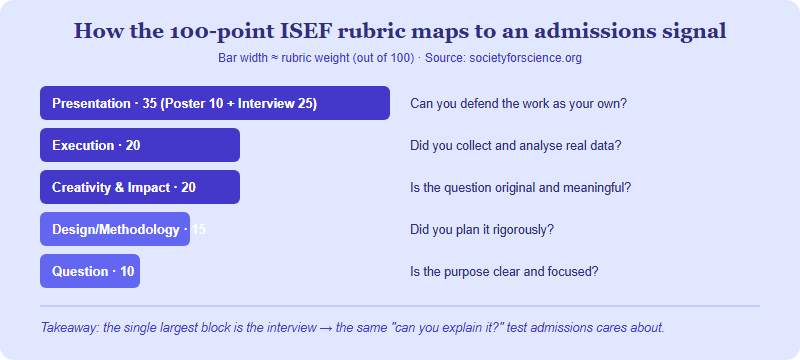
Admissions officers do not award points for competition names. They read for evidence of intellectual maturity — and an ISEF finalist line carries weight precisely because the path is hard to fake. To reach the international finals you must first win the right to attend through a Regeneron ISEF affiliated fair (for China-based students, the national route runs through CASTIC). You then present a project judged at least four times, scored out of 100, including a 25-point interview where judges probe whether the work is genuinely yours.
That structure is the signal. It tells a reader three things at once: you can frame a real research question, you can execute over months (ISEF permits no more than 12 months of continuous research), and you can defend your reasoning under questioning. Those are the same habits a research university wants to see. A simpler way to think about it: ISEF doesn’t prove you are “smart” — it provides documented, third-party evidence that you did sustained science and could explain it.
It is worth being blunt about the ceiling. Selective admissions is holistic. A strong research record sits alongside your transcript, recommendations, essays, and context. ISEF can lift an application; it cannot rescue one, and no honest guide will promise it changes a decision.
Why independent research is respected — beyond the medal
There is a reason universities, especially research-intensive ones, value science fair work more than many “activities.” Independent research is one of the few high-school experiences that mirrors what undergraduates and graduate students actually do: you choose a problem nobody assigned, live with uncertainty, and produce something testable. ISEF formalises that with a 250-word abstract, a project board, and a judging interview — a miniature version of a conference defence.
Crucially, the value is in the research, not the acronym. A student who ran a careful 8-month microbiology study and can explain her controls demonstrates more than a student who attached a famous label to a thin project. Admissions readers — and ISEF judges — are trained to tell the difference. The interview exists exactly to surface students who cannot explain their own methods. This is good news for honest students: depth is rewarded, and depth is something you control.
If you are still deciding whether to commit, two earlier guides on this site help you scope the path realistically: What Is ISEF for the big picture, and how to choose your ISEF category so your project lands where it is judged fairly across the 22 categories (including the newer Technology Enhances the Arts, or TECA).
An honest tier list: what ISEF does and doesn't do
Because the topic attracts a lot of hype, here is a deliberately sober breakdown. Treat the left column as what is defensible and the right column as where families overreach.
| What ISEF can genuinely do | What ISEF does NOT do |
|---|---|
| Provide third-party evidence of sustained, independent research | Guarantee admission to any university |
| Give you a defensible story for “intellectual curiosity” essays | Replace a weak transcript or test profile |
| Demonstrate you can frame a question and defend methods under interview | Substitute for genuine subject knowledge in your interview |
| Signal fit for research-heavy programs and majors | Matter much if you can't explain your own project |
| Build real skills (literature review, data analysis, scientific writing) | “Buy” credibility through a paid or ghost-written project |
Notice the pattern: every genuine benefit flows from doing the work, and every overreach assumes the name carries the application by itself. The most common failure mode we see in China-based applicants is treating ISEF as a finish line to be reached by any means, rather than evidence of a process they can stand behind. That gap shows up instantly in interviews and essays.
How to make ISEF actually count on an application
If you decide it fits your goals, the difference between “a line on a list” and “a credible centrepiece” comes down to a handful of disciplined choices. None of them are shortcuts.
- Start from a real question, not a category you think looks impressive. Judges score “clear and focused purpose” first; admissions readers feel the difference between curiosity and résumé-padding.
- Document the process, not just the result. Keep a dated lab notebook. The 12-month research window means your timeline is part of the story — and a genuine timeline is hard to fabricate.
- Rehearse the defence. A quarter of your ISEF score is the interview. Being able to explain limitations, alternative explanations, and “what I'd do next” is exactly what admissions interviews and supplemental essays reward.
- Write about the thinking, not the trophy. In essays, a paragraph on the experiment that failed and what you changed beats three sentences naming the award.
- Confirm every procedural detail on the official site. Affiliated-fair deadlines, forms, and eligibility change year to year; verify on societyforscience.org rather than trusting forum hearsay.
The honest verdict for China-based applicants
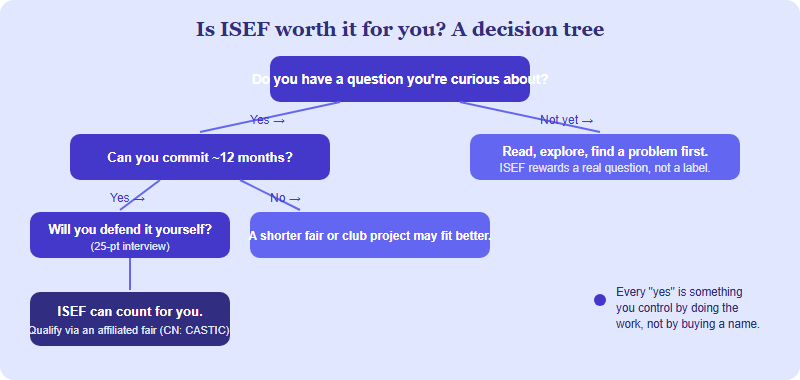
For a curious student willing to spend the better part of a year on a genuine project, ISEF is one of the most credible research signals available — because it is one of the hardest to fake. For a student chasing a line to impress, it tends to backfire: the interview, the essays, and the lack of a real story expose the gap. The verdict, then, is conditional, not universal. It is worth it when the research is real and yours.
There is also an opportunity-cost question that families rarely ask out loud. A serious ISEF project consumes time, mentorship, and often lab access — resources that could otherwise go to a different competition, a deeper extracurricular, or simply protecting grades. For students whose strongest story is not science, that trade-off may not pay off, and an honest advisor will say so. The right question is not “Is ISEF prestigious?” but “Is a year of independent research the best use of this particular student's time, given where they are applying and what they genuinely love?” When the answer is yes, the experience tends to improve far more than one line on an application — it sharpens how a student reads papers, handles failed experiments, and writes about their own thinking. Those gains travel with them into interviews and into university, whatever the final ISEF result turns out to be.
If you are weighing the path for a specific student profile and want a candid read on whether the time investment fits their goals — including the CASTIC route and how to scope a defensible project — talk it through with someone who has seen many of these applications.
Frequently asked questions
Does winning ISEF guarantee admission to a top university?
No. Admissions is holistic. ISEF is strong third-party evidence of independent research, but it sits alongside your transcript, essays, and recommendations — never a guarantee.
Do I have to qualify through a fair, or can I enter ISEF directly?
You qualify by winning the right to attend through a Society for Science affiliated fair. China-based students typically route through CASTIC. Confirm current details on societyforscience.org.
How much does the judging interview matter?
A lot. ISEF projects are scored out of 100, and the interview is worth 25 points — the single largest block — testing whether the work and reasoning are genuinely your own.
Is ISEF only worth it for STEM majors?
It is strongest for research-heavy and STEM-leaning applications, but the skills — framing questions, analysing data, defending ideas — read well across many majors. Fit matters more than the label.
This is an independent guide operated by Hanlin Education for China-based international-school students. It is not affiliated with, endorsed by, or sponsored by the Society for Science or Regeneron ISEF. Rules, deadlines, eligibility, affiliated-fair routes, and category lists change year to year — always confirm current details on societyforscience.org. We correct confirmed errors within 7 working days.