Every ISEF finalist clears two gates: a great project, and a stack of paperwork that has to be approved before experimentation starts. The most common way strong international students lose points — or get disqualified — is not weak science; it is a missing signature, a board that breaks the size limit, or a 280-word abstract where 250 is the ceiling. This guide maps the display board specs, the abstract rule, and the form chain you must complete, all anchored to the official Society for Science rules.
The display board: a 48″ × 48″ box you cannot exceed
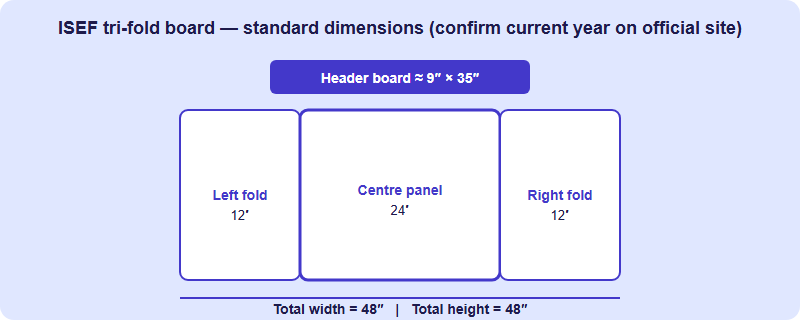
The single most ignored constraint is physical. At the Regeneron International Science and Engineering Fair, a standard tri-fold board measures 48 inches by 48 inches in total — the two side folds are 12″ each and the centre panel is 24″ — with a header board of roughly 9″ × 35″ on top. Anything that pushes past the official maximum footprint can be pulled at safety check-in. Confirm the current year’s exact display dimensions and the maximum project height/depth on the official Display & Safety rules page before you print a single panel, because these numbers are reviewed annually.
For China-based students this matters twice over: you are usually shipping or rebuilding the board on-site, so design it to fold flat and survive a flight, and never count on bringing prohibited items (live cultures, hazardous chemicals, human/animal parts, sharp objects) into the hall — the display rules forbid a long list of materials, and what you display is judged separately from what you researched. When in doubt, photograph it and confirm on the official site.
The abstract: 250 words, one page, written last
ISEF requires a maximum 250-word, one-page abstract. That is a hard ceiling, not a target — judges and the public read it, and an over-length or padded abstract signals weak editing before anyone hears you speak. Treat it as the trailer for the project: purpose, what you did, the key result, and why it matters, in plain language. Write it after the research is finished, never before, and cut every sentence that does not carry a fact or a number.
A workable structure inside 250 words: one or two sentences of problem and gap, one on your method, two on your strongest quantified findings, and one on significance or next steps. If you cannot say what is new in your own abstract, that is a content problem to fix in the lab — not a wording problem to fix on the page. For how a project earns its place across the 22 categories before you ever write the abstract, see our companion piece on how to choose your category.
The forms chain: approval has to come before experimentation
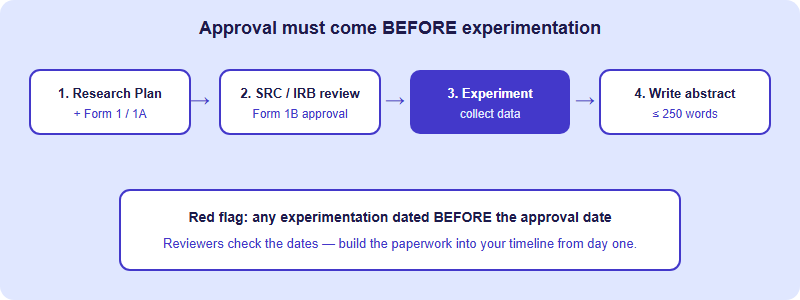
This is where the iron rule lives: projects involving human participants, vertebrate animals, or potentially hazardous biological agents must be reviewed and approved by a Scientific Review Committee (SRC) or Institutional Review Board (IRB) before experimentation begins. You cannot run the study and seek approval afterwards. Below is the core paperwork the official rules reference; the exact set depends on your project type, so always cross-check the current Rules and Guidelines before submitting.
| Form | Name (per official rules) | What it covers | Who signs / reviews |
|---|---|---|---|
| Form 1 | Checklist for Adult Sponsor | Confirms an adult sponsor reviewed the plan and the risk level of the project | Adult Sponsor |
| Form 1A | Student Checklist | Student details, project timeline, where the work is done | Student + Adult Sponsor |
| Research Plan / Project Addendum | Research Plan | The written plan attached to Form 1A — question, method, risk assessment, references | Student (reviewed before start) |
| Form 1B | Approval Form | Records SRC/IRB approval and key dates; signed after the plan is approved | SRC / IRB |
| Form 2A | Student Support / Disclosure Form | Discloses help received and any regulated procedures | Student + supervising adult |
Two practical traps for international entrants. First, the order of dates must be defensible: review/approval dates have to fall before the experimentation start date, and a reviewer who spots experimentation that predates approval can flag the project. Second, if you are doing a continuation (multi-year) project, the rules expect a defined research window — for the 2027 cycle, research spanning twelve continuous months beginning no earlier than January 2026 and ending May 2027 — plus documentation that the new year’s work is a substantive expansion, not a re-run of last year’s. Confirm the exact dates and continuation requirements for your cycle on the official site.
What you may not display — and why it trips up strong projects
A project can be scientifically excellent and still be told to remove half its booth at safety check-in. The Display & Safety rules restrict what can physically sit on the table, and the list is longer than most first-time entrants expect. Items commonly restricted or prohibited at the display include living organisms and microbial cultures (including plates that look “sealed”), preserved vertebrate or human parts, body fluids, hazardous chemicals or controlled substances, sharp items, open flame, and certain food. The principle is simple: the lab is where the science happens; the booth only represents it.
The practical workaround is documentation, not the real thing. Instead of bringing a culture, a tissue sample, or a working high-voltage rig, display high-quality photographs, your data, your logbook pages, and clear diagrams. This is doubly important for China-based entrants who cannot easily transport regulated materials across a border anyway. If you are unsure whether a specific item is allowed, the safe default is to leave it home and show evidence of it — and to confirm the current prohibited-items list on societyforscience.org well before you pack.
Three failure modes recur, all preventable:
- Photographs that need releases. If your board shows recognisable human participants, the rules around human-subject images and consent apply — when in doubt, anonymise faces and confirm what your approval allows.
- Continuation work shown as if it were all this year’s. If you built on a prior year, the board and forms must make the new contribution explicit; presenting old results as new invites a flag.
- A board that overflows the footprint. Props, laptops, and models still have to fit within the maximum allowed dimensions and height — measure the whole assembled setup, not just the cardboard.
A pre-fair paperwork timeline that actually works
Because approval must precede experimentation, the only reliable way to stay compliant is to run the paperwork on a schedule, not in a panic. A realistic backward plan from a China-based school looks like this:
| When | Paperwork milestone | Why this timing |
|---|---|---|
| Before any data | Write Research Plan; complete Form 1 & 1A with adult sponsor | Nothing can be run until the plan exists and risk is assessed |
| Before experimentation | Obtain SRC/IRB review and Form 1B approval | Hard rule — approval date must precede start date |
| During research | Keep dated, English-language logbook; complete Form 2A disclosures | Records back your timeline and ownership claims |
| ~6–8 weeks out | Finalise the ≤250-word abstract; draft the board layout | Abstract is written last; board needs revision cycles |
| ~2–4 weeks out | Print board to fold flat; plan shipping/rebuild logistics | International transport and reprints eat time |
Notice that the abstract and board — the visible deliverables — come last, after the approvals and the data. Students who invert this order, polishing a board before securing approval, are the ones who discover a fatal date problem the week of the fair. Build the compliance into the science from day one.
A first-party note for China-based finalists
From advising students who reach international fairs from Chinese international schools, three paperwork habits separate the smooth entries from the stressful ones. One: assign a real adult sponsor early — a teacher or mentor who will actually sign Form 1 and own the risk review, not a name added the week before. Two: keep an English-language lab notebook with dated entries from the first day, because continuation claims and approval timelines are only as strong as your records. Three: if your route to ISEF runs through China’s national selection system (commonly referenced as CASTIC), build in extra lead time — translation, school approvals, and shipping a board internationally all eat weeks you will wish you had. For the full qualification pathway, see how ISEF works, and for the big picture start with what ISEF is.
None of this is about gaming a form. The paperwork exists to make your science ethical and reproducible; doing it properly is itself a research skill that judges and university admissions readers notice. Confirm every specific figure here — board size, abstract limit, form names, continuation dates — against societyforscience.org for your competition year, because the rules are updated annually.
FAQ
How many students can be on one ISEF project?
The official rules state teams must have no more than three members. Each student may enter only one project per year. Confirm on societyforscience.org.
What is the ISEF abstract word limit?
A maximum 250-word, one-page abstract. It is a hard ceiling, written after the research is complete, read by judges and the public.
Do I really need approval before starting experiments?
Yes. Projects with human participants, vertebrate animals, or hazardous biological agents need SRC or IRB approval before experimentation begins, or risk disqualification.
How big can my ISEF display board be?
A standard tri-fold totals about 48″ × 48″ with 12″ folds and a 24″ centre. Verify the exact maximum dimensions for your year on the official Display & Safety rules.
This is an independent guide operated by Hanlin Education for China-based international-school students. It is not affiliated with, endorsed by, or sponsored by the Society for Science or Regeneron ISEF. All rules — display board dimensions, abstract limits, form names, and continuation dates — are reviewed annually; confirm current details on societyforscience.org. Errors are corrected within 7 working days.