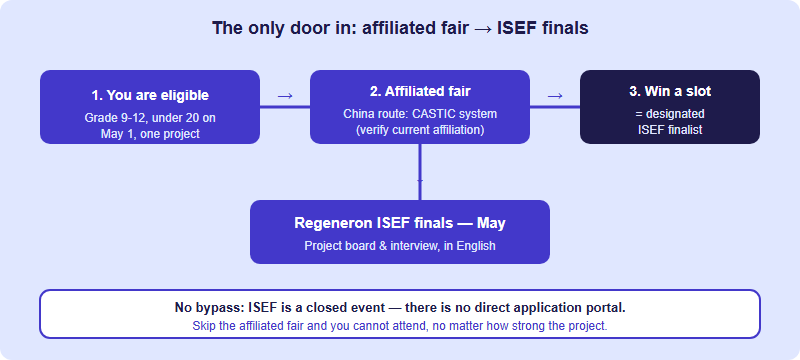
International students do not apply to Regeneron ISEF directly. Per societyforscience.org, you must be in grades 9-12 (or equivalent) and not have reached age 20 on or before May 1 preceding ISEF, then win your place at a Society-affiliated science fair — the only door in. For China-based students, that affiliated route runs through the national fair system (CASTIC), and the finals are held each May.
The one rule everything else hangs on: ISEF is a closed event
The single most important fact for any international student is this: there is no “ISEF application.” The official FAQ states plainly that students must “compete in a Regeneron ISEF affiliated science fair and win the right to attend,” because Regeneron ISEF “is a closed event.” You earn your way in through an affiliated fair, or you do not come at all. This is exactly where many overseas families lose a year — they polish a project for months expecting an upload portal that never existed.
Society for Science runs a global network of roughly 400 affiliated fairs across all 50 U.S. states, the District of Columbia, and more than 75 countries, regions, and territories. Each affiliated fair is allocated a fixed number of project slots (individual or team) it may send forward to ISEF. So your real competition is local first: you are competing to be one of your fair’s designated finalists, and only then do you stand on the ISEF floor. If you want the mechanics of how a regional win becomes an ISEF seat, our companion piece on how ISEF works, from affiliated fairs to finals, walks the full chain.
Are you eligible? The grades-and-age test
Eligibility is narrow and non-negotiable. The International Rules for All Projects require that a student “be in grades 9-12 or equivalent; and not have reached age 20 on or before May 1 preceding ISEF.” The “or equivalent” clause is what makes the pathway genuinely open to international and Chinese international-school students — you do not need to sit in a U.S. classroom. What matters is your grade level and your age on that May 1 cutoff.
| Requirement | What the official rules say | Why it matters for you |
|---|---|---|
| Grade level | Grades 9-12 or equivalent | International-school students qualify on the “or equivalent” clause |
| Age | Not reached age 20 on or before May 1 preceding ISEF | Check your birthday against that exact cutoff before you commit a project |
| Projects per student | “Each student is only allowed to enter one project” | You back one horse — choose the question you can defend |
| Research window | No more than 12 months of continuous research | For ISEF 2026, research may not predate January 2026 |
| Team size | “Team projects must have no more than three members” | Solo, pair, or trio — not a class of ten |
| Abstract | Maximum 250-word, one-page abstract | You will write tight; budget words deliberately |
| Language | “English is the official language” — boards and abstracts in English | Every Chinese-medium student must present in English at finals |
Two eligibility traps catch international applicants specifically. First, the 12-month continuous research window: a long-running lab project you began two years ago may be ineligible — the rules state the project “may not include research performed before January 2026” for the 2026 cycle. Second, the English requirement: project boards and the abstract must be in English, and judging interviews at finals are conducted in English. A brilliant project that the student cannot defend fluently in English will not score where it should.
The China pathway: how China-based students reach ISEF
Because ISEF only admits finalists from its affiliated fairs, the practical question for a student in Shanghai, Shenzhen, or Beijing is: which affiliated fair sends students from China? Historically, the national-level route has run through the China Adolescents Science & Technology Innovation Contest (CASTIC) — one of China’s largest national science competitions, organised by national science and education bodies, where top performers have gone on to represent China at ISEF. Foreign delegations and ISEF itself have engaged with CASTIC for years.
A crucial honesty note: the exact list of which fairs hold a current ISEF affiliation, and how many finalist slots each is allocated, changes year to year and is controlled by Society for Science — not by us. Confirm the current China affiliated route on the official Affiliated Fair Network before you build your plan. Do not assume a fair is ISEF-affiliated this cycle just because it was last year, or because a coaching agency says so. The official network page is the only authoritative list. If you are still deciding whether ISEF is the right competition for your science interests at all, start with our overview of what ISEF is.
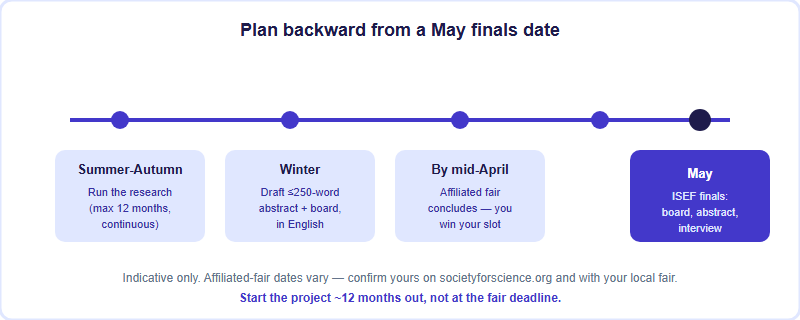
A realistic timeline: working backward from May
ISEF finals land in May. The official FAQ notes that local, regional, and state affiliated fairs “take place throughout the year, but all conclude by mid-April.” Work backward from there and the calendar gets tight fast, because your research itself is capped at a 12-month continuous window. The mistake international students make is treating the affiliated-fair deadline as the start line; it is closer to the finish line. Below is a planning skeleton — confirm every actual date against your specific affiliated fair and the official site.
What gets scored at finals (and why English fluency is part of it)
At ISEF, projects are evaluated out of 100, and the live judging interview carries real weight alongside the written and displayed work — this is not a poster contest where you pin up a board and leave. Judges talk to you. For a Chinese international-school student, this reframes preparation: you are not only doing science, you are rehearsing to explain your science, in English, to scientists who will probe your methods. The strongest China-cohort finalists we have seen treat the English defense as a discipline in its own right, drilling the “why this method, why this control, what would you do next” questions for weeks.
Category choice also shapes how you are judged, because you compete against projects in your own category, not the entire fair. With 22 ISEF categories (including the newer Technology Enhances the Arts, TECA), picking the category that genuinely fits your work — rather than the one that sounds most impressive — is a strategic decision. Our guide on how to choose your ISEF category breaks down how to read the category definitions before you commit.
First-party note for China-based students
From working with international-school students across China, the recurring pattern is not weak science — it is a misread of the process. Three corrections save the most pain: (1) lock your affiliated-fair route early and verify its current ISEF affiliation on the official network page, because that is your only entry and slots are finite; (2) respect the 12-month research window so your timeline and your data are both rules-compliant; and (3) build the English interview into your prep from day one, not the week before. None of these require insider access — they require reading the official rules the way a judge reads them, and planning backward from May.
Important: participating in ISEF, even reaching finals, is an achievement — it is not a guarantee of any university admission outcome, and anyone promising you that is misleading you. ISEF is a credible signal of independent research ability; treat it as one strong element of a profile, built honestly.
FAQ
Can international students enter ISEF directly online?
No. Per societyforscience.org, ISEF is a closed event. You must win your place at a Society-affiliated fair first; there is no direct entry portal.
What are the age and grade limits?
You must be in grades 9-12 or equivalent and not have reached age 20 on or before May 1 preceding ISEF. The “or equivalent” clause covers international-school students.
How do students in China qualify for ISEF?
Through a Society-affiliated fair; the national route has historically run via the CASTIC system. Confirm the current China affiliated route on societyforscience.org before planning.
When is ISEF held and in what language?
Finals are in May; affiliated fairs conclude by mid-April. English is the official language — boards, abstracts, and judging interviews are in English.
This is an independent guide operated by Hanlin Education for China-based international-school students. It is not affiliated with, endorsed by, or sponsored by the Society for Science or Regeneron ISEF. Rules, dates, eligibility, and the affiliated-fair network change year to year — always confirm current details on societyforscience.org. Confirmed errors are corrected within 7 working days.