No — and the scoring sheet says so directly. On the Grand Award criteria published for the 2026 cycle, the 100 points go to research question (10), design and methodology (15), execution (20), creativity and potential impact (20), and presentation (35, of which the poster is 10 and the interview 25). There is no equipment line and no budget line. Money can move some of those indirectly. It cannot move most of them.
Read the scoring sheet before you read the price list
Every year students and families arrive at the same anxious question: our school does not have a mass spectrometer, are we already out? The scoring sheet is the honest answer, and it is more encouraging than the rumour mill.
| Criterion (Science) | Points | Can money move it? | Why |
|---|---|---|---|
| Research question | 10 | No | A good question is a reading-and-thinking output. Equipment does not generate one |
| Design and methodology | 15 | Barely | Controls, replicates and blinding are design decisions, not purchases |
| Execution: data collection, analysis, interpretation | 20 | Partly | Better instruments and more consumables can raise precision and sample size |
| Creativity and potential impact | 20 | No | Novelty comes from framing. Expensive tools applied to a tired question stay tired |
| Presentation: poster | 10 | Slightly | A ceiling of 10 points. Professional printing does not lift a thin project |
| Presentation: interview | 25 | No — and money can actively hurt here | You are asked how your instrument works and why you chose it |
The engineering criteria follow the same shape, with research problem in place of research question and build-and-test in place of data collection. Weightings are revised from time to time — confirm the current criteria on societyforscience.org before planning around any specific number.
Add the columns up and roughly 55 of the 100 points sit on things money cannot buy: the question, the creative framing, and the interview. Around 10 more sit on a poster with a hard ceiling. The genuinely purchasable territory is a portion of the 20-point execution block, and even there, what you are buying is precision and sample size, not score.
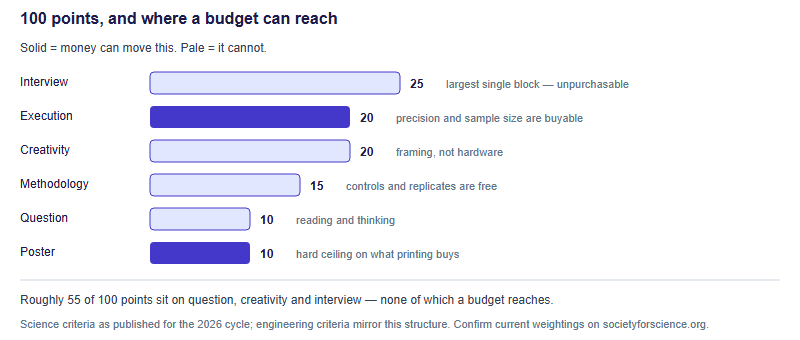
Where money genuinely does buy score
Three places, all of them inside the execution block, and all of them indirect — you buy a capability, and the capability earns the points.
- Measurement precision. If your effect is smaller than your instrument's error, you cannot detect it at any sample size. A balance that reads to three decimal places rather than one, or a sensor with a tighter tolerance, can be the difference between a result and a shrug. This is the single best place to spend.
- Sample size. Consumables are what let you run n = 30 instead of n = 6, and n is visible in every statistical test a judge will ask about. Reagents, plates, seeds, filters — boring purchases that quietly raise both execution and methodology.
- Compute, for computational projects. Rented compute time is genuinely purchasable capability. It is also the category where free tiers, academic credits and open datasets go furthest, so the effective spend is often near zero.
Notice what these have in common: each one lets you do more of the science. That is the test to apply to any proposed purchase. If the honest answer to “what does this let me measure that I could not measure before?” is “nothing, but it sounds impressive”, you have found a purchase that buys zero points.
Where money buys nothing — and the trap that costs points
The poster is worth 10. A professionally designed, large-format printed board and a carefully hand-laid-out one both score inside the same 10 points, and the gap between a good board and a beautiful board is a fraction of that. Meanwhile the interview beside it is worth 25. Any hour or unit of budget moved from rehearsal into decoration is being spent in the wrong place by a factor of more than two.
The real danger, though, is the equipment-you-did-not-operate trap. It works like this. A student gains access to an impressive instrument through a family contact or a paid programme. A technician runs the samples. The results look sophisticated. Then a judge — who very likely uses that instrument professionally — asks how it was calibrated, why those settings, what the detection limit was, and what the noise floor looked like. There is no answer, because the student never operated it.
That exchange costs points from the largest block on the sheet, and it does so precisely because of the expensive equipment. A modest instrument you understand completely outperforms a magnificent one you cannot explain. This is the clearest case in the whole competition where spending more produces a worse score.
The same logic applies to help in general: assistance received has to be disclosed on the ISEF support paperwork, and the reasoning must be yours. Our guidance on how ISEF works from affiliated fairs to the finals covers where those checks sit in the process.
Procurement realities for a China-based student
Cost is not only price. For students working from China, availability, lead time and permissibility usually bind harder than budget, and they are the constraints worth planning around.
| Constraint | What actually happens | Practical response |
|---|---|---|
| Restricted materials | Many chemicals and biological materials cannot be shipped to a private address, and some cannot be shipped at all | Route everything through your school lab and its technician. Never attempt a private import of a restricted material for a school project |
| Lead times | Specialist items ordered in October can arrive after your collection window has closed | Order in summer. Treat lead time as part of the schedule, not an administrative detail |
| Second-hand instruments | Domestic marketplaces carry retired lab equipment cheaply, with unknown calibration history | Viable if — and only if — you can verify it against a known standard and can explain that verification |
| School lab access | Usually the cheapest capability available, and routinely under-used by students who never ask | Ask early, in writing, with a written protocol. A specific request gets a much better answer than a vague one |
| Compute and data | Open datasets and free or academic compute tiers are extensive | Exhaust free resources before paying. Cite data provenance carefully either way |
Two of those deserve a warning label. Never buy or attempt to obtain a restricted substance outside your school's supervision, whatever a supplier is willing to sell you — it is a safety and legal issue before it is a competition issue, and it will end a project rather than improve one. And second-hand instruments with no calibration record are only usable if you build a verification step into your method and can talk a judge through it; otherwise the cheap instrument becomes an interview liability of exactly the same kind as the expensive one.
A spending order that matches the rubric
If you have a limited budget — and almost everyone does — spend it in the order the scoring sheet implies, not the order that feels impressive.
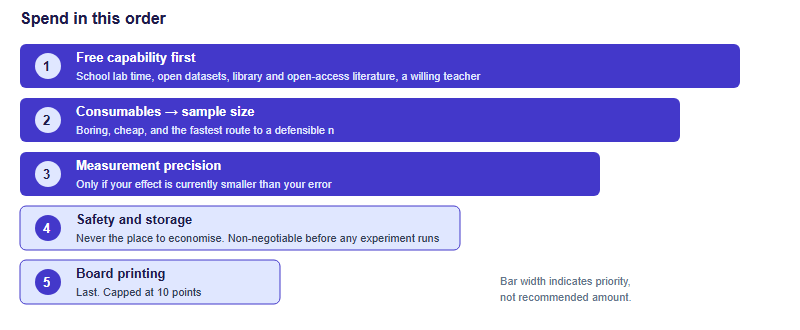
Step 4 sits deliberately above step 5 and outside the score logic entirely. Safety equipment, proper storage and correct disposal are not optimisations — they are preconditions, and projects have been disqualified over safety and documentation failures that cost far less to prevent than to explain.
What this means if your budget is genuinely small
The competition's structure is friendlier to a well-designed cheap project than most families assume, for three reasons rooted in how it is judged.
First, the category system means you compete inside one of 22 categories against projects of every budget, and the criteria are the same for all of them. Choosing a category where careful design beats instrumentation is a legitimate strategic decision, and one worth making early — our guide to choosing your ISEF category lays out the trade-offs. Behavioural and social sciences, mathematics, software design and computational work all reward thinking far more than hardware.
Second, the biggest scoring block is a conversation. A student who built a modest apparatus themselves, understands every failure mode in it, and can explain why the third design worked when the first two did not, is holding the strongest possible material for a 25-point interview. Fabrication constraints often produce better interview content than abundance does.
Third, methodology and creativity together are worth 35 points, and both are free. Adding a proper control costs nothing. Blinding your measurement costs nothing. Running one more replicate costs consumables. Reframing an ordinary question into a genuinely novel one costs reading time. That is over a third of the sheet available to anyone willing to think harder.
None of this is a claim that resources never matter — they do, and pretending otherwise would be dishonest. It is a claim about proportion. The scoring sheet was written to reward research thinking, and it does. A student who spends their limited money on sample size and their limited time on rehearsal is playing the rubric correctly. For the full picture of what ISEF asks of an international entrant, start with our overview of ISEF for international students.
Frequently asked questions
Is there a budget or equipment line on the ISEF scoring sheet?
No. The Grand Award criteria published for the 2026 cycle score research question, methodology, execution, creativity and presentation — nothing else.
Does a professionally printed board score higher?
Marginally at best. The poster is worth 10 of 100 points, while the interview beside it is worth 25. Rehearsal is the better investment.
Can I use equipment a technician operated for me?
Any assistance must be disclosed on the ISEF support forms, and judges will ask how the instrument works. Do not present results you cannot explain.
Which categories need the least equipment?
Mathematics, software design, computational work and behavioural or social sciences typically reward design and analysis over instrumentation.
This is an independent guide operated by Hanlin Education for China-based international-school students. It is not affiliated with, endorsed by, or sponsored by the Society for Science or Regeneron ISEF. Judging criteria, safety rules and material restrictions change each cycle and vary by jurisdiction — confirm current details on societyforscience.org and with your school's laboratory supervisor before purchasing or handling any material. Errors reported to our editorial desk are corrected within 7 working days.