ISEF finals are held in May — the same month AP exams are administered and the IB May examination session runs. So the last mile of an ISEF project lands on the single worst week of the international-school year, every year, for structural reasons that will not change. The collisions are predictable, which means they are plannable. Here is the map and the fix.
Why May is structurally the problem
Three fixed dates create the squeeze. ISEF finals sit in May. Underneath the finals sits your affiliated fair — for mainland-China students, the CASTIC route — which runs earlier and has its own submission deadlines. And underneath that sits a research window capped at 12 continuous months, which means you cannot solve a scheduling problem by simply extending the project sideways.
Stack those against an international-school calendar and the overlaps write themselves. AP examinations are administered in May. The IB May session runs through May, with internal assessment deadlines set by each school in the months before. A-Level summer series examinations run from roughly May into June. None of these are ISEF facts — confirm exact dates with the College Board, the IB and your examination board respectively — but the month is not in dispute, and it is the same month.
The result is a student who has spent ten months building something genuinely good, arriving at the presentation stage with no cognitive capacity left. The failure is almost never scientific. It is a scheduling failure that looks like a scientific one, because the interview is where it shows up, and the interview carries the largest single block of points on the Grand Award sheet.
If the selection sequence underneath all this is unfamiliar, our explainer on how ISEF works from affiliated fairs to the global finals sets out the pipeline that the calendar below assumes.
The collision map, month by month
This assumes a project targeting a May finals, begun in the preceding summer. Treat the school-side column as a pattern, not a schedule: your school sets its own internal assessment and mock dates, and those are the ones that will actually hurt you.
| Month | ISEF-side work | Typical international-school load | Collision risk |
|---|---|---|---|
| Jul–Aug | Question, literature, design, approvals paperwork | Near zero — holidays | None. The only free month you get. Waste it and every later month gets worse. |
| Sep–Oct | Approvals cleared; data collection begins | Term start, course selection, Grade 12 early applications | Medium — and severe in Grade 12 |
| Nov–Dec | Core data collection; first replicates | Mock examinations, term assessments, IB IA drafts | High. The month most projects silently stall |
| Jan–Feb | Data collection closes; analysis | Term-two start; IB IA final deadlines commonly land here | High |
| Mar | Analysis finished; abstract drafted; board built; affiliated-fair submission for many fairs — each fair sets its own dates, so confirm yours | Revision ramps up; more mocks | Very high |
| Apr | Fair results; interview rehearsal; board revision | Final revision fortnight before exams | Very high |
| May | ISEF finals week | AP exams; IB May session; A-Level series begins | Maximum. Direct clash |
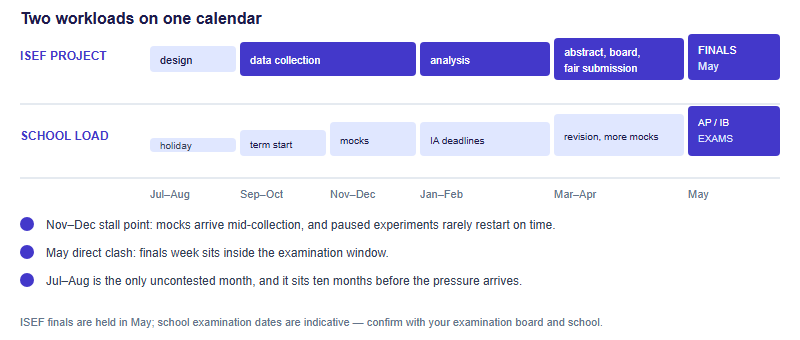
Two features of that chart matter more than the rest. The first is that the two workloads do not merely overlap — they peak together. The second is that the free month sits at the very start, ten months before you feel the pressure, which is exactly why students spend it badly.
Three tasks to front-load, and why these three
Not all project tasks compress equally. Some can be squeezed into a bad fortnight without much damage; others cannot be squeezed at all, because they depend on other people or on elapsed time you do not control. Front-load the incompressible ones.
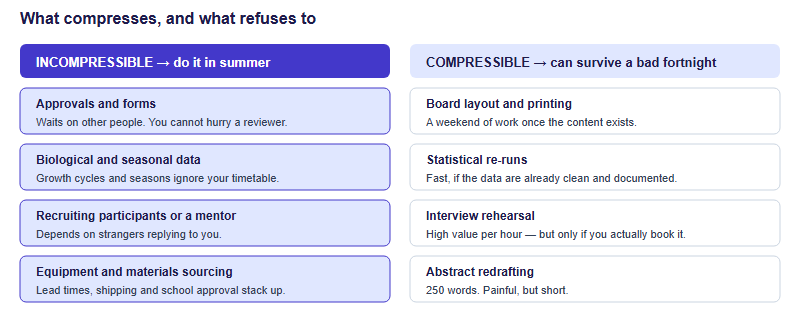
1. Approvals and paperwork. Where a project needs review before experimentation begins, that review is a queue you join, not a task you complete. In our own coaching experience students often lose several weeks here because they submitted in October rather than August, and because the first submission came back with questions. Getting the research plan and forms cleared over the summer is the cheapest month you will ever buy.
2. Anything with a biological or seasonal clock. If your organism takes six weeks to grow, six weeks is six weeks — and it does not care that you have mocks. Projects with growth cycles, seasonal field access or repeated longitudinal measurements must start their clock before the term does.
3. The first complete replicate. Not the whole dataset — one full pass, start to finish. A completed replicate tells you which steps break, how long each takes in reality rather than on paper, and whether your measurement is precise enough to detect anything. Discovering in February that your protocol has a fatal flaw is recoverable. Discovering it in April is not, given the 12-month research window is already running.
Which category you enter also affects this arithmetic more than students expect, because different project types carry different pre-experiment review burdens and very different equipment lead times. It is worth settling that early — our guide to choosing your ISEF category covers the trade-offs.
The Grade 12 version of the problem
For Grade 12 students the collision map gains a second overlay, and it is worse than the exam one, because it hits during data collection rather than at the end.
- September–November is early-application season for US universities and, for UK applicants, the mid-October UCAS deadline for Oxbridge, medicine, dentistry and veterinary courses (the main UCAS deadline falls in late January). This is exactly when the ISEF calendar wants you collecting core data.
- December–January brings regular-decision deadlines and supplementary essays, colliding with analysis.
- March–April brings decisions and offer responses, colliding with fair submission and board building.
- May brings AP and IB examinations that count towards conditional offers, colliding with finals.
The honest consequence: a Grade 12 project started in the autumn of Grade 12 is competing for hours it does not have, against a version of you who is also writing essays. If you are entering Grade 12 now and have not begun, the realistic options are a project designed to fit a genuinely smaller scope, or targeting the following cycle if your eligibility allows — ISEF is open through grade 12, subject to the age rule, so a gap-year or repeat-year student should check the current eligibility text rather than assume. Confirm on societyforscience.org.
Protecting the research window when your term goes wrong
The research window is capped at 12 continuous months, and this interacts with school disruption in a way students misunderstand. A bad term does not entitle you to extend the window; it simply consumes part of it. Three practical consequences:
- Start the clock deliberately, not accidentally. The window runs from when your experimentation begins, so exploratory tinkering in June that you later count as “the project” can cost you weeks at the far end. Decide when the clock starts and record it.
- A pause is not free, but it is survivable. If mocks eat November, the elapsed time still counts — so plan the pause into the design rather than pretending it will not happen. A protocol with natural stopping points survives a bad month; one requiring daily measurements for eleven weeks does not.
- Document the pause. Your notebook should show why there is a three-week gap in the data. An unexplained gap looks like missing data; an explained one looks like project management.
Multi-year work has its own rules, and judging focuses on the current year's contribution with the appropriate continuation documentation. If your project is a second year of something, verify the current continuation requirements before you assume last year's work counts as this year's.
An hours budget that survives a bad term
Most project plans fail because they assume a constant weekly effort that no student in an examination year actually sustains. Plan a variable budget instead, and be honest about the trough.
| Period | Realistic weekly hours | What that buys |
|---|---|---|
| Summer | 15–25 | Design, approvals, first replicate — roughly a third of the whole project |
| Term, normal weeks | 4–6 | Steady collection if the protocol is already stable |
| Mock and assessment weeks | 0–2 | Maintenance only: keep organisms alive, keep the notebook current |
| March–April | 6–10 | Writing and rehearsal, not new data |
| Examination fortnight | 0 | Nothing. Plan for zero and you will not be surprised by it |
Two rules make that budget hold. First, never schedule new data collection into a period you have marked as a trough — move it earlier or accept a smaller n. Second, keep the notebook current even in zero-hour weeks; five minutes of recording protects months of work, and a gap in the record is far more expensive later than the five minutes it would have cost.
None of this makes the May collision disappear. It makes it arrive at a student who has already finished the board, already rehearsed the interview, and has nothing left to do in April except revise for examinations. That is the whole objective. For the wider picture of what the competition asks of you, start with our overview of ISEF for international students.
Frequently asked questions
When exactly are ISEF finals held?
In May each year. ISEF 2026 ran 9–15 May in Phoenix; the 2027 host city has been briefed to us as Los Angeles, with dates to be confirmed on societyforscience.org.
Can I pause my project during mock exams?
Yes, but elapsed time still counts against the 12-month research window. Design natural stopping points in, and document the gap in your notebook.
Is it too late to start if I am entering Grade 12?
Not automatically, but scope down honestly. Grade 12 application season collides with data collection, so plan a smaller project rather than a rushed large one.
Do school exam dates ever move ISEF deadlines?
No. ISEF and your affiliated fair set their own dates independently of your school — confirm both on societyforscience.org and with your fair.
This is an independent guide operated by Hanlin Education for China-based international-school students. It is not affiliated with, endorsed by, or sponsored by the Society for Science or Regeneron ISEF. Examination dates referenced here belong to the College Board, the IB and individual examination boards and should be confirmed with them; ISEF rules and deadlines change each cycle — confirm current details on societyforscience.org. Errors reported to our editorial desk are corrected within 7 working days.