Most China-based students calibrate their ISEF project against the wrong benchmark: their school science fair. The right benchmark is public. The Society for Science runs a searchable Projects Database of finalist abstracts at abstracts.societyforscience.org, going back to 2014. Ninety minutes inside it will tell you more about the scope your project needs than a month of guessing — provided you read it as a judge, not as a shopper.
What the Projects Database actually is (and what it is not)
The database is a search interface over the abstracts of past ISEF finalists. According to the search page itself, you can filter by:
- “Keyword or Phrase” — free-text search across abstracts
- “Finalist Last Name”
- “Project Category” — a dropdown of the discipline list
- “Fair Country” and “Fair State” — the fair a finalist came through, covering a wide range of countries and US states
- Year selection, with events listed from 2014 through 2026 (including the virtual events of 2020–2021)
- “Abstracts to Display” — a toggle between all matching abstracts and winning entries only
Two limits matter before you start. First, it is a database of abstracts, not full papers, so you will see what a project claimed and roughly how, but not the raw methods detail. Second, the category names in the search dropdown span more entries than the current competition category list, because category structures have been revised over the years. Regeneron ISEF currently uses 22 categories — if you are using the database to pick where your own project belongs, map what you find back onto the current list, and read our guide on choosing your ISEF category by project strength rather than assuming a 2016 label still exists.
What the database is not: a menu. It is not there to give you a project idea, and a project that is a visible variant of a finalist abstract is the weakest possible entry — it invites the one question you cannot answer well (“what did you add?”).
The four calibration questions to ask of every abstract
Reading abstracts passively teaches you nothing. Every time you open one, answer these four questions in writing. Twenty abstracts at four questions each takes about ninety minutes and produces the single most useful document in your planning file.
| Question | What you are measuring | What a weak answer reveals about your own plan |
|---|---|---|
| 1. How big is the claim? | The distance between what was measured and what is asserted | If finalist claims are narrower than yours, your hypothesis is over-scoped |
| 2. How many decisions are visible? | Choices of control, sample, instrument, statistic named explicitly | If they name five design decisions and you have made two, your design is thin |
| 3. What is the comparison? | Against what baseline, control group or existing method the result is judged | If you cannot name your comparison in one sentence, you do not have one yet |
| 4. What is the evidence density? | Sentences carrying a number, a condition or a magnitude vs. sentences of framing | If your draft abstract is mostly motivation, your results are not ready |
The reason this works is that abstracts are compressed almost to the point of pain. At a cap of 250 words, every sentence a finalist spent on something is a sentence they judged more valuable than everything they cut. The allocation is therefore a signal about what the writer believed mattered — and after twenty abstracts in your category, the consensus becomes obvious.
A four-search protocol: ninety minutes that will change your scope
Run these four searches in this order. Each answers a different question, and the order matters because searches 3 and 4 only make sense once you know what “normal” looks like.
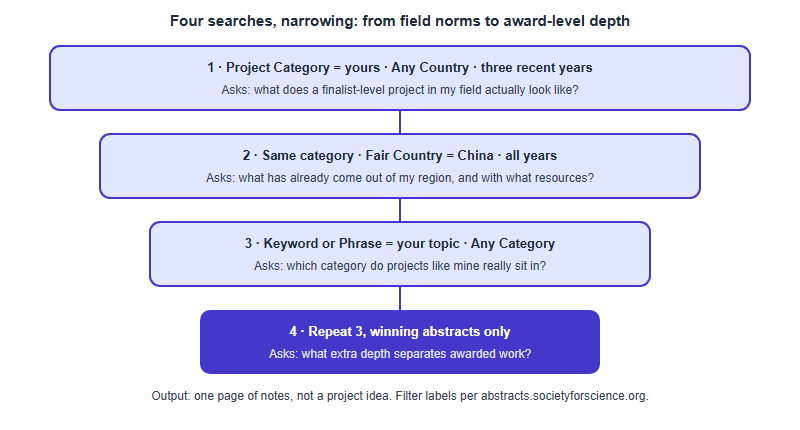
Search 2 deserves special attention if you are based in mainland China. Filtering by Fair Country tells you what has historically come through your region's route — useful context for a student who is about to attempt something similar. Note that the country filter refers to the fair a finalist came through, so it is a rough proxy for where the work was done, not a guarantee. For how the selection route itself operates, see our explainer on how ISEF works from affiliated fairs to the global finals.
Search 3 is the one students skip and regret. Searching your topic keyword across all categories reveals that projects a lot like yours have been entered under two or three different categories — which is exactly the judgement call you have to make yourself, and the reason category choice is a strategic decision rather than an administrative one.
Reading an abstract like a judge: the 250-word anatomy
The ISEF abstract is capped at 250 words. That constraint is the whole reason abstracts are such a good teaching instrument: nobody writes a padded 250-word abstract twice. Below is the allocation we coach toward — it is our editorial target, not a rule and not a measurement of past finalists. Use it to audit your own draft, and use the real abstracts you read to check whether the balance holds in your category.
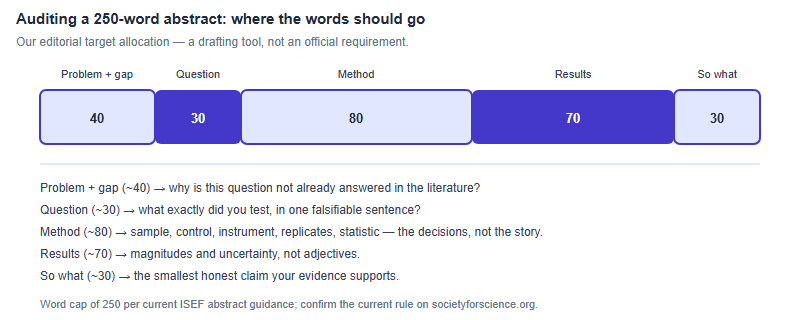
Now do the diagnostic. Take any finalist abstract in your category, and any draft of your own, and count the words in each of the five slots. The gap between the two profiles is your project's to-do list. In our experience with China-based cohorts, the most common distortion is a 90-word problem statement and a 30-word method — a project that has been read about far more than it has been run.
The line you must not cross: inspiration versus appropriation
This is where a legitimate research method turns into a disqualifiable one. The database exists so that students can see the standard. It does not license reuse. Four practical boundaries:
- Calibrating scope is fine. Copying a design is not. Learning that finalist projects in your category typically test three conditions with a defined control is calibration. Reproducing a specific finalist's conditions and control and calling it your own project is appropriation.
- Text is off-limits, full stop. Do not lift phrasing from any abstract, published paper or web page into your own abstract, research plan or board. Your abstract must be your own writing.
- If a past project genuinely inspired yours, cite it and say what you added. Building deliberately and openly on prior work is normal science. Building on it silently is the version that ends badly under judge questioning.
- The forms are where this gets formal. ISEF's international rules exist in part to “protect the rights and welfare of the student researcher” and to “determine eligibility for competition in the Regeneron ISEF.” The current rules package — including the interactive ISEF Rules Wizard that works out which documentation your project needs, the Display & Safety Rules, and the AI Use Table covering generative-AI use — is published on societyforscience.org. Read the Rules Wizard output before you finalise your design, not after.
A useful self-test: if a judge asked you to explain, in your own words, why you chose each parameter in your protocol, could you answer without referring to anyone else's project? If not, you have inherited a design rather than made one.
Turning ninety minutes of reading into three decisions
Reading is not the deliverable. By the end of the protocol you should have made three concrete decisions and written them down:
- Scope. One sentence stating the claim you will defend — narrower than the one you started with, in almost every case we see.
- Category. The current ISEF category (of the 22) you will enter, plus the runner-up you rejected and one line on why. If you cannot write the “why”, you have not decided yet.
- The comparison. The control, baseline or existing method against which your result will be judged. This is the decision that most distinguishes finalist-level abstracts from school-fair ones, and it is the one students defer longest.
Do this in August or September and the rest of the season is execution. Do it in January and you are re-scoping under deadline pressure. If you are still at the very beginning, our overview of what ISEF is and who can enter sets out the grades 9–12 eligibility window and the shape of the pathway before you start reading abstracts at all.
FAQ
Is the ISEF Projects Database free to search?
It is publicly searchable at abstracts.societyforscience.org, with filters for keyword, category, fair country and year, and events listed from 2014 onward.
Can I do my project on the same topic as a past finalist?
Topics are not owned. Designs and text are. Choose the topic freely, then build your own question, comparison and protocol.
How many abstracts should I read before finalising my scope?
About twenty, answering the four calibration questions in writing each time. Passive reading of a hundred teaches less than active reading of twenty.
Do the database category names match the current 22 categories?
Not exactly — the dropdown spans older structures. Map anything you find onto the current category list on societyforscience.org.
This is an independent guide operated by Hanlin Education for China-based international-school students. We are not affiliated with, endorsed by, or sponsored by the Society for Science or Regeneron ISEF. Database filters, category structures, abstract limits and rules change from season to season — confirm all current details on societyforscience.org. Factual corrections are made within 7 working days of notification.