Most ISEF projects that fail do not fail in the lab. They fail in the three weeks after something goes wrong, while the student quietly hopes it will fix itself. A broken protocol, a collapsed sample and a genuine null result are three different problems with three different fixes — and only one kind of failure is actually unrecoverable. This is the triage sequence to run instead of panicking.
Six ways an ISEF project fails — and only one is fatal
Students describe all of these with the same sentence: “my project isn’t working.” They are not the same problem, and treating them the same way is why good projects get abandoned in November. Before you decide anything, name which one you actually have.
| Failure mode | What it looks like | When it usually surfaces | Recoverable? |
|---|---|---|---|
| Execution failure | Replicates disagree wildly; baselines drift; you cannot reproduce your own week-one result | Weeks 3–8 of data collection | Yes — usually the easiest fix |
| Method mismatch | Clean, consistent data that simply does not speak to your hypothesis | First serious analysis pass | Yes, at the cost of scope |
| Access loss | Mentor leaves, lab closes, field site becomes unavailable, school schedule changes | Any time; often after a holiday | Depends entirely on months remaining |
| Sample collapse | You planned n=60 and got n=11; survey response rate falls off a cliff | Analysis, sometimes earlier | Yes, if you re-frame honestly |
| Null result | Tight methods, adequate power, no effect found | Analysis | Not a failure at all |
| Integrity failure | Data adjusted after the fact; work that is not yours; procedures run without required approvals | Any time | No. This is the fatal one. |
The asymmetry matters. Five of these six are ordinary research friction that experienced judges have seen hundreds of times. The sixth ends the project — and can end more than the project, because approval, documentation and independence-of-work requirements are enforced through the official forms and review process. If you have any doubt about whether something crossed that line, raise it with your mentor and your fair before you go any further, and check the current requirements on societyforscience.org.
The four-gate triage: diagnose before you pivot
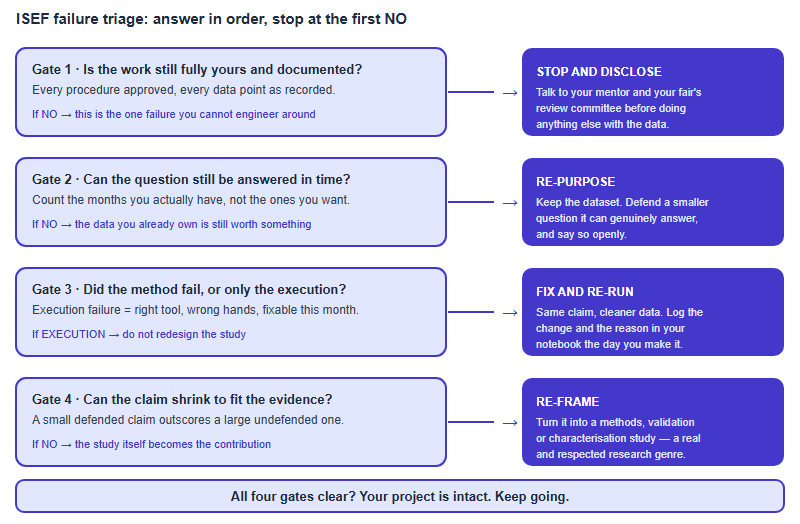
The single most expensive mistake is pivoting early. A student hits a bad month in October, declares the project dead, starts something new in December, and now has a rushed four-month project instead of a repaired ten-month one. Run these four gates in order and stop at the first “no” — the gate you fail tells you which salvage move you are allowed.
A null result is not a failed project. “We ran out of time” is.
This is the single most damaging misconception we see in China-based cohorts, and it comes from the school science-fair habit of choosing questions whose answer you already know. ISEF is not a school science fair. If your hypothesis was genuinely uncertain when you wrote your research plan, then “no effect” is a legitimate answer to a legitimate question — and defending it well demonstrates exactly the reasoning judges are trying to assess.
The distinction judges care about is not positive versus negative. It is defensible versus uninformative. A defensible null result can answer three questions: was the study capable of detecting the effect you were looking for, what magnitude of effect can you now rule out, and what would have had to be different for the result to change. An uninformative null result cannot answer any of them — because the sample was too small, the measurement too noisy, or the comparison never properly controlled. That is not a null result; it is an underpowered study, and it needs the re-framing move from Gate 4 rather than a triumphant “we proved there is no relationship.”
Write the honest version into your abstract and your board. Judges have read thousands of confident conclusions unsupported by the data on the same poster. A student who says “this design could not have detected an effect smaller than X, so my conclusion is limited to effects above that threshold” is doing something rare and visible. If you are still deciding what kind of contribution your project makes, our guide to choosing an ISEF category by your project's real strength is worth re-reading at this point, because a re-framed project sometimes belongs in a different category than the one you started in.
Three legitimate rescue moves — and the one that ends your project
1. Narrow. Keep the method, shrink the claim. You planned to show that your treatment improves outcomes across three conditions; the data support one condition with a clean effect and two with noise. Report one. A narrower claim, fully evidenced, with the failed conditions honestly reported as limitations, is a stronger project than a broad claim that dissolves under a judge's second question.
2. Re-frame. When the method cannot support the biological, chemical or engineering claim you wanted, make the method itself the object of study. Characterisation studies, validation studies, sensitivity analyses and negative-control investigations are ordinary research genres. “I set out to measure X with a low-cost sensor and discovered the sensor drifts systematically with humidity; here is the drift curve and the correction I derived” is a complete project.
3. Re-purpose. When access is gone and no new data are coming, the data you already hold usually answer a smaller question than the one you asked. Go back to your dataset and find the question it can answer, then say plainly in your write-up that this was not the original question and why the original became impossible. Judges do not punish a change of direction that is documented; they punish one that is concealed.
The move that ends your project: changing the hypothesis after seeing the results and presenting it as the original, or dropping data points that spoil the pattern. Both are integrity failures, not analysis choices — and both are exactly what a well-kept notebook makes impossible to do by accident. If your notebook does not currently show the date every decision was made, fix that this week, before you have a reason to want it blurry.
Calendar gates: when the deadline decides for you
Salvage options are a function of remaining time, and time is set by your fair, not by your ambition. For mainland-China students the binding date is the deadline of the affiliated selection route — described in our guide to how ISEF works from affiliated fairs to the global finals — not the ISEF finals in May. The pattern below is the shape of a normal season, but the specific dates that govern you are your own fair's; confirm them on societyforscience.org and with your fair organiser.
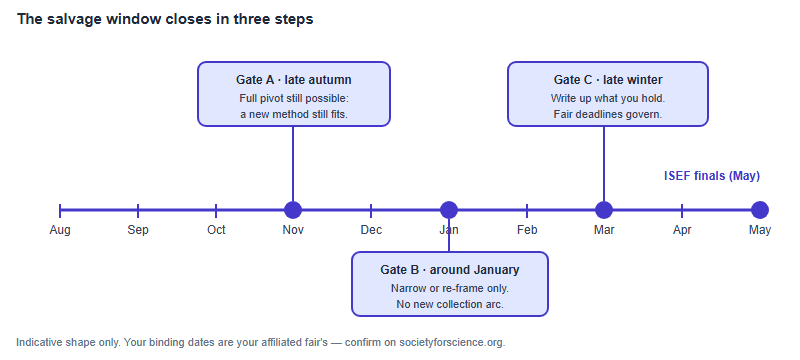
The practical rule: make the pivot decision early and deliberately, or accept that you will make it late and badly. Put a calendar reminder at Gate A and Gate B now, in August, while nothing has gone wrong. When those dates arrive, spend one hour re-running the four gates honestly. Students who schedule these reviews in advance almost never end up in the February scramble.
How to talk about it: the board, the abstract and the interview
Once you have salvaged, you have to present. Three rules that consistently separate the students who recover well:
- Put the limitation in your own words before the judge does. Naming your study's weakness first converts it from a discovered flaw into evidence of scientific judgement. Judges probe hardest exactly where a student is visibly avoiding a topic.
- Show the decision trail. “In week 9 the sensor drift exceeded my tolerance, so on 14 November I switched to the corrected calibration; here is the notebook page” is a complete, verifiable answer. Reconstructed-from-memory explanations are not.
- Do not oversell the salvage. A re-purposed project is a re-purposed project. Say what you set out to do, what became impossible, what you did instead, and what you can now defend. Your abstract is capped at 250 words, so this has to be compressed into perhaps two sentences — write those two sentences before you write anything else.
If you are new to the competition and reading this as a warning rather than a rescue, start with our overview of what ISEF is and how the pathway works — much of the failure described here is avoidable by choosing a question whose failure mode you can survive.
FAQ
Can I switch to a completely new ISEF project in December?
Technically yes, but a new design needs its own forms — and, where prior approval applies, that approval before you start experimenting; check the current requirements on societyforscience.org. You would also be competing with a four-month project against ten-month ones, so repair before you replace.
Will judges mark me down for a null result?
Not for the null itself. They assess whether your design could have detected an effect and whether you interpret the absence honestly.
My mentor left and I lost lab access. Is the project over?
Not necessarily. Re-purpose the data you already hold to a smaller question you can fully defend, and document why the original became impossible.
Do I have to disclose that I changed direction mid-project?
Yes. Undisclosed changes read as concealment; documented ones read as judgement. Record each decision in your notebook on the day.
This is an independent guide operated by Hanlin Education for China-based international-school students. We are not affiliated with, endorsed by, or sponsored by the Society for Science or Regeneron ISEF. Rules, deadlines, forms and category definitions change from season to season — confirm all current details on societyforscience.org and with your affiliated fair before acting on anything here. Factual corrections are made within 7 working days of notification.