ISEF does not judge your whole research career — it judges one project, built inside a defined window. The rules allow each student one project, containing no more than 12 months of continuous research, with a cut-off date before which work does not count. If you are starting this summer, that window is the single most important constraint on how you scope your idea.
The three sentences that define “this year’s project”
Three rules on the Society for Science rules pages do almost all the work of deciding what you can enter:
- One project per student. You cannot hedge by entering two ideas and seeing which advances.
- No more than 12 months of continuous research. The research that makes up your entry has to fit inside a twelve-month span.
- A cut-off date. The published rules for the current cycle state that a project may not include research performed before January 2026 — and the official ISEF FAQ adds that only a 12-month project falling within the last 18 months before that ISEF is allowed. The cut-off moves every year, so confirm the date for your own ISEF year on societyforscience.org.
Layer on the basic eligibility rule — students must be in grades 9–12 or equivalent and must not have reached age 20 on or before 1 May preceding ISEF — and you have the complete frame. Everything else is your choice; these are not.
Read together, the 12-month and 18-month numbers describe two different things. Twelve months is how much research your entry may contain. Eighteen months is how far back that block of research may sit relative to the finals. The practical effect is that a project finished long before the season cannot be revived unchanged, and a project stretched across three summers cannot be entered as one giant study. If ISEF is new to you, our overview of what ISEF is and how it is structured gives the wider context.
What the window looks like from a late-July start
Take a student beginning now, in late July 2026, aiming at the finals in May 2027 (Society for Science holds ISEF each May; the 2026 edition ran in Phoenix from 9–15 May 2026 and the 2027 finals are scheduled for Los Angeles in May 2027 — confirm dates on the official site). That student has roughly ten months of calendar between the first approved experiment and finals week, and every one of those months sits comfortably inside the allowed window.
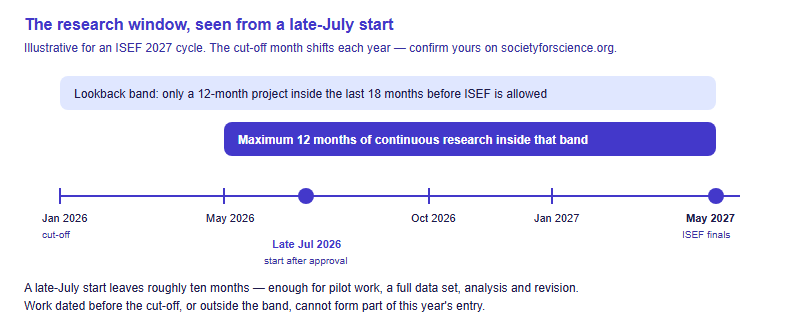
There is a second layer that only shows up if you map the window onto a real school year. Ten calendar months are not ten working months for a student in an international school in China. Realistically, you lose most of the weeks around end-of-semester assessments, the Chinese New Year break interrupts anything that needs daily attention, and for Year 12 students the spring is already congested with AP or IB internal deadlines. A workable planning assumption is that roughly six to seven of those ten months are genuinely productive, front-loaded into the summer and autumn.
That reframes what “starting in July” buys you. It is not extra months at the end — those are consumed by analysis, the abstract, board production and fair logistics. It is the ability to fail once. A pilot run in August that shows your assay is too noisy, your sensor drifts, or your survey question is ambiguous still leaves time to redesign and run the real study in the autumn. A student who starts in October gets one attempt, and one attempt is what turns a promising question into a thin data set.
The arithmetic has a strategic consequence students rarely notice. Because the window is generous rather than tight for a July start, the binding constraint on your project is almost never the ISEF calendar — it is your own access to equipment, participants, growing seasons or supervisors. Design backwards from those. A plant-growth study with three generations, an animal-behaviour observation schedule, or a survey requiring recruitment all consume calendar in chunks you cannot compress by working harder in April.
Continuation projects: expansion versus repetition
Any project built on your own earlier research may be treated as a continuation, sometimes called a research progression. Continuations are entirely legitimate — multi-year research lines are how real science works, and how many of the most sophisticated ISEF projects come to exist. But the rules draw a hard line: the new work must be a substantive expansion on the prior work, for example testing a new variable or opening a new line of investigation.
The counter-example is stated just as plainly. Repeating your previous experiment with the same methodology and the same research question — even with a bigger sample size — is given as an example of an unacceptable continuation. “I ran it again with 200 subjects instead of 60” is not a new project. Neither is switching the poster design.
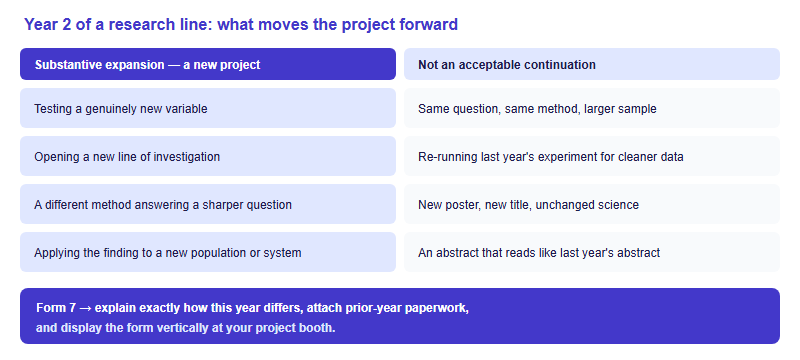
Worked examples make the distinction concrete. The table below shows how the same first-year study can branch into a defensible second-year project or a dead end.
| Year 1 project | Year 2 that counts as expansion | Year 2 that does not |
|---|---|---|
| Effect of three LED wavelengths on lettuce biomass | Whether the best wavelength changes under water stress — a new interacting variable | The same three wavelengths, more replicates, tighter error bars |
| Survey of sleep duration and test anxiety in one school | Testing an intervention (a fixed screen curfew) rather than describing a correlation | The same survey instrument, distributed to two more schools |
| Low-cost sensor prototype for indoor particulates | New calibration algorithm benchmarked against a reference instrument | The same prototype rebuilt with a neater enclosure |
| Antibacterial activity of four plant extracts on one species | Isolating which fraction of the active extract drives the effect | The same four extracts tested on a fifth bacterial strain with no new question |
Form 7, prior-year paperwork and the abstract rule
Continuations carry three extra documentation duties, and reviewers report failures on all of them:
- Form 7, the Continuation Projects Form. It is completed after experimentation and asks you to explain, as completely as possible, how this year’s project differs from the previous work. The form is displayed vertically at the project booth, so judges see your own account of the progression.
- Prior-year documentation. Society for Science lists “prior year paperwork for continuations” among the most common paperwork problems — projects must supply the earlier research documentation even when this year’s progress is obvious to the student.
- A current-year abstract. The abstract is written after experimentation, in your own words, within a 250-word maximum, and reflects the current year’s work only. Reviewers explicitly flag continuations whose abstracts read too much like the previous year’s.
There is an unglamorous discipline behind all three: keep last year’s materials. Students who deleted a data book, lost the signed forms or overwrote the old poster file discover in February that the missing item is a rules problem, not a nostalgia problem.
Designing a research line that stays legal every year
If you intend to work in the same area across two or three years — which is often the right ambition for a student who has found a real question — plan the branch points before you start, not after results arrive. Every year in that line has to satisfy the same eligibility and qualification rules, which our page on how the ISEF competition works sets out in full.
- Write down the question tree, not the question. Sketch the parent question and three child questions it could open. Year 1 answers one child; Year 2 takes a different branch. This is the cleanest way to guarantee a new variable or new line of investigation exists.
- Keep each year’s scope small enough to finish. A tightly finished study leaves an obvious next question. A sprawling unfinished one leaves only the temptation to re-run it.
- Change the question before you change the sample size. If your instinct for next year is “more data,” treat that as a warning sign, not a plan.
- Archive everything at the end of each cycle. Signed forms, data book, raw data, abstract, poster. Store one folder per year.
- Re-check your category each year. A branch that moves from biology into engineering may belong in a different category — see our guide on choosing the right ISEF category, since the category shapes how judges frame the work.
Finally, remember that the window rules operate at every level of the pipeline, not just the finals. Your affiliated fair applies the same International Rules, so the eligibility question is settled long before anyone travels — our explainer on how projects move from an affiliated fair to ISEF sets out that chain. Getting the scope right in July is what keeps the option open in May.
Frequently asked questions
Can I enter two projects at ISEF?
No. The rules allow each student one project. Team projects have no more than three members, and each member is still bound by the one-project rule.
How long is my research allowed to run?
No more than 12 months of continuous research, and it must fall inside the allowed lookback period before that year’s ISEF. Confirm the exact cut-off on societyforscience.org.
Can I continue last year’s project?
Yes, if the new work is a substantive expansion — a new variable or new line of investigation. Repeating the same question and method with a larger sample does not qualify.
What do continuation projects have to display?
Form 7 must be completed and displayed vertically at the project booth, and prior-year documentation must be supplied with your paperwork.
This is an independent guide operated by Hanlin Education for China-based international-school students. We are not affiliated with, endorsed by, or sponsored by the Society for Science or Regeneron ISEF. Rules, cut-off dates and forms change each cycle — confirm current details on societyforscience.org. Any factual error reported to our editorial desk is corrected within 7 working days.