Choosing your ISEF category feels like an administrative box to tick. It is not. Your category decides who judges your project (subject-expert judges) and which projects you are compared against. With 22 categories for 2026, the right choice is the one that matches your project’s core contribution — its method and finding — not the topic that sounds most impressive. Here is how to choose by strength.
Why the category choice is strategic, not clerical
Every ISEF project is entered in exactly one of the 22 categories, and that single decision shapes your whole judging experience. Two consequences follow. First, your judges are recruited as experts in that category — they will expect the depth, vocabulary and standards of that field. Second, your competitive set is everyone else in the same category; Grand Awards are given within each category. So the question is not “which category sounds the most advanced?” but “where will expert judges best recognise what my project actually contributes?”
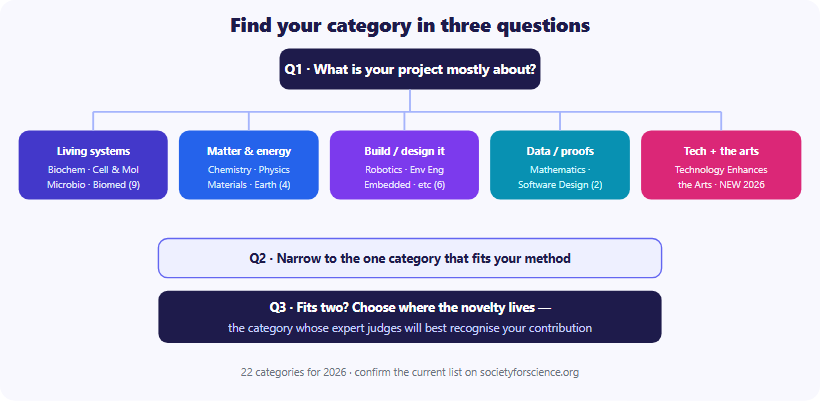
The 22 categories, in five broad families
It helps to see the field as five families (an editorial grouping — the official list is flat). For what each individual category covers, see our companion reference, the full ISEF guide; here is the map you choose from:
| Life Sciences (9) | Animal Sciences · Behavioral & Social Sciences · Biochemistry · Biomedical & Health Sciences · Cellular & Molecular Biology · Computational Biology & Bioinformatics · Microbiology · Plant Sciences · Translational Medical Science |
| Physical Sciences (4) | Chemistry · Earth & Environmental Sciences · Materials Science · Physics & Astronomy |
| Engineering (6) | Biomedical Engineering · Embedded Systems · Energy: Sustainable Materials & Design · Engineering Technology: Statics & Dynamics · Environmental Engineering · Robotics & Intelligent Machines |
| Maths & Computer Science (2) | Mathematics · Software Design |
| New for 2026 (1) | Technology Enhances the Arts |
The rule that breaks ties: choose by contribution, not topic
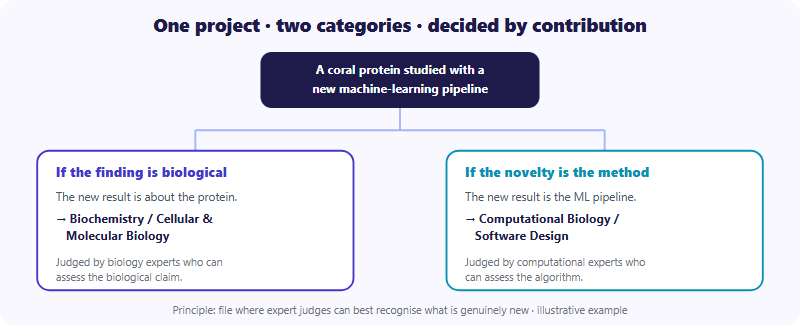
Most serious projects could plausibly sit in two categories. The reliable rule is to file by where your project’s novelty lives — the part a judge should be expert enough to evaluate. The topic is not the decider; the contribution is.
Three category-choice mistakes to avoid
- Chasing the “impressive” category. Filing a modest chemistry project under a glamorous-sounding category just invites expert judges who expect far more depth there. Fit beats prestige.
- Choosing by topic instead of method. “It’s about the ocean” does not make it Earth & Environmental Sciences if your actual contribution is an engineered sensor (Environmental Engineering) or an algorithm (Software Design).
- Ignoring the competitive set. You are ranked within your category, so a genuinely well-fitting category where your contribution stands out serves you better than a crowded one where it blends in. Choose for fit first — never misfile to game the field.
A four-step category checklist
Run your project through these before you register with your affiliated fair:
- 1 · Name your contribution in one sentence. What is genuinely new — a finding, a device, a method, a proof?
- 2 · Match that contribution to a family (living systems, matter & energy, engineering, maths/CS, tech-and-arts).
- 3 · Narrow to the single category whose expert judges are best placed to evaluate that contribution.
- 4 · Sanity-check the competitive set and confirm the category is on the current official list — categories can be renamed or added (2026 added Technology Enhances the Arts).
Once your category is settled, the rest of the build follows: see how the affiliated-fair path works and what ISEF judges look for so your project speaks to the judges you have chosen.
Frequently asked questions
Does my category choice affect my chances?
Yes. Grand Awards are decided within each category, so your category sets both your expert judges and the projects you are ranked against. The aim is the best-fitting category, where judges can recognise your contribution — not the most impressive-sounding one.
What if my project fits two categories?
Choose the category that matches where the novelty lives. If your contribution is a biological finding, file in the relevant life-science category; if it is a new algorithm or method, file in a computational one. The contribution decides, not the topic.
How many categories are there, and can the list change?
There are 22 for 2026, grouped here into five broad families, and the list does change — 2026 added Technology Enhances the Arts. Always confirm the current categories on the official site before registering.
When do I lock in my category?
Typically when you register for your ISEF-affiliated fair, so decide early — it shapes how you frame your abstract and your board. Confirm the exact process with your affiliated fair.
This is an independent guide to the Regeneron International Science and Engineering Fair, operated by Hanlin Education for China-based international-school students. We are not affiliated with, endorsed by, or sponsored by the Society for Science or Regeneron ISEF. Categories, eligibility, dates and rules change by year — always confirm the current details on the official Society for Science / ISEF site. Confirmed errors are corrected within 7 working days.