Almost everyone who does a serious ISEF-track project does not reach the international finals. That is arithmetic, not judgement: more than 1,700 finalists are drawn from 365 affiliated fairs worldwide. If your fair did not nominate you last spring, you are holding a real research asset and an application-season decision. This is how to handle both without overstating either.
The arithmetic nobody puts on a poster
Checked on societyforscience.org in September 2026, the published shape of the route is this: more than 1,700 young scientists compete at the finals, selected from 365 affiliated fairs in more than 60 countries, regions and territories, competing for more than $7 million in awards and prizes. What is not published anywhere is the denominator — the number of students who entered a school, city or provincial fair in the first place. It is very much larger.
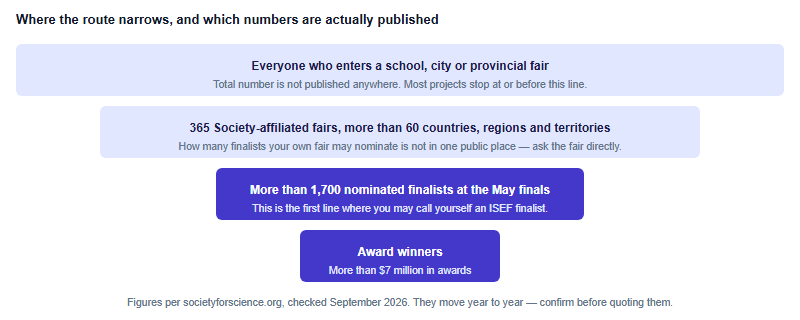
Two things follow from that shape. First, not advancing is the ordinary outcome of entering a competitive selection, not evidence that the science was poor; fairs nominate against a limited allocation and a particular judging panel on a particular day. Second, and less comfortably, the fact that the outcome is ordinary does not make it valuable on its own. What makes it valuable is the artefact you built on the way, and whether you can still explain it in November.
What you are actually holding
Students who did not advance tend to describe themselves as having nothing. Inventory it properly and the position looks different. Each of the following has a use after the season ends, and each decays at a different rate.
| Asset | What it is good for now | How fast it decays |
|---|---|---|
| The data set and lab notebook | A continuation project, a write-up, or an entry to a different competition | Slowly, if the records are dated and complete; instantly, if they are not |
| The research plan | Evidence you can design a study, and the skeleton of any future proposal | Does not decay — it is reusable across topics |
| The 250-word abstract | The single most reusable paragraph you own; it is already the summary an application asks for | Does not decay |
| Interview and poster experience | Speaking about technical work under questioning, in a second language | Fades within months without practice |
| The mentor or sponsor relationship | A recommender who has watched you work, not just study | Fades fast if you go quiet after the result |
| Knowing why it did not advance | The most useful thing on this list, if you actually asked | Gone within weeks — judges’ impressions do not keep |
The last row is the one students skip. If your fair offers any feedback route, use it now rather than next spring. A one-line answer — the control was weak, the sample was too narrow, the claim outran the data — is worth more to the next project than a season of guessing.
The naming problem, and why it matters more than the result
Autumn is application season, and this is where a spring result gets described in writing for the first time. It is also where a manageable outcome turns into a serious problem, because competition names are precisely the sort of claim a reader can check.
The word to be careful with is finalist. At ISEF it has a specific meaning: a student nominated by an affiliated fair to compete at the international fair. It is not a synonym for “did well at a fair”, and it is not a description of reaching the last round of your own regional competition. Write only what happened, at the size it happened.
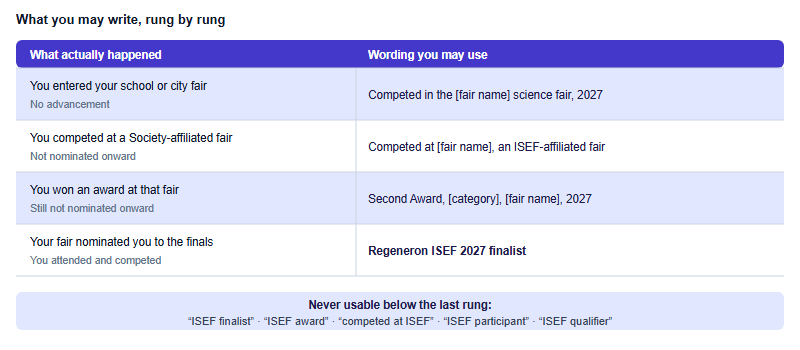
This is not only an integrity point, it is a strategic one. An overstated line is the single most checkable thing in a file, and once a reader finds one they read the rest differently. A precisely named regional award, described accurately, is a stronger document than a vague grand claim, because the precision itself signals someone who understands the field they are claiming to belong to.
How a fair-level result works inside an application
The useful way to think about any competition result is cross-validation. An admissions reader is not scoring the award in isolation; they are checking it against the transcript, the activity list and the essays, and asking whether those documents describe the same person. A regional science-fair award corroborates a stated interest in biology in a way that a self-declared passion cannot, because a third party sat in front of the project and made a judgement about it. Several results across a profile corroborate each other in the same way, which is what makes the whole file believable rather than asserted.
That mechanism does not require the result to be large. It requires it to be consistent and specific. In our own coaching records the files that read best are the ones where the activity entry, the essay and the recommender all describe the same project at the same size — the same research question, the same method, the same honest limitation. Results vary, and this is our own observation rather than a verified statistic, but it is a far more controllable variable than which fair nominated whom. No competition result guarantees any admissions outcome.
Practically, that means the essay opportunity here is not “I won”. It is the moment your data refused to behave, what you did about it, and what you now believe about the question. A student who can write that paragraph has demonstrated more than a nomination would have.
Four routes forward, and how to pick one this month
Route 1: continue the same project next season. The rules permit continuation, with one constraint that governs your planning. Per the International Rules, “students will be judged only on laboratory experiment/data collection performed over 12 continuous months beginning no earlier than January 2026 and ending May 2027” — so the judged data must sit inside the current window, and continuation means building forward, not resubmitting. Choose this if you can name the specific weakness that stopped you and the specific experiment that fixes it. Dates and window definitions change between editions, so read the current version.
Route 2: write it up properly and stop competing with it. A finished write-up is a durable artefact in a way a poster is not. School research journals, student conferences and preprint-style repositories all exist; standards and appropriateness vary enormously, so check what any given venue actually is before submitting. A project that becomes a readable ten-page document has outlived its competition.
Route 3: take the same work to a different competition. Different competitions have different eligibility rules, different windows and different formats, and a project built for one does not automatically transfer. Check each one’s own rules directly rather than assuming ISEF rules apply; nothing about ISEF eligibility carries across.
Route 4: stop cleanly, and say why. This is a legitimate choice, not a failure, particularly for a Grade 12 student heading into applications or a student whose question turned out to be unanswerable with available tools. Write the abstract, archive the data, thank the sponsor, and move on. A student who can articulate why they closed a line of work is showing judgement, which is a research skill.
If you are choosing between routes one and three, the deciding question is usually infrastructure rather than ambition: whether you still have access to the instrument, the site or the participants. For how the route itself is structured, our explanation of how ISEF works from affiliated fairs to the finals is the place to start, and what ISEF is covers the wider structure if you are advising a younger sibling entering the cycle now.
Questions students ask
Can I call myself an ISEF finalist if my fair did not select me?
No. Finalist applies only to students nominated to the international finals. Name the fair and award you actually won.
Can I continue the same project next season?
Yes, as a continuation project, but only data collected inside the current twelve-month window are judged.
Does a regional fair award still help an application?
It can corroborate a stated interest when the transcript, activity list and essays describe the same work. No result guarantees anything.
Should I hide that I did not advance?
No. Describe the work at its real size. Overstating a result is the one failure a reader can verify and will remember.
This is an independent guide operated by Hanlin Education for China-based international-school students. We are not affiliated with, endorsed by, or sponsored by the Society for Science or Regeneron ISEF. Finalist numbers, fair counts, award totals and research-window dates change between editions, so confirm current details on societyforscience.org before acting on anything here. Factual errors are corrected within 7 working days of being reported.