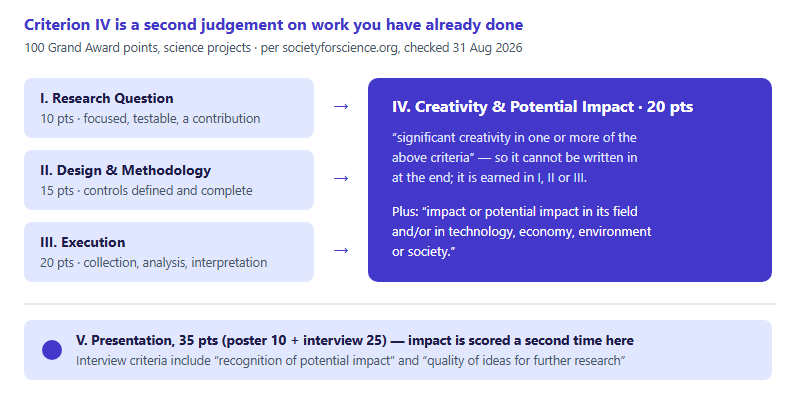
Creativity and Potential Impact carries 20 of the 100 Grand Award points, and it is the criterion students prepare for last, or not at all. The published wording scores a project that “demonstrates significant creativity in one or more of the above criteria” — meaning creativity is judged inside your research question, your design and your execution, never as a paragraph bolted on in April. Here is how those 20 points are really earned.
What the criterion actually says
The Grand Award judging criteria are published by Society for Science. Checked on societyforscience.org on 31 August 2026, the science-project version allocates 100 points across five headings, and the fourth reads: Creativity & Potential Impact (20 pts) — “project demonstrates significant creativity in one or more of the above criteria” and “project has impact or potential impact in its field and/or in technology, economy, environment or society.” The same page defines the quality directly: “A creative project demonstrates imagination and inventiveness. Such projects often offer different perspectives that open up new possibilities or new alternatives.”
Criteria are revised between editions, so read the current version yourself before you plan against any summary, including this one. But the structural point below has held long enough to build a season on, and if the wider system is new to you, start with what ISEF is before reading further.
| Criterion (science projects) | Points | What it is judging |
|---|---|---|
| I. Research Question | 10 | Clear, focused purpose; identifies a contribution to the field; testable |
| II. Design and Methodology | 15 | A well-designed plan; variables and controls defined, appropriate and complete |
| III. Execution: data collection, analysis, interpretation | 20 | Systematic collection, reproducibility, appropriate statistics, sufficient data |
| IV. Creativity & Potential Impact | 20 | Significant creativity in one or more of the criteria above; impact or potential impact |
| V. Presentation | 35 | Poster 10; interview 25 |
Read criterion IV twice. The phrase that governs your whole season is “in one or more of the above criteria.” The criteria above it are the question, the method and the execution. So the 20 points are not a fifth deliverable. They are a second judgement passed over three things you have already done — which is why a student who writes a beautiful “innovation” paragraph the week before the fair cannot move this score, and a student who made one unusual method decision in October can.
The three places creativity is actually earned
Because criterion IV points back at criteria I, II and III, there are exactly three doors into it. Each has an ordinary version that scores nothing extra and an inventive version a judge can name in one sentence. The difference is rarely money and almost never the topic.
| Door | The version that reads as ordinary | The version that reads as creative | The test to apply |
|---|---|---|---|
| Research question (10 pts) | A question lifted intact from a review paper's “future work” section, or a textbook demonstration repeated with a new sample | A question that reframes the problem — the field measures A, but the real constraint is B, and here is a way to test B | Could a competent student have found this question by reading one review? If yes, what did you add? |
| Design and methodology (15 pts) | A published protocol or kit procedure followed as written, with only the control the protocol already specifies | A decision the standard protocol would not have made: an extra control that isolates a confound, a rig built because the standard instrument was unavailable, a randomisation that removes an order effect | Name, in one sentence, the single decision you made that a standard protocol would not have made |
| Execution (20 pts) | Running the procedure and reporting the output | An analysis choice that extracts more signal from limited data, a validation loop that checks your own instrument, a documented calibration for a substitute you improvised | What did you build, adapt or calibrate yourself — and where is it written down? |
In our editorial experience reading student drafts from China-based international schools, the creative move that scores most reliably is constraint-driven method invention. A student cannot access a standard instrument, builds a substitute from available parts, and then — this is the part that converts it into points — validates that substitute against something known and documents the calibration. That is imagination and inventiveness in the sense the criterion means. Buying the instrument would have produced cleaner data and no creativity score at all.
Potential impact is a scope claim, not a grand claim
Notice the order in the official wording: impact “in its field” comes first, then technology, economy, environment or society. Impact inside a narrow field counts. Students routinely throw that away by reaching for the widest possible claim, which the judge then has to discount.
Three failure modes account for almost every impact sentence we read:
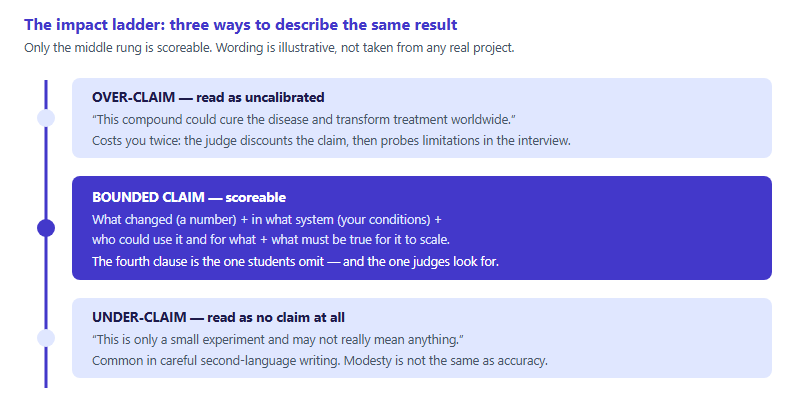
- Grandiosity. “This could help cure Alzheimer's disease.” A first-year graduate student would not write that about the same result. It signals that the author has not calibrated their own evidence, which then damages the interview score for “understanding interpretation and limitations of results and conclusions.”
- Vagueness. “This research is useful for society and the environment.” Nothing here can be scored, because nothing here can be checked.
- Under-claiming. Common among careful second-language writers, who hedge every sentence until no claim survives: “this is only a small experiment and may not mean anything.” Modesty is not the same as accuracy. If your result holds under your conditions, say so plainly.
A defensible impact statement has four parts and fits in two sentences: what changed (a number), in what system (your stated conditions), who could use it and for what, and what would have to be true for it to hold at a larger scale. The fourth part is the one students omit, and it is the one that turns a claim from advertising into science.
Impact is scored twice, and the second time is out loud
The 25-point interview criteria published alongside the rubric include “recognition of potential impact in science, society and/or economics” and “quality of ideas for further research,” as well as “understanding interpretation and limitations of results and conclusions.” The same material is therefore examined twice: once as written work under criterion IV, and again in conversation inside the largest single block of points on the sheet.
That gives you two answers to rehearse, each about forty seconds, both in English:
- “Why does this matter?” Deliver the four-part bounded claim above, then stop. Do not escalate when the judge stays silent — silence is often a test, and students fill it by inflating the claim they just made.
- “What would you do next?” This is the cheapest creativity point available and most students waste it on “collect more data.” Name the specific experiment that would break your own conclusion, and say why it is the right next one. A student who can identify the experiment that would falsify their own result is doing exactly what the criterion calls inventiveness.
Remember that your first panel is not the final's panel. Selection fairs judge months earlier and may apply their own criteria — see how ISEF works from affiliated fairs to the global finals — so both answers have to exist by that earlier date, not by May.
Four places these 20 points are not
- Not in equipment. Nothing in the criterion mentions apparatus. A borrowed confocal microscope improves data quality, which is criterion III; it does not by itself demonstrate imagination or inventiveness.
- Not in an exotic topic. A rare subject investigated with a copied protocol scores below a common subject investigated with a method you designed. A novel topic and a novel approach are different things, and the criterion names the second.
- Not in the fashionable method. Per our operator briefing of 1 August 2026, the 2026 final ran under the theme Future Forward and its official programme included a session on the future of AI — a pointer to where projects are trending. That is our own record rather than a published Society statistic, and it is context rather than a prediction about judging. But the implication is hard to miss: in a crowded space, reaching for the fashionable tool is the least differentiating decision available to you.
- Not in the category you choose. Category adds no creativity points — but it decides which judges read your project and which projects sit beside it, which changes how unusual your approach looks. Our guide to choosing your ISEF category covers that trade-off.
A creativity audit you can run this week
Answer these six in writing, one sentence each, about the project you are actually running right now. It takes twenty minutes, and it is far more useful in September than in April, because four of the six can still be fixed by changing what you do next.
- Could a competent student have found my research question in a review paper? If yes, what did I add to it?
- Which single decision in my method would a standard protocol not have made?
- What have I built, adapted or calibrated myself, and where is that documented?
- Can I state my main result as a number, under stated conditions, in one sentence?
- Can I name one experiment that would falsify my conclusion, and say why it is the right next one?
- Does my impact sentence survive a sceptical “so what?” asked three times in a row?
If four or more answers come out thin, the remedy is not a rewrite. It is a method decision — one extra control, one self-built instrument, one analysis that squeezes more out of the data you can realistically collect. Made in September, that decision has months to turn into evidence. Made in April, it is a paragraph, and paragraphs do not move criterion IV.
Frequently asked questions
How many points is creativity worth at ISEF?
The published Grand Award criteria give Creativity & Potential Impact 20 of 100 points. Confirm the current version on societyforscience.org.
Do I need a completely original topic to score creativity?
No. The criterion rewards creativity in the question, the method or the execution, so an inventive method on a common topic can score well.
Is a bigger impact claim better?
No. Judges score impact you can defend. A bounded claim with stated conditions beats a cure claim your data cannot support.
Where else is impact assessed?
Interview criteria list recognition of potential impact and quality of ideas for further research, so rehearse both answers aloud in English.
This is an independent guide operated by Hanlin Education for China-based international-school students. We are not affiliated with, endorsed by, or sponsored by the Society for Science or Regeneron ISEF. Judging criteria, point weights and rules are revised between editions: confirm current details on societyforscience.org. Criteria quoted here were checked on 31 August 2026; the observation about 2026 project trends is attributed to our own operator briefing of 1 August 2026 and is not a Society statistic. Errors reported to our editorial desk are corrected within 7 working days.