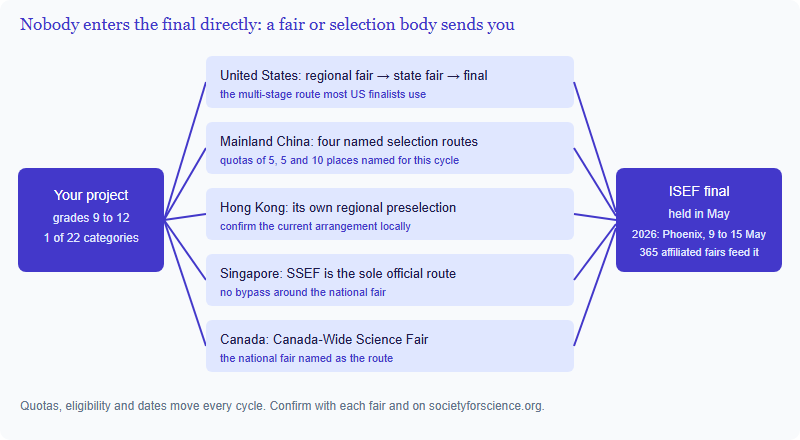
No student applies to the Regeneron ISEF final. Society-affiliated fairs do the selecting: finalists earn their place by winning at an affiliated local, regional, state or national fair, and the 2026 final in Phoenix drew its field from 365 affiliated fairs across more than 60 countries, regions and territories. So your first question is not how strong your project is. It is which fair can send you.
The structure that decides your calendar: fairs select, ISEF receives
Almost every misunderstanding we hear from families in August comes from imagining ISEF as an application: a portal, a deadline, a committee somewhere reading projects from around the world. It does not work that way. The Society for Science describes its finalists as students who earned the right to compete by winning at a Society-affiliated local, regional, state or national science fair. The final assembles a field that fairs have already chosen.
Three practical consequences follow, and they matter more than any advice about topic choice:
- Your real deadline belongs to a fair, not to ISEF. A fair's registration window, paperwork requirements and judging date sit months before the May final. Miss them and the quality of the project is irrelevant for that cycle.
- Your first audience is that fair's judges — a different panel, often a different rubric, sometimes a different language of submission from the final itself.
- Eligibility is defined by the fair, not by ambition. Which school you are enrolled in, which province or region that school sits in, and sometimes which curriculum you follow decide which fair may accept you.
If the overall shape of the system is still unclear, start with our explainer on what ISEF is and then the stage-by-stage walkthrough of how ISEF works from affiliated fairs to the global finals. This article is narrower: it maps the routes a China-based international-school student can realistically use, and tells you what to verify before you build a ten-month project around one.
The four mainland-China selection routes named for the 2026-27 cycle
Most students in mainland China have heard of one route: CASTIC, the national youth science and technology innovation contest long associated with sending Chinese projects onward. Our operator briefing of 1 August 2026 names four selection routes that produced places in this cycle, and they are more granular than a single national name suggests. Treat the table below as a starting list to verify, not as a rulebook — quotas and eligibility are reset from year to year, and the briefing is our own record rather than a published official page.
| Selection route (per briefing) | Described as serving | Places named this cycle | Verify before you commit |
|---|---|---|---|
| Fair for students at schools for children of foreign nationals | Students enrolled at that school type — the closest thing to a dedicated international-school route | Five direct places | Whether your school sits inside this fair's remit at all; the registration window; whether the school or the student registers |
| Shanghai science-seed selection | Students inside the Shanghai selection system | Recommends its award-winning projects; no fixed number given | What counts as award-winning in the current cycle, and the earlier deadline for entering the Shanghai selection itself |
| Chongqing selection | Students in the province, vocational schools included | Five projects | Provincial eligibility rules, whether non-local enrolment qualifies, any subject restrictions |
| Beijing-Tianjin-Hebei Youth Science Fair | Students across the three-jurisdiction region | Ten projects | Which schools may register, the submission deadline, and which approval paperwork must be signed before you start experimenting |
Two features of that table deserve emphasis. First, three of the four routes are geographic: they select from students in a city or region, which means a strong project in a province with no named selection cannot simply enter the nearest one. Second, the numbers are small — five, five, ten. That, not 1,700, is the number you are actually competing for, a point we return to below.
Outside the mainland: routes follow enrolment, not preference
Families sometimes ask whether they can enter through whichever jurisdiction looks least competitive. In practice each fair defines who it may accept, usually by school and residency, so route-shopping is rarely available and attempting it costs a season. The briefing names the following arrangements for students studying in nearby systems.
| Jurisdiction | Route named in the briefing | What it means in planning terms |
|---|---|---|
| Hong Kong | Its own regional preselection | Your calendar is set by that preselection, not by mainland fairs; confirm the current arrangement before assuming a mainland route is open to you |
| Singapore | SSEF is the sole official route | There is no bypass: a Singapore-based student plans backwards from SSEF |
| Canada | The Canada-Wide Science Fair | Relevant if you study in the Canadian system; confirm feeder requirements with the fair itself |
How to find your route in one afternoon
This is a three-question exercise, and it is worth doing before you choose a research question rather than after.
- Which system am I enrolled in? A school for children of foreign nationals, a private international division of a local school, a local public school with an international programme — these are not the same thing for fair eligibility, even when the classrooms look identical.
- Which fair's remit covers that school? Ask your science coordinator in writing, and ask for the fair's name and contact rather than an assurance. Where nobody at school knows, contact the selection nearest to you and ask whether students at your school type are eligible.
- Does that fair's calendar still leave me ten to twelve months? If the answer is no for this cycle, you are planning for the next one — which is a legitimate, and far less stressful, answer to reach in August.
If no named route covers you. This happens often, and inventing a route is the one thing you must not do. Realistic options: ask whether your school can be brought inside an existing fair's remit for future cycles; pursue the national contest structure that feeds selections in your province; enter a different research competition this year and treat the work as continuable evidence; or work through your school toward the international-school fair if your school type qualifies. Whichever you choose, get the eligibility answer from the fair rather than from a forum, a vendor, or us.
Quota maths: what you are actually competing for
The 2026 final gathered more than 1,700 finalists. That number is intimidating and largely irrelevant to your planning, because you never compete against the global field. You compete for your fair's slate: five places, or five projects, or ten. Read that as good news and bad news at once.
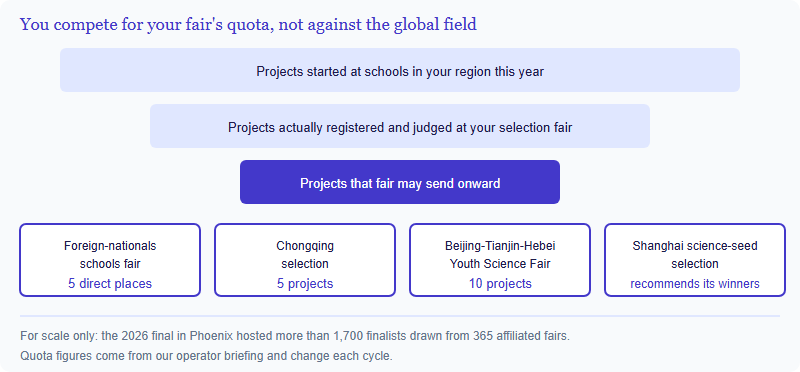
The bad news is that a small quota is brutal in a strong year, and it does not care how much you spent or how advanced your equipment was. The good news is more useful: the bar you must clear first is your own fair's bar. That reorders your priorities in a way most students get wrong.
- Paperwork and deadlines outrank polish. An unsubmitted approval form or a missed registration ends the season for a project that would otherwise have travelled.
- Your fair's criteria come first, the final's second. Ask which criteria the selection judges use and in which language you will present. Upgrade for the final after you are selected, not before.
- Category grouping may differ. The final runs 22 categories, but a selection fair may cluster subjects differently, which changes who you are compared against. Read our guide to choosing your ISEF category, then confirm your fair's own category list before registering.
Five questions to ask a fair before you build a season on it
Send these five, in writing, to whoever administers the selection you intend to use, and keep the reply. It is the most valuable document in your project folder in August, and it costs nothing.
- Registration: when does the window open and close, and does the school register or the student?
- Eligibility: how is it defined — school, grade, residency, curriculum, nationality? Ask for the wording rather than a yes.
- Quota and selection: how many projects go forward, and who decides — a judging panel, a recommendation carried over from earlier awards, or both?
- Approvals: which forms or ethics reviews must be completed before experimentation begins, and by what date? This is the one item that cannot be fixed in hindsight.
- Language and format: what language are the written submission and the interview in, and what is the abstract limit? The final caps abstracts at 250 words; your fair may set something different.
One last filter, aimed at the offers arriving in your inbox this month: any programme, agency or mentor claiming they can place you directly in the ISEF final is describing a structure that does not exist. Selection sits with affiliated fairs and official selection bodies, in slates of five and ten. Anyone promising to bypass that is either misinformed or selling something they cannot deliver.
Frequently asked questions
Can I apply to the ISEF final directly?
No. Finalists qualify by winning at a Society-affiliated local, regional, state or national fair. Confirm current rules on societyforscience.org.
My province has no named selection fair. What do I do?
Ask your school which fair covers it, then ask that fair about eligibility in writing. Settle the route before designing the project.
Do the quotas stay the same each year?
No. Places, eligibility and dates are reset each cycle, so treat any number, including ours, as something to re-confirm with the fair.
Does winning my school science fair qualify me?
Only if that fair is affiliated or feeds a selection that is. School fairs usually sit one step below; confirm the chain upward.
This is an independent guide operated by Hanlin Education for China-based international-school students. We are not affiliated with, endorsed by, or sponsored by the Society for Science or Regeneron ISEF. Selection routes, quotas, eligibility, deadlines and fees change every cycle: confirm current details on societyforscience.org and with the fair you intend to enter. Mainland-China and regional route detail is attributed to our operator briefing of 1 August 2026. Errors reported to our editorial desk are corrected within 7 working days.