ISEF is conducted in English: the project, the paperwork and the judging interview all run in it. On the Grand Award criteria published for the 2026 cycle, 35 of 100 points sit under Presentation — 10 for the poster, 25 for the interview. That makes scientific English a scored skill for China-based students, not a background one. Here is what to fix, in order.
Where English is actually scored
It helps to be precise about this, because “improve your English” is useless advice. English does not have its own line on the scoring sheet. What it has is a monopoly on delivery. Every other line — the research question worth 10 points, design and methodology worth 15, execution worth 20, creativity and potential impact worth 20 — reaches a judge only through sentences you wrote or spoke. A methodology that deserves 15 points earns 15 points only if the judge can reconstruct it from your text.
The interview line is where this bites hardest. At 25 points it is the single largest item on a 100-point sheet, and it is the only one you cannot prepare in advance and hand over. You can revise an abstract fourteen times. You get one pass at answering “why did you choose that control?” in real time. Students who read English comfortably and speak it hesitantly consistently underperform their project here.
If you are new to how the competition is structured, our explainer on what ISEF is and how it works for international students covers the eligibility and format assumptions this guide takes for granted. Weightings are revised from time to time — confirm the current Grand Award criteria on societyforscience.org before you plan around any specific number.
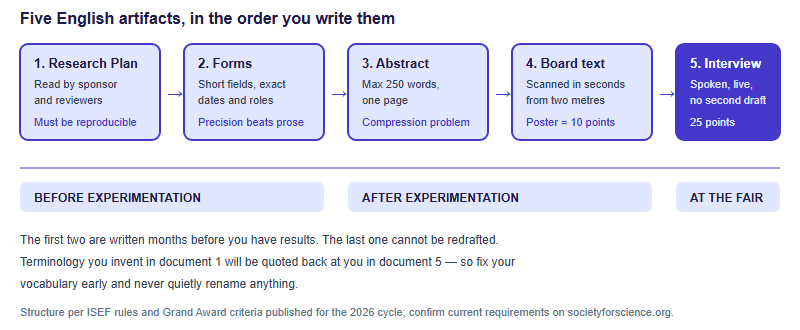
The five English artifacts, and what each one has to survive
Students tend to think of “the writing” as one task that happens near the end. It is actually five separate documents with different readers, different lengths and different failure modes, spread across the whole project year.
| Artifact | Written when | Length | Who reads it | Most common failure |
|---|---|---|---|---|
| Research Plan / Project Addendum | Before you start experimenting | No published word cap — check current rules | Adult sponsor, and reviewers where pre-approval applies | A procedure a stranger could not repeat |
| Forms (1, 1A, 1B, 2A and any project-specific ones) | Before you start experimenting | Short fields | Fair officials and reviewers | Vague role descriptions; dates that contradict the plan |
| Abstract | After experimentation | Maximum 250 words, one page | Fair officials, judges, and a public project database | Reads like an introduction; results arrive too late or not at all |
| Project board text | Final weeks | Whatever stays legible from two metres | Judges scanning many boards | Paragraph walls nobody reads |
| The judging interview | At the fair | Spoken — confirm current format on societyforscience.org | Grand Award and special award judges | Recognising the vocabulary but being unable to produce it |
Notice the asymmetry. Two of the five are written before you have any results, which means your English has to describe an intention precisely. Two are written under a hard length ceiling. One cannot be edited at all. Different problems, different practice.
Six patterns that cost China-based writers clarity
These are not grammar-textbook errors. They are the specific habits that survive translation and quietly make a good project read as a confused one. Fix these six and most of the rest sorts itself out.
- Topic-comment carry-over. Chinese comfortably opens with a topic and comments on it afterwards. English science prose wants the actor in the subject slot. “About the temperature, it was controlled at 37 °C” becomes “We held the incubator at 37 °C.”
- Missing or floating articles. “We used microscope to observe cell” reads as a draft. English forces you to decide between a, the and a plural — and that decision carries meaning: the sample is one you already introduced, a sample is any one.
- Coordinate chains where subordination is needed. Long strings joined by “and” are natural in Chinese and flat in English. A judge reading “we did X and we did Y and then Z increased” cannot tell which step caused what. Subordinate the supporting clause: “After we removed the light source, Z increased by 18%.”
- Nominalisation inflation. “We carried out an investigation on the influence of pH” is nine words doing the work of three: “We varied pH.” Turning verbs into nouns feels formal and reads evasive.
- Over-strong connectives. “Therefore”, “so” and “thus” assert causation. If all you have is an association, say so — a judge who spots an unearned “therefore” will spend the interview probing it.
- Terminology drift. Calling the same thing a sample in the research plan, a specimen on the board and a material in the interview looks like three things. Write your terms down once and freeze them, including units and variable names.
Terminology drift deserves emphasis because it is invisible to the writer. You know the three words mean the same object. A judge meeting your project for the first time does not, and the register expected also shifts with your discipline — a chemistry judge and a behavioural-science judge read very different vocabulary as normal. Our guide to choosing your ISEF category is worth revisiting for that reason alone: the category decides who reads your English.
Tense, voice and the calibration problem
Three conventions cover almost every sentence you will write.
- Established knowledge takes the present tense. “Chlorophyll absorbs light most strongly in the blue and red bands.”
- What you did takes the past tense. “We measured absorbance at 15-minute intervals.”
- What a figure or table does takes the present tense. “Figure 2 shows the decline after minute 40.”
On voice: the passive is not required. Many students were taught that scientific writing must avoid “we”, and then produce sentences so contorted that the agent disappears entirely. Active constructions are widely accepted in current journals, and they hold up far better under questioning, because a judge asking “who made that decision?” gets an answer instead of a shrug.
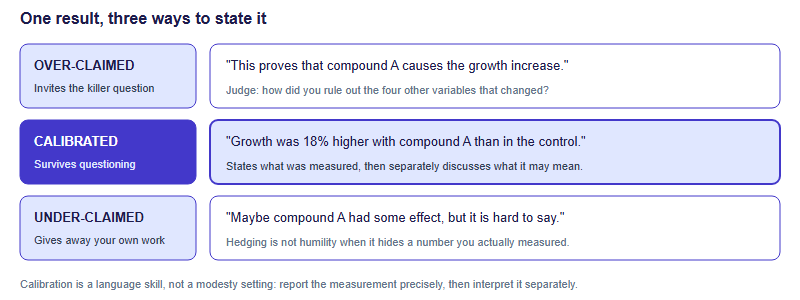
The harder skill is calibration — matching the strength of your claim to the strength of your evidence. Chinese-language academic writing in school settings often rewards confident conclusions. ISEF judging does the opposite: a well-hedged claim signals that you understand your own limitations, and an over-claim invites the one question you cannot answer.
250 words is a compression problem, not a summary problem
The abstract is written after experimentation and capped at 250 words on one page. Students treat this as “write a short version of everything”, which is why so many abstracts spend 120 words on background and run out of room before the results.
Budget the words before you write them. A workable split is roughly 40 words of purpose and question, 70 of procedure, 70 of results with actual numbers, 50 of conclusion, and about 20 in reserve. Anything that does not fit one of those four jobs is cut, no matter how much you like it.
Then apply mechanical cuts, which reliably free 30–50 words without touching content:
- “In order to” → “To”. “Due to the fact that” → “Because”.
- Delete “It is worth noting that”, “As we all know” and “In this study, we aim to”.
- Delete any sentence that restates your title.
- Replace adjectives with numbers: “a significantly large increase” → “an increase of 18%”.
- Delete the future tense entirely — the work is done.
Write the abstract in English from the start rather than drafting in Chinese and translating. Translated abstracts almost always run long, because Chinese compresses differently and the structures that survive translation are the wordy ones. If you must draft in Chinese to think clearly, draft the logic in Chinese as bullet points and compose the sentences in English.
From written to spoken: producing vocabulary under pressure
The gap that decides interviews is between recognition vocabulary and production vocabulary. You recognise “confounding variable” instantly on the page. Producing it, unprompted, in the third minute of a conversation with an unfamiliar adult is a different capability, and it is the one being scored.
Four drills that target it directly:
- The 90-second method. Explain your entire procedure aloud in 90 seconds with no notes, in English, until it is fluent. Then do it in 30 seconds. The compression forces you to know which steps are load-bearing.
- Say your numbers out loud. Reading “37 °C”, “0.05”, “10⁻³ mol/L” and “µL” silently is not the same as saying them. Numbers and units are a recurring stumbling point for otherwise fluent students — rehearse them.
- Answer the why questions, not the what questions. “What did you do?” is answerable from memory. “Why that control? Why that sample size? What would you change?” require you to reason in English in real time. Have someone ask only why-questions for ten minutes.
- Memorise a structure, not a script. A memorised paragraph collapses the moment a judge interrupts — and judges interrupt. Memorise the order (question → design → what you measured → what you found → what it does not show) and generate the sentences fresh each time.
One last note on integrity, because it matters more than any writing technique. Help you receive with your project and its documentation has to be disclosed on the ISEF support paperwork, and the science and the reasoning must be yours. An abstract written by someone else is discoverable in about ninety seconds of interview, and it damages far more than a score. Polishing your own English is legitimate; outsourcing the thinking is not. For how these documents sit inside the wider selection process, see our walkthrough of how ISEF works from affiliated fairs to the finals.
Frequently asked questions
Does an ISEF project have to be in English?
Yes — ISEF is conducted in English, and the paperwork, board and interview all run in it. Confirm current language provisions on societyforscience.org.
How long can the ISEF abstract be?
A maximum of 250 words on one page, written after experimentation, per the rules published for the 2026 cycle. Confirm the current limit before submitting.
Should I write in the passive voice to sound scientific?
No. Active constructions such as “We measured” are widely accepted, clearer to read, and much easier to defend when a judge asks who decided what.
Can someone else translate or polish my writing?
Assistance must be disclosed on the ISEF support forms, and the science and reasoning must be your own. Check current disclosure rules on societyforscience.org.
This is an independent guide operated by Hanlin Education for China-based international-school students. It is not affiliated with, endorsed by, or sponsored by the Society for Science or Regeneron ISEF. Rules, criteria and deadlines change each cycle — confirm current details on societyforscience.org before acting on anything here. Errors reported to our editorial desk are corrected within 7 working days.