ISEF is open to students in grades 9 through 12 who have not reached age 20 on or before 1 May preceding the finals, but the eligible window and the useful window are not the same thing. A competitive project runs roughly 10–12 months, and the finals sit in May — so the single highest-leverage month to begin is the summer before Grade 11. This is what each starting point actually buys you, and the timing trap that catches Grade 12 starters every year.
The arithmetic nobody does before choosing a start date
Work backwards and the whole question resolves itself. ISEF finals are held in May. Before the finals sits your affiliated fair — for mainland-China students, the CASTIC route — with its own earlier deadline. Before that fair sits your write-up, before the write-up sits analysis, before analysis sits data collection, and before data collection sit approvals and design. The strongest projects begin about 10–12 months ahead of the finals they target.
Run that backwards from a May finals and you land in the previous summer. Not the previous autumn — the previous summer, which is why August is the month this question gets asked. A student who begins in September has already lost the design-and-approval buffer that makes a calm October possible. A student who begins in January is not running a shortened version of the same project; they are running a different, smaller one.
This is also why “which grade should I start in” is a better question than “when should I start”, because the answer is really about how many complete cycles you can fit before you run out of school. If you have not yet read how the selection route sits underneath the finals, our explainer on how ISEF works from affiliated fairs to the global finals sets out the sequence the calendar below assumes.
Four starting points, four honest outcomes
| You start in… | What it realistically buys you | What you are actually purchasing | Biggest risk |
|---|---|---|---|
| Grade 9 | A skills year, then two full project cycles | Technique, statistical literacy and a mentor relationship before the stakes rise | Starting a “project” too early and producing a school-fair-grade result you then have to disown |
| Grade 10 | One learning project, then one competitive project | The right to make your beginner mistakes on a low-stakes attempt | Treating the first attempt as the serious one and burning the mentor's patience |
| Summer before Grade 11 | One full 10–12 month competitive cycle, results landing in spring of Grade 11 | The only cycle that finishes early enough to appear in most application timelines | No second chance if the project fails; the triage decisions all become urgent |
| Grade 12 | A compressed cycle whose results arrive after most application decisions | The science, and little else strategically | Doing a rushed project for a strategic reason that the calendar has already cancelled |
Note what the table does not say. It does not say a Grade 9 start produces a better result than a Grade 11 start — plenty of strong projects are single-cycle projects by students who started at exactly the right moment and executed cleanly. What the earlier start buys is error tolerance: the ability to have a bad October and still be fine, because you have already learned where your own failure modes are.
The multi-year arc: what each year is for
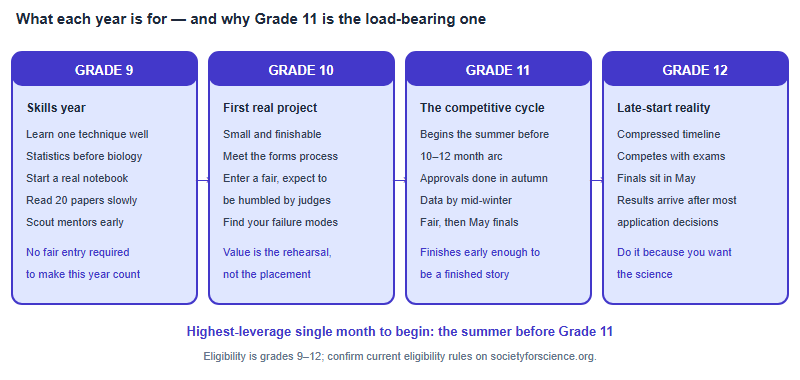
The Grade 12 timing trap
Here is the arithmetic that rarely gets said out loud to families. ISEF finals are held in May. Most undergraduate application deadlines fall in the autumn and winter before that May, and most decisions are released in the spring. A Grade 12 student who begins an ISEF project in September is therefore building something whose outcome will not exist at the moment nearly every application is submitted.
That does not make a Grade 12 project pointless. It makes it a project you should do for scientific rather than strategic reasons — and if that is your reason, it is a good one. What it should stop you doing is compressing an eight-month research programme into four months on the assumption that the result will arrive in time to matter strategically, because for most application timelines it will not. Every year we meet Grade 12 students carrying a great deal of stress over exactly this mismatch, and the stress is usually the result of nobody having drawn the calendar.
To be explicit, because this is an area full of overclaiming: no competition result guarantees any admissions outcome, and this site makes no such claim. Our overview of what ISEF is, who can enter, and whether it is worth it for applications is the place to start if that is the question underneath your question.
If you are already in Grade 12 and want to do research anyway, the honest options are: run a genuinely smaller study you can finish and defend properly; ask your fair's SRC whether joining a Grade 11 team-mate's project is even permitted in your case — ISEF caps teams at three and generally does not allow membership changes once a research year is under way or after a project has competed; or use the year to build technique for university, where the research runway is far longer than anything school offers.
What a Grade 9 “skills year” should actually contain
The most common Grade 9 mistake is starting a project. A 14-year-old with no technique, no statistics and no mentor will produce a project that is difficult to be proud of a year later, and the experience frequently sours the whole idea. A skills year is more valuable and much less painful. Five components:
- One technique, learned properly. Cell culture, PCR, a specific assay, microcontroller instrumentation, a programming language for data analysis — one, not five. Depth in a single technique is what makes a mentor willing to take you on later.
- Statistics before biology. Distributions, variance, sample size, what a p-value does and does not mean. In our experience this is the most common gap in China-based cohorts, and it is the one that turns an otherwise good Grade 11 project into an underpowered one.
- A real lab notebook habit. Dated entries, decisions recorded on the day they are made. Building this habit on low-stakes work is far easier than installing it in a crisis.
- Twenty papers, read slowly. Not skimmed. Read to the point where you could explain each one's method and its weakness to a classmate.
- Mentor scouting. Identify three plausible mentors and make contact long before you need one. Mentors say yes to students who have already done something, which is what the previous four points are for.
Notice that none of this requires entering a fair, and none of it is wasted if you later change field. It is also entirely doable alongside a normal Grade 9 workload, which a real project is not.
What to do this August, by grade
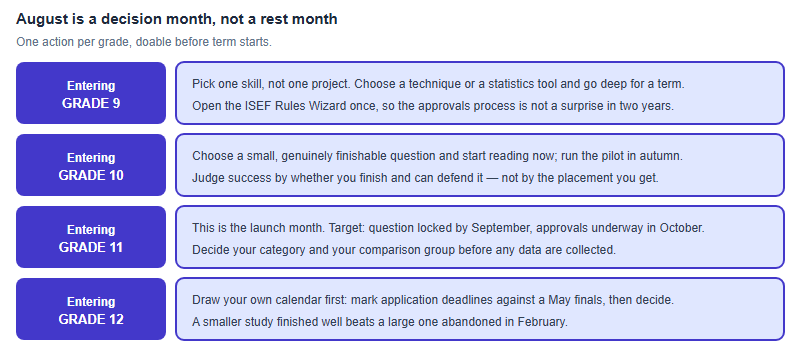
Whichever row you are in, one decision outranks the rest of the list: the category you intend to enter, because it shapes what counts as a good result and what a judge will compare you against. Make it early and deliberately using our guide to choosing your ISEF category by your project's real strength, rather than defaulting to whichever of the 22 sounds closest to your school subject.
FAQ
Can Grade 9 students enter ISEF?
Yes — eligibility runs from grade 9 through grade 12, subject to the current rules and your affiliated fair. Confirm details on societyforscience.org.
Is it too late to start ISEF in Grade 11?
No. The summer before Grade 11 is the highest-leverage moment to begin a full 10–12 month cycle targeting the following May.
Should a Grade 12 student still try ISEF?
Only for the science. Finals sit in May, after most application decisions, so a rushed Grade 12 project rarely delivers the strategic benefit students expect.
How long does a competitive ISEF project take?
Roughly 10–12 months from question to finals, including approvals, data collection, analysis and write-up before your fair's deadline.
This is an independent guide operated by Hanlin Education for China-based international-school students. We are not affiliated with, endorsed by, or sponsored by the Society for Science or Regeneron ISEF. Eligibility rules, category lists, fair deadlines and finals dates change from season to season — confirm all current details on societyforscience.org and with your affiliated fair. No competition result guarantees any admissions outcome. Factual corrections are made within 7 working days of notification.