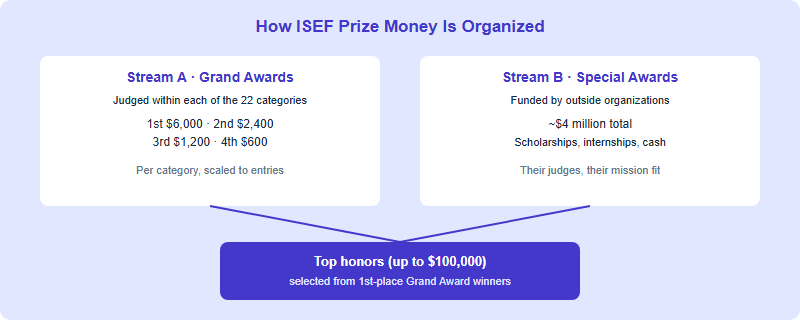
ISEF distributes more than $7 million in awards, prizes, and scholarships across over 1,600 finalists each year, in two main streams: Grand Awards given within each of the 22 categories ($6,000 / $2,400 / $1,200 / $600), and Special Awards funded by outside organizations. A small group of top honors — up to $100,000 — is selected from the first-place category winners. This guide explains how the tiers fit together and what each one actually signals. All amounts below are per the Society for Science; confirm current figures on societyforscience.org.
The two streams: Grand Awards and Special Awards
Most students picture “winning ISEF” as one big prize. In reality the awards run on two parallel tracks. Grand Awards are judged by ISEF’s category judges and handed out within each of the 22 categories — so every category produces its own first through fourth place. Special Awards are separate: dozens of professional societies, companies, universities, and government agencies send their own judges to pick projects that fit their mission, and they fund scholarships, internships, and cash prizes. A single project can win in both streams, or in neither. Understanding this is the difference between “I didn’t win” and “I placed third in my category and took a Special Award” — very different outcomes that both happen at the same fair. To see where awards sit in the overall event, read how ISEF works, from affiliated fairs to the global finals.
Grand Awards: the category prizes
Within each of the 22 categories, judges give cash Grand Awards. Per the Society for Science, the standard amounts are $6,000 (first), $2,400 (second), $1,200 (third), and $600 (fourth), with the number of awards scaled to the number of projects entered in that category. Because the awards are per category, your competition is the other projects in your category — not the entire fair. This is one more reason category choice matters; our guide on how to choose your ISEF category walks through all 22, and the complete ISEF guide explains how the category system works.
| Grand Award (per category) | Cash amount | What it represents |
|---|---|---|
| First Award | $6,000 | Top project in that category; pool for top honors |
| Second Award | $2,400 | Among the strongest in the category |
| Third Award | $1,200 | Recognized category standout |
| Fourth Award | $600 | Category-level recognition |
The top honors: selected from first-place winners
The prizes that make headlines are drawn from the pool of first-place Grand Award winners. Per the Society for Science, these include the George D. Yancopoulos Innovator Award ($100,000), two Regeneron Young Scientists Awards ($75,000 each), the Gordon E. Moore Award for Positive Outcomes for Future Generations ($50,000), and the F. Thomson Leighton and Bonnie Berger Family Prize ($50,000), alongside a set of $10,000 honors such as the Craig R. Barrett Award for Innovation, the Robert Horvitz Prize for Fundamental Research, the Peggy Scripps Award for Science Communication, and the Mary Sue Coleman Award for Life Science Innovation & Impact. These are not separate applications — you reach them by winning your category first. Award names and amounts can change year to year, so confirm the current slate on the official site.
Special Awards: the hidden half of the prize table
Special Awards are easy to overlook and strategically important. Outside organizations — scientific societies, companies, universities, and agencies — bring their own judges to ISEF and grant awards to projects aligned with their interests across hundreds of finalists. They take many forms:
- Cash prizes from professional and corporate sponsors.
- Scholarships toward university study.
- Internships and trips — including international science seminars and other contest invitations.
The practical takeaway: a project that does not place first in a crowded category can still earn meaningful recognition (and money) from a Special Award organization whose mission it fits. That is why finalists often describe their results in two parts — their Grand Award placement and their Special Awards — rather than a single win-or-lose verdict.
What each tier signals for college applications
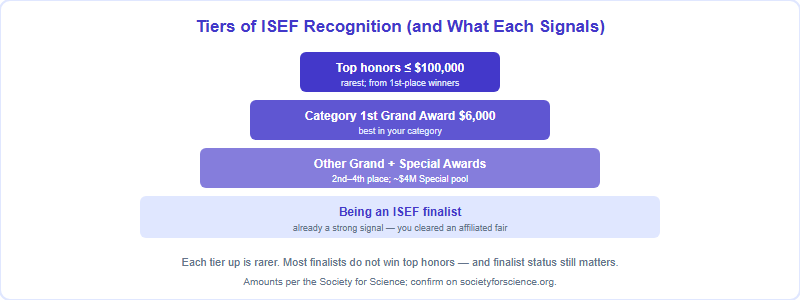
For China-based students weighing ISEF against other extracurriculars, the honest framing is about signal, not guarantees. No award — not even a top honor — guarantees admission anywhere, and you should be wary of anyone who claims otherwise. What the tiers do is differentiate the strength of a documented research signal:
- Finalist status already shows you produced original research good enough to clear a competitive affiliated fair — a genuine differentiator over generic activities.
- A Grand Award adds independent, named recognition within a field.
- Special Awards show that an outside organization valued your work enough to back it — sometimes with scholarships or internships that carry their own opportunities.
- Top honors are exceptional and rare; they are wonderful but should never be your baseline expectation or the reason you do the project.
The deeper value is the research itself: a serious project gives you a real story, a mentor relationship, and material for essays and interviews that no prize line alone provides. For a fuller, balanced view of the admissions question, see our honest assessment, in the complete ISEF guide. Chase the science; treat the awards as a possible bonus, not the goal.
Frequently asked questions
How much can you win at ISEF?
Category Grand Awards run $6,000 / $2,400 / $1,200 / $600, top honors reach $100,000, with Special Awards making up a large share — over $7M overall. Confirm current figures on societyforscience.org.
What is the difference between Grand Awards and Special Awards?
Grand Awards are judged within each of the 22 categories. Special Awards come from outside organizations choosing projects that fit their mission, often as scholarships or internships.
Do you apply separately for the top $100,000 award?
No. The headline honors are selected from first-place Grand Award winners. You reach them by winning your category first, not through a separate application.
Does an ISEF award guarantee college admission?
No. No award guarantees admission. ISEF strengthens a documented research signal and gives you real material for essays; treat results as a bonus, not a promise.
This is an independent guide operated by Hanlin Education for China-based international-school students. It is not affiliated with, endorsed by, or sponsored by the Society for Science or Regeneron ISEF. Award names, amounts, and structures change year to year — always confirm current details on societyforscience.org. We correct any reported errors within 7 working days.