An ISEF-level project is not written in a weekend — it is a roughly 12-month arc that ends at the global finals each May. Working backward, most finalists start a serious research question 9–12 months out, finish experiments and analysis by winter, and clear their affiliated fair (which feed ISEF and generally conclude by mid-April) before the finals. This calendar shows where each phase falls and where China-based students lose time. For exact 2026–2027 deadlines, always confirm on societyforscience.org and with your specific local fair.
Why ISEF is a calendar problem, not a writing problem
ISEF is the final stage of a pipeline. You do not apply to ISEF directly — you qualify by placing at a Society-affiliated local, regional, state, or national fair, and those fairs run on their own schedules. According to the Society for Science, finalists are selected from hundreds of affiliated fairs across more than 75 countries, regions, and territories, and the affiliated fairs generally conclude by mid-April, with the global finals held in May (ISEF 2026 ran in Phoenix, May 9–15). That single fact reshapes your whole year: your “real deadline” is not May — it is whenever your affiliated fair submits, which can be months earlier. If you only learn the concept of a research-question in March, you have already lost.
The other reason ISEF rewards early planners: certain project types (those involving human participants, vertebrate animals, or potentially hazardous biological agents) require committee review and documented approval before experimentation begins. The exact forms and approval steps are defined in the official International Rules and Guidelines — confirm on the official site — but the planning implication is fixed: approvals add weeks at the front of your project, not the end. For the basics of how the pipeline fits together, see our explainer on how ISEF works, from affiliated fairs to the global finals.
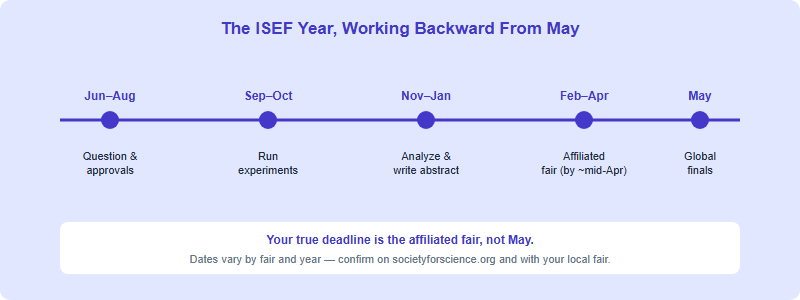
Phase 1 (summer, ~12–9 months out): question, mentor, and approvals
Summer is the cheapest time you will ever have. Use it to do three things that are painful to do during term: settle a researchable question, line up a mentor or research site if your design needs one, and start any required pre-experimentation paperwork. A strong question is narrow, testable, and feasible with the resources you can actually reach — a school lab, a university contact, a public dataset, or a field site. Avoid questions that secretly require equipment you will never get.
- Lock the question. Read recent abstracts in your target area (the Society’s project database holds abstracts from 2014 to 2026) to see what “competitive depth” looks like.
- Identify regulated elements early. If your idea touches human participants, vertebrate animals, or potentially hazardous biological agents, those typically need documented committee review before you start. Read the official rules now — confirm on the official site — so approvals do not blow up your schedule in October.
- Confirm category fit. Knowing roughly which of the 22 categories your project belongs in shapes your methods; our guide on how to choose your ISEF category walks through all 22 by strength.
Phase 2 (autumn, ~8–5 months out): run the experiment
This is the part most students underestimate. Real data collection rarely works on the first attempt: protocols fail, samples spoil, code has bugs, and trials need repeating for statistical validity. Budget for at least one full redo. The students who reach finals usually have more data than their board can show, because they ran enough trials to say something defensible. Keep a dated logbook from day one — judges and reviewers value documented process, and your future abstract will be far easier to write if every result is timestamped.
For China-based students, autumn is also when access friction shows up. A mentor’s lab may be unavailable, an instrument may be shared across a department, or a dataset may sit behind a request process. Each of these is a multi-week delay if you discover it in November rather than July — another argument for front-loading.
Phase 3 (winter, ~4–3 months out): analysis, abstract, and board
By winter your experiments should be essentially done, freeing you to analyze, draw conclusions, and produce the two deliverables every finalist needs: a tight abstract and a clear display board. The official ISEF abstract has a hard ceiling of 250 words, which forces ruthless prioritization — problem, method, key result, conclusion. We cover that constraint in detail in our complete guide to ISEF. The board and forms have their own requirements; build them against the official checklist, not a friend’s memory of last year.
| Phase | Approx. window | Primary output | Most common time-sink |
|---|---|---|---|
| 1 · Question & approvals | ~12–9 months out (summer) | Researchable question; approvals started | Committee review for regulated projects |
| 2 · Experiment | ~8–5 months out (autumn) | Clean, repeated data | Failed trials & required redos |
| 3 · Analysis & abstract | ~4–3 months out (winter) | 250-word abstract + display board | Cutting the abstract to length |
| 4 · Affiliated fair | By ~mid-April (varies) | Placement that qualifies for ISEF | Missing the local fair’s own deadline |
| 5 · Global finals | May | Judging interviews | Travel/logistics for international finalists |
Phase 4–5 (spring): the affiliated fair, then finals
Here is the trap that catches international students: the affiliated fair is the gate to ISEF, and its deadline is set by that fair — not by ISEF. Affiliated fairs generally conclude by mid-April, but registration and submission can close weeks earlier. If you are in China, identify which Society-affiliated fair you will enter, and confirm its calendar, before you finalize your project, using the Society’s “Find-a-Fair” resource. Once you qualify, the May finals shift the workload to communication: judges decide much of your outcome in short interviews, so rehearse explaining your work concisely. Our companion piece on how ISEF works maps the affiliated-fair-to-finals path in full.
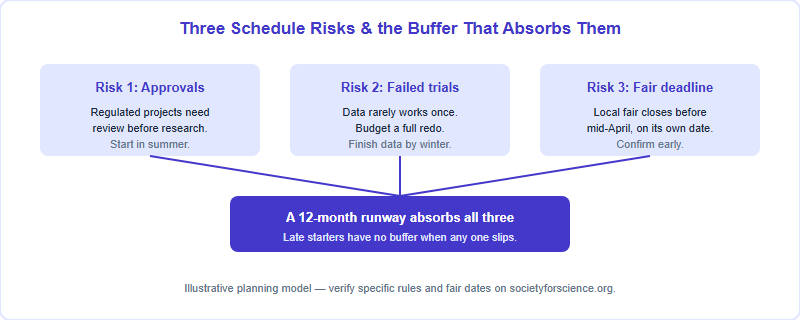
A China-based variant of the calendar
International students carry a few extra constraints that should pull every milestone earlier:
- Mentor and site access can take longer to arrange remotely; begin outreach in early summer, not autumn.
- Affiliated-fair routing matters — identify your qualifying fair and its submission window first, then design backward from it.
- Finals logistics (travel, documents) for a May trip abroad are best handled the moment you qualify, not after.
- Rules literacy — because regulated-project approvals and forms are non-negotiable, read the official rules at the start, not the week before submission.
None of this changes the science. It changes when you do it. The most common reason a capable Chinese student misses ISEF is not weak research — it is starting the calendar in spring when the gate already closed.
Frequently asked questions
When should I start an ISEF project?
Most finalists begin a serious question roughly 9–12 months before the May finals — typically the prior summer — so experiments and the affiliated fair fit before the cutoff.
What is my real deadline — May?
No. Your true deadline is your affiliated fair’s submission date. Affiliated fairs generally conclude by mid-April, but each sets its own earlier registration window; confirm with your fair.
Do some projects need approval before I start?
Yes. Projects involving human participants, vertebrate animals, or hazardous biological agents typically require documented review before experimentation. Read the official rules and confirm on the official site.
How do China-based students qualify for ISEF?
By placing at a Society-affiliated fair that feeds ISEF. Use the Society’s Find-a-Fair resource to locate your qualifying fair and its calendar before designing your project.
This is an independent guide operated by Hanlin Education for China-based international-school students. It is not affiliated with, endorsed by, or sponsored by the Society for Science or Regeneron ISEF. Competition rules, deadlines, fair calendars, and award details change — always confirm current details on societyforscience.org. We correct any reported errors within 7 working days.