At the International Science and Engineering Fair, the project that wins is rarely the one with the fanciest equipment — it is the one whose researcher can explain it clearly, defend the method, and answer “what would you do next?” without freezing. Grand Awards are decided through repeated live judging interviews at your booth, each only a few minutes long. This guide breaks down how that conversation works and exactly what to rehearse, so a strong project does not get under-scored by a nervous five minutes.
How ISEF judging actually runs
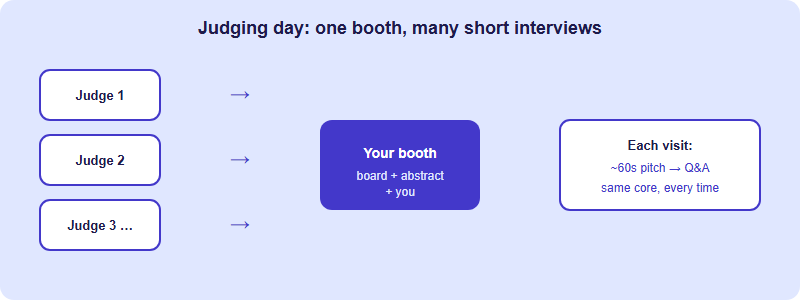
ISEF judging is conversational and repeated. Over the main judging day, multiple Grand Award judges visit your booth one after another; each spends a short, time-pressured window with you — typically only a handful of minutes — talking through the work. There is no written exam. Judges form their assessment from what you say, the questions you handle, and how well your display and abstract support your claims. For the official schedule and structure of judging day, confirm the current details on societyforscience.org, because timings change year to year.
Because the slot is short and you repeat it many times, two things follow. First, you cannot narrate everything — you must lead with the result that matters and let questions pull out the rest. Second, your delivery has to be reproducible: the tenth judge should hear the same crisp version as the first, even when you are tired. The students who medal treat the pitch like a rehearsed instrument, not an improvisation. For where the project itself earns credibility before judging, revisit how to choose your category — being judged in the right category against the right peers matters as much as the pitch.
Build a layered pitch: 60 seconds, then 3 minutes, then deep
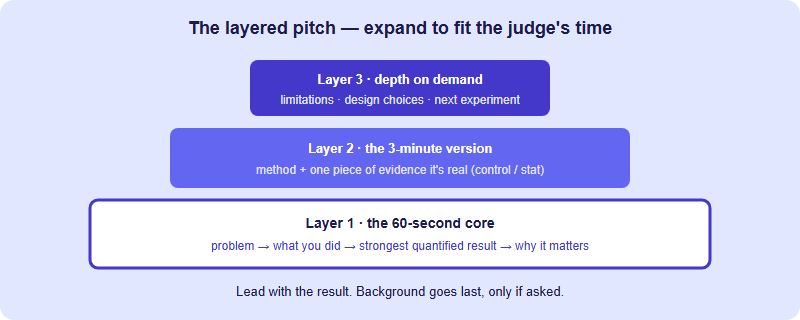
Do not memorise one long speech. Build your explanation in expandable layers so you can match whatever time a judge gives you and whatever they probe. A reliable structure:
- Layer 1 — the 60-second core: the problem, what you did, your single strongest quantified result, and why it matters. A judge who only has a minute should still leave knowing your headline finding.
- Layer 2 — the 3-minute version: add your method and one piece of evidence that the result is real (a control, a statistic, a replication). This is where you show rigour, not just outcome.
- Layer 3 — depth on demand: limitations, why you chose this design over alternatives, what surprised you, and the next experiment. This is the layer that separates a finalist from an award.
Notice the bias: results and method first, background last. Judges discount projects that spend two minutes on textbook context before reaching what the student actually contributed. If you cannot reach your own result inside the first 60 seconds, your pitch is mis-weighted.
The questions you must be ready for
Judges probe for understanding and ownership, not recitation. The recurring question types below are predictable enough to rehearse out loud until the answers are automatic.
| Question type | What the judge is really testing | How to answer well |
|---|---|---|
| “Why does this matter?” | Significance & framing | Name a concrete application or who benefits — avoid “it’s interesting” |
| “How do you know the result is real?” | Rigour & validity | Point to your control, sample size, or statistical test |
| “What’s the weakness here?” | Self-awareness & honesty | State a genuine limitation; honesty scores higher than a defensive “none” |
| “What would you do next?” | Scientific thinking | Give one specific, fundable next experiment — not “more data” |
| “Which part did you do?” | Ownership of the work | Be precise and truthful about your contribution vs. your mentor’s |
That last row is non-negotiable. ISEF’s rules require disclosure of help received, and judges are skilled at sensing a project a student cannot fully explain. The safest — and most credible — answer is the accurate one: say clearly what you designed, ran, and analysed yourself, and what came from a lab, dataset, or mentor. A student who owns a smaller, honestly-described contribution beats one who over-claims a project they cannot defend.
The five mistakes that quietly cost points
Most under-scored interviews are not disasters; they are a series of small, fixable errors that add up. From watching students rehearse before international fairs, these are the recurring ones — and each has a concrete countermeasure.
| Mistake | How it reads to a judge | The fix |
|---|---|---|
| Burying the result under background | “This student doesn’t know what’s important” | State the headline finding in the first two sentences |
| Reciting a memorised speech | Brittle — collapses on the first interrupting question | Memorise only the 60-second core; keep the rest flexible |
| Over-claiming the contribution | Erodes trust; invites harder probing | Be precise about what you vs. a mentor/lab did |
| Answering “no weaknesses” | Signals poor scientific self-awareness | Name one real limitation and how you’d address it |
| Vague next steps (“collect more data”) | Suggests shallow thinking | Give one specific, designable follow-up experiment |
The throughline is honesty plus precision. Judges are experienced researchers; they reward a student who clearly understands the boundaries of their own work over one who oversells. A confident “here is exactly what I did, here is its limitation, and here is what I’d test next” is a stronger answer than a polished claim the student cannot defend under follow-up.
Your booth and body language are part of the pitch
The interview is multimodal: judges read your board and your delivery alongside your words. You do not need theatrics — you need to remove friction so the science lands. A few practical habits that consistently help:
- Make the board do work you don’t have to narrate. A clean results figure you can point to lets you say “as you can see here” instead of describing numbers verbally — far easier under nerves and across a language gap.
- Stand to the side, not in front, of your board so the judge can see your key figure while you talk. Gesture to the data, not at the air.
- Pause instead of filling silence. A two-second pause to think before answering a hard question reads as thoughtful; rushing reads as rehearsed.
- Watch the judge’s cues. If they glance at their watch or step back, wrap to your conclusion — respecting their time is itself a positive signal.
- Reset between judges. Take a breath, re-centre your board, and deliver Layer 1 fresh. The fifth judge deserves the same energy as the first.
None of this substitutes for substance, but it removes the small distractions that can make a strong project feel less convincing than it is. Treat the booth as a tool that carries half the message so your spoken pitch can carry the other half.
A first-party note for China-based finalists presenting in English
From coaching students who present at international fairs after studying in Chinese international schools, the language gap is real but beatable — and judges are explicitly understanding of non-native English. The fix is not perfect grammar; it is clarity and pacing. Three habits that work:
- Script and rehearse only Layer 1 word-for-word, then practise Layers 2–3 as flexible bullet points. A memorised 60-second core gives you a confident start every time, even when nerves spike with the first judge.
- Record yourself and watch it back. Most international students discover they rush and swallow the key number. Slow down on your one headline result and say the figure twice.
- Pre-write answers to the five question types above in English and say them aloud until they are reflexive. Translating in your head mid-interview is what causes freezing; pre-loading the phrases prevents it.
Plan your route to the fair early too — for the qualification pathway and the China selection track (commonly referenced as CASTIC), see how ISEF works. The interview is the payoff of a year of research, but it is a separate skill from the research itself, and it is the one most international entrants under-train. Treat it like the experiment it is: define what good looks like, rehearse, get feedback, iterate.
Everything procedural here — judging-day timings, interview length, disclosure requirements — should be confirmed for your competition year on societyforscience.org, as ISEF reviews its format annually.
FAQ
How long is an ISEF judging interview?
Each Grand Award judge spends only a few minutes at your booth, and you repeat the interview with many judges across judging day. Confirm exact timings on societyforscience.org.
Is there a written test at ISEF?
No. Awards are decided through live conversations with judges at your project booth, supported by your display board and 250-word abstract.
What do ISEF judges ask about most?
Significance, whether your result is valid, your project’s weaknesses, your next experiment, and which parts of the work you personally did.
Does weaker English hurt my chances at ISEF?
Judges are used to non-native speakers; clarity and a well-rehearsed core pitch matter more than perfect grammar. Practise your headline result out loud.
This is an independent guide operated by Hanlin Education for China-based international-school students. It is not affiliated with, endorsed by, or sponsored by the Society for Science or Regeneron ISEF. Judging-day timings, interview length, and disclosure requirements are reviewed annually; confirm current details on societyforscience.org. Errors are corrected within 7 working days.