An ISEF abstract is a one-page, maximum 250-word summary of your current-year project that judges and visitors read first. Per the official Society for Science guidance, it covers four blocks — Purpose, Procedure, Observations/Data/Results, and Conclusions — and deliberately leaves out acknowledgements, mentor work, a bibliography, and tables or charts. This guide shows international-school students how to build each block to length.
What the official rules actually require (and what they don't)
Before drafting a single sentence, it helps to separate hard rules from writing advice. The hard rules come straight from the Society for Science “How to Write an ISEF Abstract” resource and the International Rules; everything else in this article is coaching built on top of them. If a detail below ever conflicts with the current version on societyforscience.org, the official site wins — always confirm before you submit through your affiliated fair.
The non-negotiables, verified on the official source:
- Length: the abstract should be 250 words or less, on a single page.
- Whose work it describes: it must describe research conducted by the student(s) — not work done by a supervising adult, and not work done before the finalist's own involvement.
- No generative AI: under the International Rules for All Projects, a student may not use generative AI to write the research plan, abstract, poster, or to create citations. You can use AI to study a topic; you cannot have it write your abstract.
- What it omits: no acknowledgements (including references to mentors, institutional facilities, awards or patents), no bibliography, and no tables, charts, graphs or other images.
Notice what that list does not include: there is no required font, no mandated heading labels printed on the page, and no separate “keywords” field invented by third-party blogs. If a template you found online adds fields the official guidance never mentions, treat them as that author's preference, not a rule. (New to the competition itself? Start with What Is ISEF and how ISEF works, from affiliated fairs to finals.)
The four-block structure, in order
The official guidance organises the abstract into four content blocks. Think of them as a funnel: you open wide with context, narrow to exactly what you did, report only the results that matter, and close with a one- to two-sentence verdict. The diagram below shows the flow and the rough share of your 250 words each block deserves.
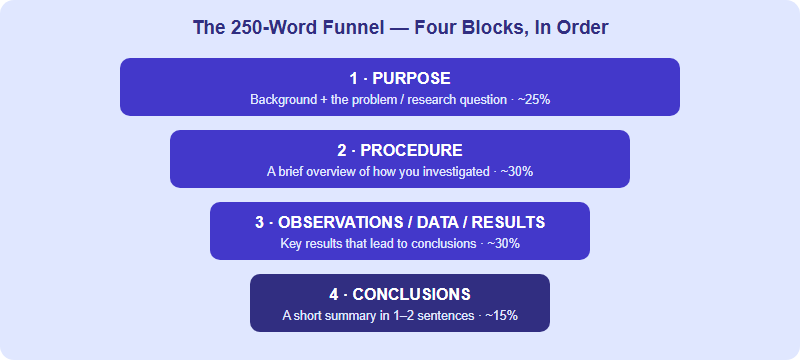
Block 1 — Purpose. Open with one or two sentences of background so a non-specialist understands why the problem matters, then state the problem or research question precisely. Resist the urge to write a literature review; you have roughly 60 words here, not 600.
Block 2 — Procedure. Give a brief overview of how the investigation was conducted — the design, the key variables, and what you measured. The official guidance is explicit that you should not discuss specific experimental procedures or statistical methods in great detail. Name your approach; do not narrate every pipette step.
Block 3 — Observations / Data / Results. Report only the key results that lead directly to your conclusions. Because tables, charts and graphs are not allowed in the abstract, you must convert your strongest numbers into words: a percentage change, a direction, a comparison. Drop secondary findings that do not change the verdict.
Block 4 — Conclusions. Close with a short summary, ideally one to two sentences, stating what your results mean and — optionally — a real-world application. This is the line a busy Grand Award judge remembers, so make it land.
Reference table: include vs. omit
Most rejected or weak abstracts fail not on science but on housekeeping — they smuggle in things the rules exclude, or they bury the result. Use this table as a final pre-submission checklist. Every “omit” row is drawn from the official guidance.
| Element | Include? | Why / official basis |
|---|---|---|
| Title, finalist name(s), school, city, state, country | ✅ Include | Standard header fields on the official abstract form. |
| Purpose / research question | ✅ Include | Required content block (background + statement of the problem). |
| Brief procedure overview | ✅ Include | Required — but an overview, not a detailed protocol. |
| Key results that drive the conclusion | ✅ Include | Required — key results only, in words. |
| Conclusion (1–2 sentences) & possible application | ✅ Include | Required closing block; application is optional. |
| Acknowledgements (mentors, facilities, awards, patents) | ❌ Omit | Official guidance: do not include acknowledgements. |
| Work done by a mentor or before your involvement | ❌ Omit | Must describe the student's own current-year work. |
| Bibliography / references / citations | ❌ Omit | The ISEF abstract does not include a bibliography. |
| Tables, charts, graphs, images | ❌ Omit | Not permitted in the abstract. |
| Anything written by generative AI | ❌ Omit | Prohibited by the International Rules for All Projects. |
What reviewers actually do with your abstract
The abstract is not a formality filed and forgotten. Per the official guidance, it is reviewed by Special Award Organization judges and Grand Award judges to decide whether your project stands out in its category or qualifies for special awards, and the general public and other ISEF visitors read it for a quick overview of your design and findings. In other words, two very different audiences — an expert deciding awards and a passer-by — both meet your project through these 250 words first.
That dual audience is also why clarity beats jargon. A judge in your category understands the terminology, but the abstract is their fast triage before the interview; a clean problem-method-result arc signals a clean project. Knowing how the full Grand Award rubric weights things helps you decide what to foreground. Here is the official 100-point breakdown.
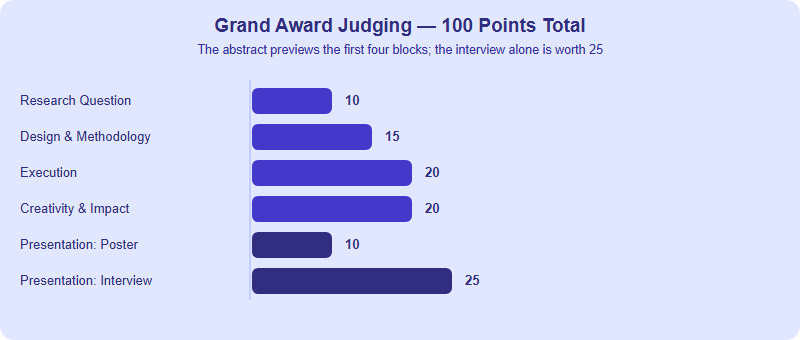
Two takeaways for abstract writing. First, the abstract directly mirrors the four highest-content rubric rows — research question, methodology, execution (your data), and the impact you claim in your conclusion — so writing it well is a rehearsal for the categories that earn 65 of the 100 points. Second, because the interview carries 25 points on its own, every claim you make in 250 words is a claim you must defend out loud. Never write a result or implication into your abstract that you cannot explain and justify to a judge standing in front of your poster.
A practical drafting workflow for China-based students
If you are qualifying through an affiliated or regional fair — in mainland China, that pathway runs through CASTIC before any ISEF finals in May — you will often write your abstract under a local deadline first. A workable sequence:
- Draft long, then cut. Write a 350–400 word version with all four blocks, then delete adjectives, method detail, and any sentence that does not move from problem to conclusion. Cutting to 250 is editing, not writing.
- Convert one figure to a sentence. Pick the single graph that proves your point and describe it in words (“treatment X reduced Y by 38% versus control”). That replaces the chart you are not allowed to include.
- Read it cold to a non-scientist. A parent or a friend in another subject should be able to restate your problem and result. That is exactly the “general public” test ISEF describes.
- Bilingual check. If you drafted thinking in Chinese, verify that translated technical terms match the standard English used in your category. Mismatched terminology is the most common avoidable error for international finalists. Choosing the right category early helps here — see how to choose your ISEF category.
- Confirm the exact field requirements for your fair. Affiliated fairs run on the ISEF rules but may add their own submission portal and dates. Verify specifics on the official site rather than assuming.
Done well, the abstract becomes a compression test for the whole project: if you cannot state your problem, method, result and meaning in 250 honest words, the gap is usually in the science, not the writing — and finding that gap now, before judging, is the entire point.
Frequently asked questions
How long can an ISEF abstract be?
Per official Society for Science guidance, the abstract should be 250 words or less and fit on a single page. Always confirm the current limit on societyforscience.org before submitting.
Can I include a chart, table, or citations in my ISEF abstract?
No. The official guidance says do not include tables, charts, graphs or images, and the ISEF abstract does not include a bibliography. Describe key results in words instead.
Can I use AI like ChatGPT to write my abstract?
No. The International Rules for All Projects state a student may not use generative AI to write the research plan, abstract, poster, or to create citations.
Who reads the abstract during ISEF?
Special Award and Grand Award judges read it to decide if your project stands out, and ISEF visitors and the public read it for a quick overview of your design and findings.
This is an independent guide operated by Hanlin Education for China-based international-school students. It is not affiliated with, endorsed by, or sponsored by the Society for Science or Regeneron ISEF. Rules and procedures can change — always confirm current details on the official site, societyforscience.org, before you register or submit. Spotted an error? We correct confirmed mistakes within 7 working days.