Yes, a proof can be an ISEF project. Mathematics (MATH) is one of the 22 categories, and its results are theorems, bounds, classifications and honestly labelled conjectures rather than measurements. The complication is scoring: the Society for Science publishes two sets of Grand Award criteria, one for science and one for engineering, and none written for proofs. Your job is to show how a mathematical result answers questions worded for experiments.
What the Mathematics category actually covers
The Society’s category page describes Mathematics as, among other things, “the deductive study of numbers, geometry, and various abstract constructs, or structures.” Hold on to the word deductive. A MATH project stands or falls on what you can show must be true, and on how precisely you state what you have not shown.
The page lists seven subcategories. The summary list printed in the 2026–2027 International Rules omits Algebra, but the rules book sends readers to the website for full definitions, so treat the page as the fuller list and confirm with your affiliated fair.
| Subcategory (code) | What the category page says it covers | A claim that would sit here (our example) |
|---|---|---|
| Algebra (ALB) | “algebraic operations and/or relations and the structures which arise from them” | Which polynomials in a family factor over the integers |
| Analysis (ANL) | “infinitesimal processes”, typically involving limits | A sharp convergence bound for a recursive sequence |
| Combinatorics, Graph Theory, and Game Theory (CGG) | Finite sets, graphs and games, “often with a view toward classification and/or enumeration” | Who wins a game for every board size |
| Geometry and Topology (GEO) | “the shape, size, and other properties of figures and spaces”, knot theory included | An invariant that separates a family of knots |
| Number Theory (NUM) | “the arithmetic properties of integers and related topics such as cryptography” | Which integers can be written in a given form |
| Probability and Statistics (PRO) | Random phenomena and statistical tools “used to analyze and interpret data” | An exact hitting probability for a random walk |
| Other (OTH) | Work that fits none of the above; the principal subcategory comes first | Rarely the right answer |
Three boundaries catch strong students. Cryptography sits in the Number Theory description, while Software Design has a Cybersecurity subcategory: a mathematical property of a scheme reads as mathematics, the security of a working system reads as software. Modelling is the second. Computational Biology and Bioinformatics is defined around “computer science and mathematics as they relate to biological systems”, so a model whose payoff is biological belongs there; if the payoff is the mathematics, MATH holds even for applied work, and the 2026 Mathematics Grand Award titles include knot theory alongside a numerical method for blood flow. Third, a study of how people learn mathematics is a study of people, with human-participant rules attached. Our guide to choosing your ISEF category by contribution applies the same test everywhere.
Competition maths and research maths reward different habits
Many China-based students who reach research through AMC, AIME, UKMT or Euclid preparation are the quickest problem solvers in their school, and still stall in the first month. In our own coaching the stall is rarely technique. It comes from habits competitions reward and research punishes.
| Question | Competition mathematics | Research mathematics |
|---|---|---|
| Is the statement true? | Guaranteed; a solution exists | Unknown; it may be false |
| Unit of time | Minutes to hours | Weeks to months, dated in a notebook |
| What “finished” means | A correct final answer | A precisely stated result and its limits |
| Partial progress | Usually earns little | Often the project: special cases, bounds, data |
| Where you start | Past papers and technique | The literature: what is known and open |
| Who checks the work | An answer key or a marker | You in writing, then a judge in person |
The first row matters most. A research question carries no guarantee, so test the statement cheaply before trying to prove it: small cases, a quick script, a deliberate hunt for a counterexample. A week spent disproving a naive conjecture is usually the week the real question appears.
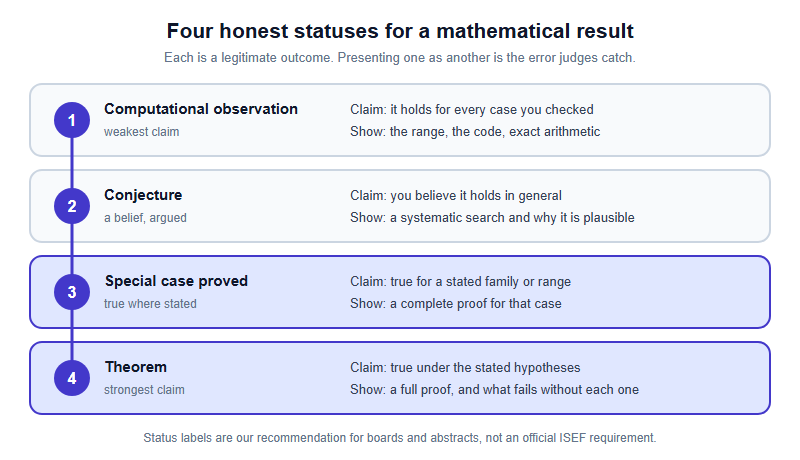
The ladder matters because the 2026–2027 International Rules say that projects that are “demonstrations, literature reviews, ‘library’ research, informational projects, and/or ‘explanation’ models are not recommended or appropriate for ISEF.” A polished account of a theorem you read about is an explanation. A project needs a claim of your own, at whatever rung you can honestly stand on.
Reading a science rubric as a mathematician
The Grand Award criteria on societyforscience.org come in a science version and an engineering version. There is no mathematics sheet, and the criteria page does not say which version a proof is read against, so ask your fair. The weights are shared: Research Question or Problem 10, Design and Methodology 15, Execution 20, Creativity & Potential Impact 20, and Presentation 35, split into a 10-point poster and a 25-point interview.
The science version is worded for experiments: a question “testable using scientific methods”, “variables and controls defined”, “reproducibility of results”, “sufficient data collected to support interpretation and conclusions”. Each phrase has a mathematical equivalent, and a judge finds it faster if your board names it.
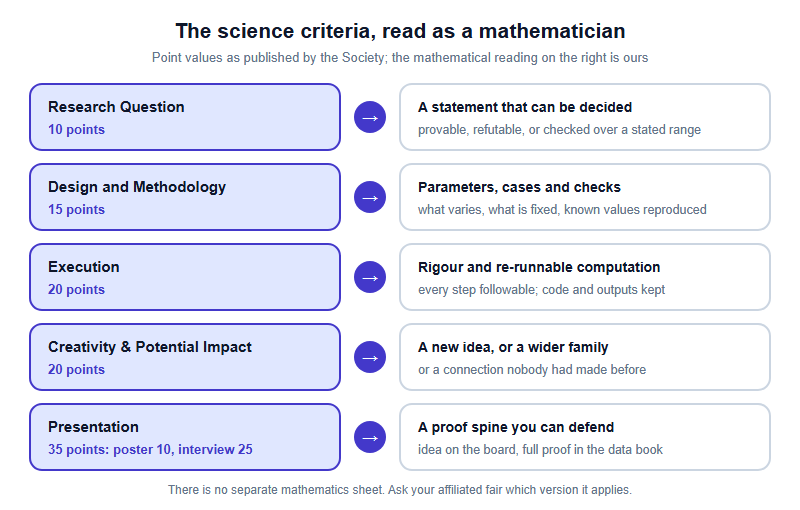
- Testable becomes decidable: precise enough to be proved, refuted by a counterexample, or checked over a stated range.
- Variables and controls become parameters and checks: what you vary, what you hold fixed, and which known values your method must reproduce before you trust it. Recovering a published small case is mathematics’ nearest thing to a control.
- Reproducibility becomes followability: another reader can follow every step, and anyone can re-run your code and get your tables.
- Sufficient data becomes proportion: “holds for every n up to 40” is a result; “holds for all n” is a different result that needs a proof.
The Research Plan is where the translation first appears in writing. Per the rules, every project needs one before experimentation, covering rationale, research question or expected outcomes, materials, procedures, risk and safety, data analysis and bibliography. For a proof, materials are software and key references, procedures are your proof strategy and search plan, and data analysis is how you verify computations. Every project also needs Forms 1, 1A, 1B and 2A. A pure mathematics project involves no human participants, animals, biological agents or tissue, so it does not wait for committee approval before starting, which makes a mid-September start workable. The rules still require SRC review before competition, and the research may not include work performed before January 2026.
What “new” can honestly mean in a high-school proof
Judges do not expect a Grade 11 student to settle a famous open problem, but they expect you to know what was already known. Among the things the rules say an SRC examines is “evidence of appropriate literature search and attribution”, and in mathematics that search is also your novelty check. Before you prove anything, search zbMATH Open and arXiv’s mathematics sections, and the On-Line Encyclopedia of Integer Sequences whenever small cases produce a list of numbers. Record what you searched and when.
These are the contributions we see hold up, roughly from strongest to most fragile:
- A new result on a well-chosen family, with the restriction stated in the title rather than hidden.
- Exact values or bounds for small cases, proved by hand or by exhaustive computation you can defend.
- A generalisation of a known theorem, with the point where the original argument breaks identified.
- A conjecture with systematic evidence, labelled as a conjecture and backed by a search plan, not a handful of examples.
- A new proof of a known result, which works only when the proof adds something you can name: it is elementary, shorter or more general.
Computation needs its own discipline: exact arithmetic wherever rounding could change a conclusion, every script kept with the output it produced, and the verified range stated. If code or a simulation appears on a screen at the fair, the Display & Safety rules say you must be prepared to show it in its entirety, unaltered after inspection. Per the rules, AI may be used as a project resource if cited, but not to write the research plan, abstract or poster, or to create citations. In a mathematics interview, a step you cannot reconstruct unaided is a liability, whoever produced it.
The interview, the booth and what the project says in an application
The interview is worth 25 points, and its bullets read like an oral examination: “understanding interpretation and limitations of results and conclusions”, “degree of independence in conducting project”, “quality of ideas for further research”. The Society’s FAQ says its judges hold a Ph.D. or equivalent degree and/or have six years of relevant experience, so expect to walk someone through a proof. Prepare the proof spine, meaning the three to five steps everything rests on; the hardest lemma on one page; the counterexample that shows why a hypothesis is needed; your next question; and where the problem came from.
Proofs are long and posters are not. Put the statement, the idea of the proof and the status labels on the board, and keep the full proof in your project data book, which the rules call not required but “strongly recommended for judging purposes”. Boards and abstracts must be in English, so write quantifiers with care: a missing “for all” changes the theorem. At ISEF 2026, Mathematics Grand Awards ran from a First Award of $6,000 to Fourth Awards of $600, and the Special Awards list included the American Mathematical Society and Mu Alpha Theta; sponsors and amounts change by year.
In an application, a mathematics project works by cross-validation. Competition results show you can solve problems someone else posed, quickly; a research project shows you can choose a question, live with not knowing, and state exactly what you established. Seen together with a mathematics-heavy transcript and a recommender who watched the work, those documents corroborate one another, which is what makes a profile believable. No result guarantees an outcome. If you are still mapping how fairs feed the finals, start with how ISEF works from affiliated fairs to the finals and our complete ISEF guide.
Frequently asked questions
Can a pure proof with no experimental data be an ISEF project?
Yes. Mathematics is one of the 22 ISEF categories. State what you proved and what you only observed, and show reasoning a judge can check.
Which judging criteria apply to a mathematics project?
The Society publishes only science and engineering criteria. Map each science criterion onto your proof, and ask your fair which version it uses.
Does a mathematics project need SRC or IRB approval before I start?
Not if it involves no people, animals, biological agents or tissue. It still needs a research plan, the core forms and SRC review before competition.
Is a new proof of a known theorem enough for ISEF?
Only if the proof itself adds something you can name, such as generality or simplicity. Explaining a known result is not considered appropriate.
This is an independent guide operated by Hanlin Education for China-based international-school students. We are not affiliated with, endorsed by, or sponsored by the Society for Science or Regeneron ISEF. Categories, subcategories, judging criteria, forms and award amounts change between editions, so confirm current details on societyforscience.org and with your affiliated fair before acting on anything here. Factual errors are corrected within 7 working days of being reported.