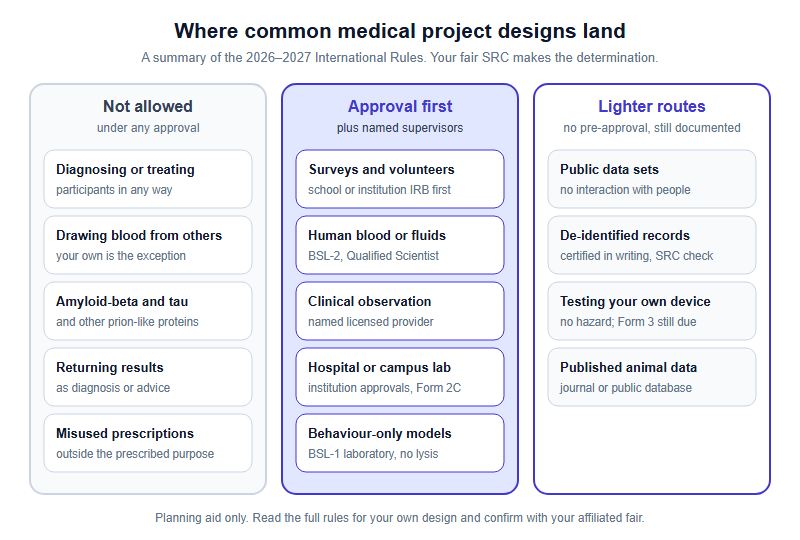
Yes, a pre-med student can do serious medical research for ISEF, but the 2026–2027 International Rules draw lines no hospital placement can move. Students may not diagnose, give medication or perform medical procedures on participants; purified amyloid-beta, tau and related proteins are prohibited; clinical observation needs a named, licensed provider. Inside those lines, most projects belong in Biomedical and Health Sciences, Translational Medical Science or Biomedical Engineering.
The lines the International Rules draw
Every affiliated fair and ISEF itself work from the International Rules, republished each season. For a student drawn to disease, the 2026–2027 edition produces a short list of activities that are simply unavailable, and a longer list available only when named people and approvals are in place before the first participant or sample. It also sets the window: this cycle’s project may not include research performed before January 2026.
| What you want to do | What the 2026–2027 rules say | What it means for planning |
|---|---|---|
| Diagnose, give medication or perform procedures | Prohibited on human participants | Design studies that measure, not ones that treat or screen |
| Draw blood | Prohibited on anyone except yourself; human blood work is BSL-2 under a Qualified Scientist, with only your own blood exempt | Plan around samples you may handle |
| Tell participants their results | Prohibited: no disclosing research data, and no diagnostic or medical advice | A “free screening” design cannot run |
| Observe procedures or collect treatment data | Only under direct supervision of a licensed health care provider named in the IRB-approved plan | Shadowing is not yet a protocol |
| Publish a diagnostic app | Prohibited on public websites or app stores without appropriate FDA approvals | Keep it a research prototype |
| Work with amyloid-beta, tau, alpha-synuclein, TDP-43, amyloid fibrils or Huntingtin | Prohibited for prions and commercially available purified prion-like proteins, and for plasmids encoding them | Many Alzheimer’s and Parkinson’s designs need rethinking |
| Use prescription drugs | Prohibited outside the prescribed purpose; otherwise sourced through a practitioner or researcher, or research-grade | Nothing from a family medicine cabinet |
| Use vertebrate disease models | Prior approval; no studies designed to cause death, no deaths from procedures, no euthanasia by students | A protocol your host lab runs may still be ineligible |
Row six deserves a second reading if neurodegeneration is why you want medicine. The rules name the molecules, and a design we see in student Alzheimer’s proposals, adding a purchased amyloid-beta peptide to a neuronal cell line, sits inside the prohibition. Two routes stay open. The rules permit animal models already bred to express prion-like proteins, such as C. elegans and Drosophila, in a BSL-1 laboratory if the work is behavioural only, with any cell lysis or protein purification at BSL-2. And analysis of published data handles no biological material; animal data or images are exempt from IACUC pre-approval only when the original study is peer-reviewed or the data sit in a public database. Note too that culturing even C. elegans is prohibited at home.
Which medical-sounding category fits your claim
Five categories attract medical projects, and their definitions overlap more than students expect. Biomedical and Health Sciences covers “studies specifically designed to address issues of human health and disease”, including “the diagnosis, treatment, prevention or epidemiology of disease”. Translational Medical Science covers projects “translating novel discoveries in the biomedical sciences into effective activities and tools for clinical and public health use”, with subcategories for disease detection and diagnosis and for treatment and therapies. Diagnosis and treatment therefore sit on both sides of the line.
Biomedical Engineering adds a wrinkle: as we read the category pages in September 2026, its definition opens with the same sentence as Translational Medical Science. The definitions will not separate those two for you; the subcategories will. Cellular and Molecular Biology, which studies “the structure, function, intracellular pathways, and formation of cells”, suits a cell-level question with no clinical claim, and Computational Biology and Bioinformatics suits work built on computer science and mathematics applied to biological systems.
| Your one-sentence claim is about… | Category | Subcategories that signal it |
|---|---|---|
| A mechanism that maintains health or, when disrupted, causes disease | Biomedical and Health Sciences (BMED) | Cell, Organ, and Systems Physiology; Genetics and Molecular Biology of Disease; Immunology; Nutrition and Natural Products; Pathophysiology |
| Moving a discovery toward a diagnostic, preventive or treatment tool | Translational Medical Science (TMED) | Disease Detection and Diagnosis; Disease Prevention; Disease Treatment and Therapies; Drug Identification and Testing; Pre-Clinical Studies |
| A device, sensor, material or engineered biological part | Biomedical Engineering (ENBM) | Biomaterials and Regenerative Medicine; Biomechanics; Biomedical Devices; Biomedical Sensors and Imaging; Cell and Tissue Engineering; Synthetic Biology |
| How cells work, without a disease claim | Cellular and Molecular Biology (CELL) | Cell Physiology; Cellular Immunology; Genetics; Molecular Biology; Neurobiology |
| A computational analysis of biological or health data | Computational Biology and Bioinformatics (CBIO) | Computational Epidemiology; Computational Pharmacology; Computational Neuroscience; Genomics |
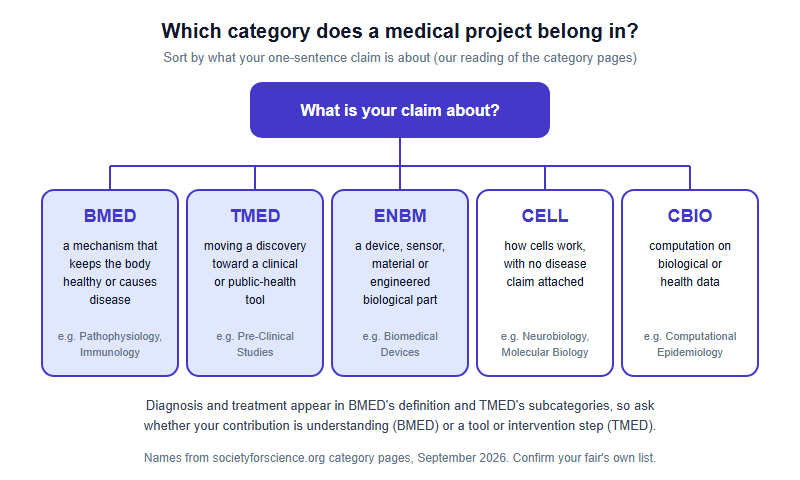
The test we use: if that sentence starts “this student showed that the pathway…”, you are in BMED or CELL. If it starts “this student built and tested a way to detect…”, you are in TMED or ENBM, depending on whether the contribution is the assay or the apparatus. Our guide to choosing your ISEF category by contribution covers the method in full.
Four project shapes that stay inside the lines
1. Health data you did not collect. Often the most realistic route from China. The rules exempt data or record review studies that use preexisting data sets that are publicly available or published, with no interaction with humans. Retrospective data from a clinician or hospital is exempt only if it arrives de-identified, the professional providing it certifies that in writing, and your affiliated fair SRC checks the documentation. The rules require compliance with privacy laws where they apply, and work outside the United States must also follow local law.
2. Studies of volunteers. Surveys, questionnaires and tests of any kind make a project a human participant study, approved by an IRB before recruitment begins. A school IRB needs at least an educator who is not your Adult Sponsor, a school administrator, and a medical or mental health professional. Participants under 18 give assent, a parent gives written permission with the survey attached, and nothing may be returned to anyone as a diagnosis or advice.
3. Bench models. Established cell lines are handled at the biosafety level their source indicates, with the source or catalogue number recorded in your plan and forms; ask your SRC whether a particular line needs prior review before you order it. BSL-2 work, in the rules’ words, is “commonly limited to a Regulated Research Institution” and must be supervised by a Qualified Scientist, meaning someone with a related doctoral or professional degree, or extensive experience and expertise in your area. For vertebrate models the rules add a sentence to read twice: “Some protocols permitted in a Regulated Research Institution are not permitted for participation in ISEF.”
4. Devices and sensors. If you are the only tester and testing poses no hazard, the rules exempt it from IRB pre-approval, though testing any student-designed invention still requires Risk Assessment Form 3. Once anyone else tries it, including people answering a survey about whether they would use it, IRB approval comes first. Testing that involves a medical diagnosis or intervention must follow the prohibition on medical procedures and be supervised by a health care professional with credentials in that area.
Hospitals, private labs and the paperwork that travels with them
The plan we hear most often from China-based families is a placement in a hospital department or a university laboratory. The rules do not rank these by prestige; they test documentation. A human participant project at a Regulated Research Institution, illustrated in the rules as a “university, hospital, medical center, government lab”, needs IRB approval from that institution, and you must obtain a copy. The rules add that a letter from a mentor or Qualified Scientist “is not sufficient documentation”. Outside the United States, an RRI is a comparable institution that follows the country’s laws on the care and use of vertebrate animals.
The sentence that surprises families most concerns private facilities. Per the rules, “independent or private laboratories, such as those established to support student researchers do not meet the requirements of oversight or committee infrastructure to be considered RRIs”, and they “should be considered the same as high school laboratories”. A well-equipped paid lab therefore does not unlock what the rules reserve for an RRI, such as germline genome editing, human embryonic stem cells or euthanasia for tissue removal. We coach research projects ourselves, so apply the same two questions to us as to anyone else: is the facility an RRI under that definition, and who exactly is the Qualified Scientist?
Two more documents follow the work. If any of it was conducted or mentored, on site or virtually, anywhere other than home, school or field, Form 2C must be completed and displayed at the booth. And if a mentor is involved, the research plan should delineate which parts are yours, because the abstract may describe only your own work and the interview scores your “degree of independence”.
What judges and admissions readers take from a medical project
Medicine tempts students into the largest claims in the fair, and the rubric tests them. Creativity & Potential Impact is worth 20 points and asks whether a project “has impact or potential impact in its field and/or in technology, economy, environment or society”; the interview then scores “understanding interpretation and limitations of results and conclusions”. A compound that lowered a marker in one cell line is a finding about that marker in that line. Calling it a treatment invites the judge’s first question, which will be about the distance between the two.
The booth has medical-specific limits too. Human or animal parts and body fluids, sharp items such as syringes and pipettes, and chemicals including water may not be displayed. Completed consent or assent forms must not be in the exhibit hall at all, and references to an institution, mentor or funder belong only in an acknowledgement section and official paperwork such as Form 2C.
In a pre-med application the project works by cross-validation. An admissions reader sets it beside the science transcript, health-related activities, the essays and the recommender, and asks whether they describe the same student. A tightly bounded project whose limits you can explain corroborates an interest in medicine far better than an inflated clinical claim, the easiest line in any file to check. No project guarantees an outcome. If the route to the finals is still unclear, read how ISEF works from affiliated fairs to the finals and our complete guide to ISEF first.
Frequently asked questions
Can I use patient data from a hospital for an ISEF project?
Only through routes the rules allow: approval from the hospital IRB, or de-identified data certified in writing and checked by your SRC.
Can a project on Alzheimer disease use amyloid-beta or tau?
Not as purified proteins, which the rules prohibit. Behaviour-only work with bred animal models and studies of published data remain open.
Does a private research lab count as a Regulated Research Institution?
No. The rules say independent labs set up to support student researchers are not RRIs and are treated like high school laboratories.
Should a medical project go in BMED or TMED?
Choose by your claim. Explaining a disease mechanism fits BMED; moving a discovery toward a diagnostic or treatment tool fits TMED.
This is an independent guide operated by Hanlin Education for China-based international-school students. We are not affiliated with, endorsed by, or sponsored by the Society for Science or Regeneron ISEF. Rules, categories and forms change between editions, and your SRC or IRB decides for any real project, so confirm current details on societyforscience.org. Factual errors are corrected within 7 working days of being reported.