For students planning ISEF team projects, the most critical structural constraint is simple: a team cannot exceed three members. This is not a recommendation but a hard ceiling enforced by the Society for Science. Whether you are working solo or in a group, understanding how this limit interacts with regional selection processes—such as those in Hong Kong—is vital for your preparation strategy.
The Hard Cap on Team Size
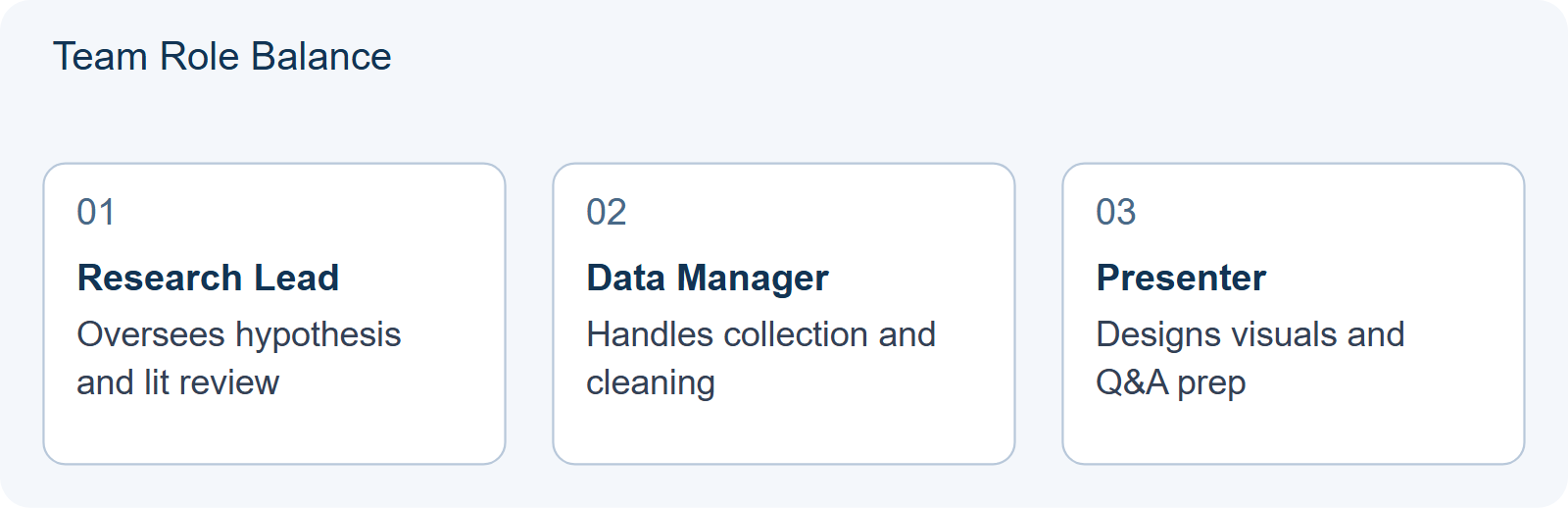
Regeneron ISEF allows participation either as an individual student or as a team of up to three students. There are no exceptions for larger groups. If you have four collaborators, one person must step back or the project must be split into two distinct entries. This limitation forces teams to be highly efficient. In practice, successful ISEF team projects often feature clear roles: one member might handle data collection, another literature review and analysis, and a third presentation design. However, judges expect every member to understand the entire project, not just their slice.
Hong Kong Selection Pathway
It is important to note that ISEF does not accept direct individual registrations. Students must qualify through affiliated competitions. For Hong Kong students, the primary route is the ISEF Hong Kong Regional Selection organized by the Hong Kong New Generation Cultural Association. The eligibility rules here are specific:
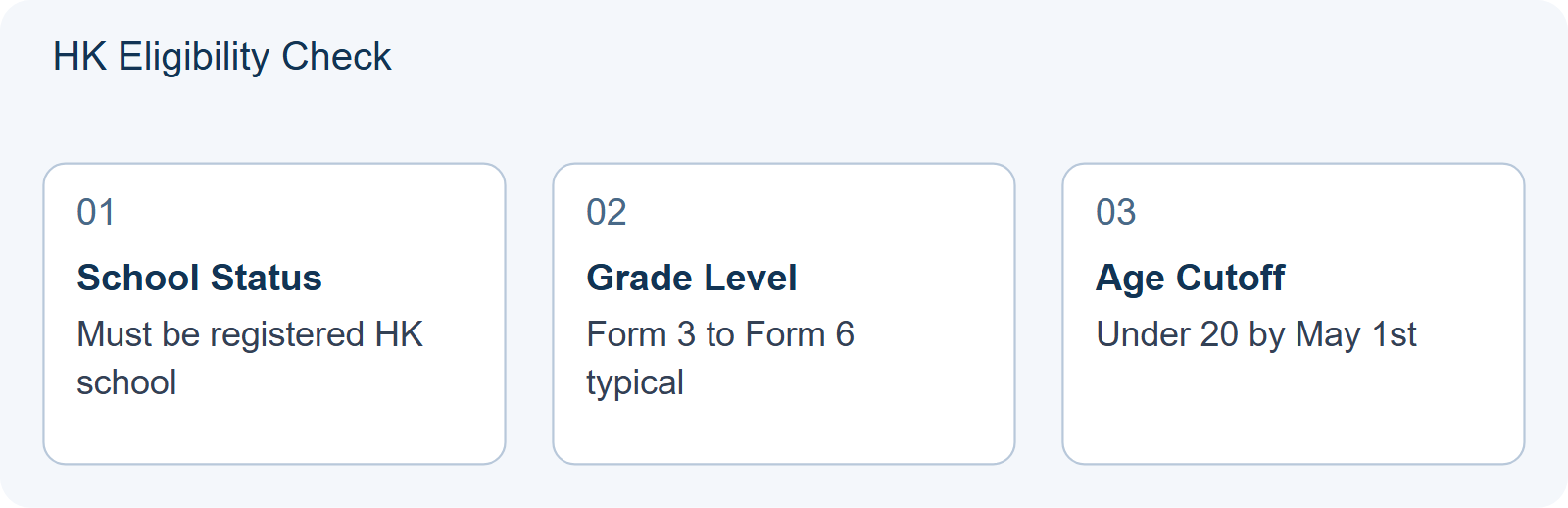
- School Status: Participants must be full-time students at registered Hong Kong schools.
- Grade Level: For the 2025-26 season, eligible grades were Form 3 through Form 6.
- Age Limit: Students must be under 20 years old by May 1st of the competition year.
Regarding team composition in Hong Kong, the source material confirms that students can form teams of up to three. It does not explicitly detail whether these three members must come from the same school or if cross-school combinations are permitted. Prospective participants should verify current administrative guidelines directly with the regional organizer, as policies can shift between seasons. Do not assume cross-school teams are allowed without confirmation.
Practical Division of Labor
While there is no official “division of labor” form required for entry, managing workload is essential for quality. Many teams fail because they treat collaboration as parallel work rather than integrated research. Here is a suggested approach for structuring your teamwork, which is our advice, not an official rule:
| Phase | Suggested Focus | Team Strategy |
|---|---|---|
| Proposal | Literature & Hypothesis | All members read core papers; one drafts the proposal. |
| Execution | Data Collection | Rotate tasks to ensure everyone understands the methodology. |
| Analysis | Interpretation | Group discussion to challenge biases before writing results. |
| Presentation | Visuals & Q&A | Practice answering questions together; avoid siloed knowledge. |
Judges often probe individual contributions during interviews. If one member cannot explain a basic aspect of the experiment conducted by another, it may raise concerns about the authenticity of the collaboration. Therefore, regular sync-ups are more valuable than simply splitting tasks and working in isolation.
Registration Mechanics
In the Hong Kong context, registration involves downloading forms from the regional website, completing them, and uploading files named specifically (e.g., ProjectName.zip). Ensure all team members’ information is accurate. Mistakes in registration details can lead to disqualification regardless of project merit. For broader guidance on navigating entry routes, see our article on ISEF Entry Routes.
If you are considering a medical or biological focus, remember that team dynamics also affect lab safety and ethics approvals. Reviewing ISEF Medical Research rules early can prevent costly delays. Ultimately, the size of your team matters less than the depth of your shared understanding. A cohesive pair often outperforms a disjointed trio.
HYPOTHETICAL/ILLUSTRATIVE: The ‘Specialist vs. Generalist’ Trade-off in a Three-Person Team
To apply the division-of-labor advice effectively, consider a hypothetical scenario involving three students—Alex, Jamie, and Sam—planning an environmental science project on microplastic filtration efficiency. They face a common strategic dilemma: should they assign rigid, specialized roles based on individual strengths, or rotate responsibilities to ensure broad competency? This decision directly impacts their ability to handle judge inquiries during the interview phase.
Choice A: Rigid Specialization. Alex, who has advanced coding skills, handles all data analysis and Python scripting. Jamie, with strong lab experience, manages all physical experiments and sample preparation. Sam, an excellent writer, drafts the entire research paper and designs the presentation visuals. In this model, each member works in isolation within their domain. While this maximizes initial speed and technical quality in specific areas, it creates significant knowledge silos. If a judge asks Sam about the statistical significance of a p-value generated by Alex’s code, Sam might struggle to explain the underlying logic because he never touched the raw data. Similarly, if Alex is asked why a specific filtration material was chosen over another, he may lack the contextual understanding that only Jamie gained through hands-on trial and error.
Choice B: Integrated Rotation with Lead Ownership. In this alternative approach, the team still assigns primary ownership for major deliverables (e.g., Alex leads analysis, Jamie leads experimentation), but mandates cross-training checkpoints. For instance, before finalizing the dataset, Alex must walk Jamie and Sam through the cleaning process and the rationale behind outlier removal. During the writing phase, Sam does not just polish text; she conducts a ‘teach-back’ session where Alex and Sam explain their respective sections to her, ensuring she understands the scientific narrative, not just the grammar. Conversely, Jamie explains the experimental constraints to Alex so the analysis accounts for real-world limitations.
The critical difference lies in shared mental models. Choice A optimizes for output volume; Choice B optimizes for resilience under questioning. Judges often probe the boundaries of collaboration. If one member cannot articulate the core methodology or results interpretation, it signals a fragmented team rather than a cohesive unit. In our hypothetical, when faced with a question about a discrepancy between the lab results and the statistical model, the team using Choice B can collaboratively troubleshoot the answer. The team using Choice A might freeze or give conflicting answers, revealing that they did not truly integrate their work.
| Decision Factor | Rigid Specialization (Choice A) | Integrated Rotation (Choice B) |
|---|---|---|
| Initial Speed | High (parallel workflows) | Moderate (sync meetings required) |
| Interview Resilience | Low (knowledge gaps exposed) | High (collective understanding) |
| Error Detection | Limited (single point of failure) | Robust (peer review across roles) |
Reusable Self-Check: To determine if your current labor division is sufficient, conduct a ‘Blind Spot Audit.’ Have each team member randomly select a section of the final abstract or a key graph from the poster. Without looking at notes, ask them to explain: 1) What the data shows, 2) How it was obtained, and 3) Why it matters. If any member hesitates significantly or defers entirely to another person, your division of labor is too siloed. Adjust your workflow to include mandatory cross-explanation sessions before final submission. This practice ensures that the three-person limit becomes a strength of depth, not a weakness of fragmentation.
Team projects require careful coordination under the three-person limit. Before assigning roles, review ISEF Experimental Design to structure your methodology. Ensure all members understand data sourcing via Where Your ISEF Data Actually Comes From. Finally, align your division of labor with scoring expectations in ISEF Creativity & Potential Impact to maximize evaluation points.
Frequently Asked Questions
Can I have more than three people on my ISEF team?
No. The maximum team size is strictly three students. Any additional collaborators cannot be listed on the official entry.
Do all team members need to attend the finals?
The provided sources do not specify attendance rules for the international finals. Check the latest Society for Science handbook for current travel and presence requirements.
Are cross-school teams allowed in Hong Kong?
The source states students must be from registered HK schools but does not explicitly confirm if mixed-school teams are permitted. Verify with the local organizer.