Choosing an ISEF research mentor is one of the most consequential decisions a Hong Kong family makes after deciding to compete. The right mentor teaches a student to design, execute, and own original work. The wrong one delivers a polished project that leaves the student unable to explain their own methods. This guide helps you tell the difference before you commit.
Start With the Student’s Starting Point
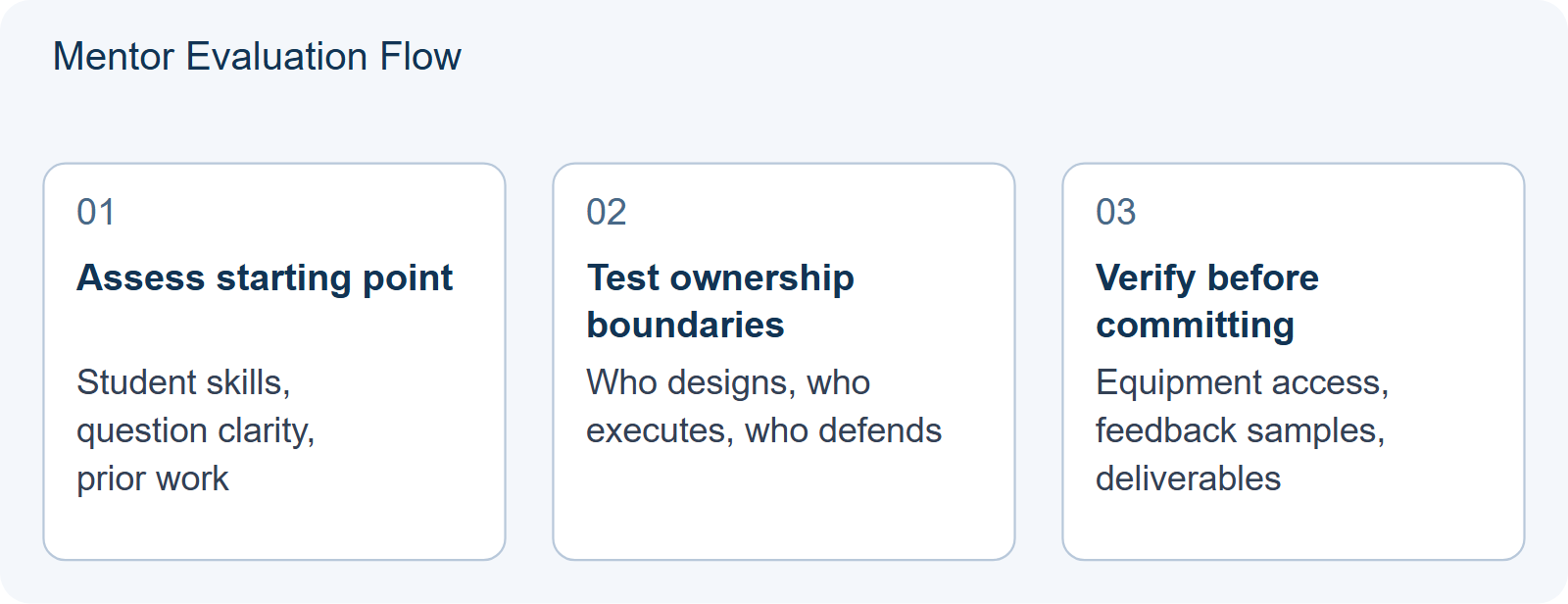
Before engaging any mentor, clarify what the student actually brings to the table. A mentor’s value depends entirely on matching their guidance to genuine student capacity.
Ask yourself:
- Does the student have a tentative research question, or only a broad interest area?
- Have they completed any prior independent project with documented process?
- What equipment or lab access do they currently have through school or other channels?
A mentor who never asks these questions before quoting a project package is not mentoring—they are vending. The ISEF Hong Kong registration and association requirements demand that the student be prepared to document their own process through institutional review and affiliated fair scrutiny. A mentor should structure their teaching to produce that documentation naturally, not retrofit it at submission time.
Separate Technical Guidance From Student Ownership
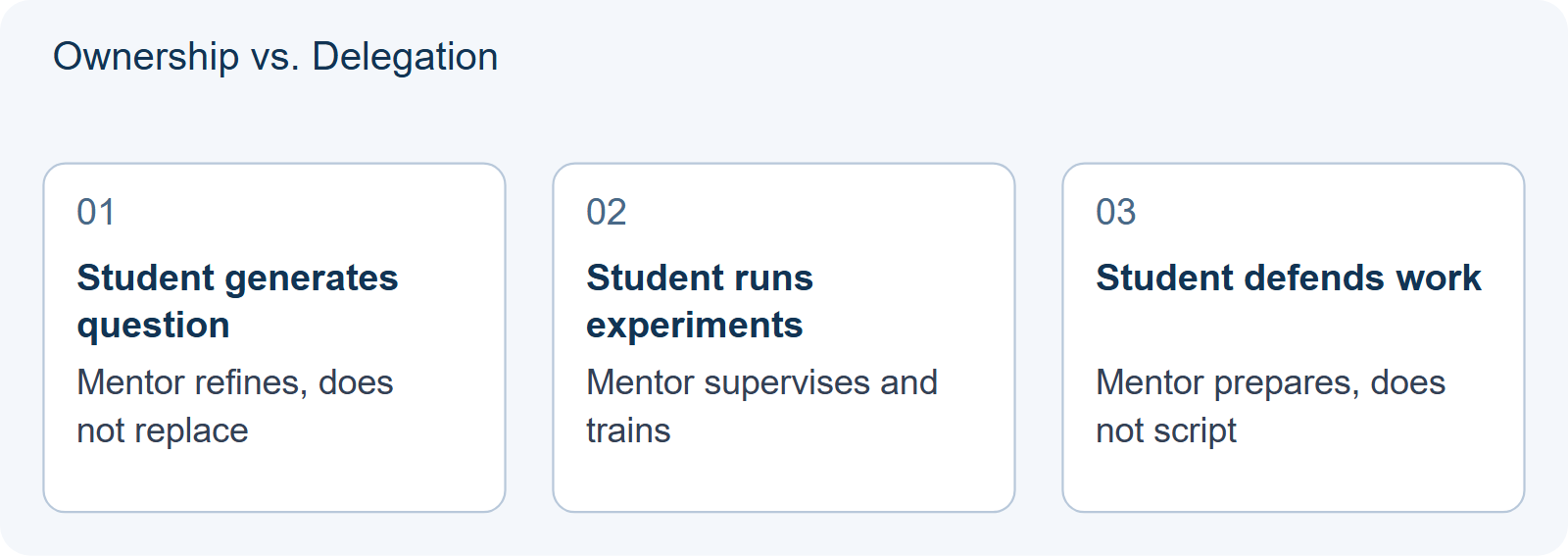
The defining feature of legitimate ISEF research mentorship is that the student retains intellectual ownership. This is not merely ethical; it is operational. ISEF judging includes direct questioning of finalists about their methodology, decisions, and limitations. A student who did not design the experiment cannot defend it.
When evaluating a prospective mentor, probe for these boundaries:
| Red flag | What to ask instead |
|---|---|
| Mentor assigns a “proven” topic from a catalog | “How do you help a student develop their own question from an observation?” |
| Mentor writes or heavily edits the research plan | “Can you show me feedback you gave on a student’s draft, in your own words?” |
| Student never touches equipment; mentor runs all procedures | “What lab access will my child have directly, and what training precedes it?” |
| Timeline is fixed regardless of student pace | “How do you adjust when a student’s experiment fails or produces unexpected results?” |
The ISEF entry routes and timeline for Hong Kong students include strict deadlines for affiliated fair qualification. A mentor who respects student ownership builds slack into the timeline for iteration, rather than compressing the student into a pre-built schedule.
Verify Access to Equipment and Suitable Supervision
ISEF projects span 22 categories, many requiring specialized equipment. A mentor’s promise of “advanced lab experience” means little if the student never handles the instruments.
Practical verification steps:
- Request a specific list of equipment the student will use directly, not merely observe.
- Confirm whether supervision is continuous or check-in based; ISEF rules require qualified supervision for certain procedures.
- Ask how the mentor handles the Hong Kong-specific institutional approval requirements that precede ISEF registration.
Some mentors subcontract lab access to third parties. This is not inherently problematic, but the chain of responsibility must be clear. If the student will work in a university lab, who signs the required forms? Who is present during work sessions? Vague answers here predict problems at the registration stage.
Request Concrete Examples of Feedback on Student-Designed Work
The most reliable predictor of mentorship quality is the nature of feedback. A mentor who only critiques final products is editing; one who shapes process is teaching.
When interviewing mentors, request:
- A anonymized example of written feedback on a student’s early research proposal
- Description of how they guided a student through a failed experiment
- How they helped a student narrow an overly broad question
Be wary of mentors who cannot produce these examples, or who describe their role in terms of “getting projects to finalist level.” The goal is not the finalist stage; it is the student’s development as an independent researcher. Finalist recognition may follow, but it cannot be the organizing principle.
Define Scope, Deliverables, and Records Before Commitment
A mentorship agreement should specify what the student will do, not merely what the mentor will provide. This protects both parties and keeps focus on student growth.
Recommended pre-commitment clarity:
| Element | What to document |
|---|---|
| Research question origin | Student-generated, with mentor refinement process described |
| Experimental design | Student drafts; mentor reviews with written feedback |
| Data collection | Student performs; mentor verifies procedures |
| Analysis and conclusion | Student leads; mentor challenges interpretation |
| Documentation for ISEF | Student compiles; mentor checks completeness against rules |
This structure aligns with how ISEF evaluates projects: the student must be able to explain every element. A mentor who front-loads their own expertise into the project undermines this requirement, however impressive the final display.
Preparing for Your Consultation
If you are considering guided support for navigating Hong Kong’s ISEF pathway, prepare efficiently before any conversation:
- Bring the student’s academic timeline: Current year, available weekly hours, and any conflicting commitments.
- List prior project experience: Science fairs, research programs, or independent investigations, with outcomes.
- Identify category interest: Even a shortlist of ISEF categories helps assess mentor fit.
- Confirm school affiliation status: Whether the student’s school is already connected to the Hong Kong affiliated fair network affects registration strategy.
- Prepare specific questions about ownership: Use the tables above to probe the mentor’s actual practice, not their marketing.
Effective mentorship is not about finding someone who will make the path easy. It is about finding someone who will make the student capable of walking it.
Frequently Asked Questions
How can I tell if a mentor is doing the student's actual research for them?
Ask the student to explain their hypothesis formation, their unexpected results, and their next steps without the mentor present. If they cannot, or if their language mirrors the mentor's promotional materials too closely, the student likely lacks ownership. Also request timestamped drafts showing the student's own writing progression.
What should a mentorship contract include for ISEF preparation?
It should specify the student's responsibilities in each phase—question development, experimental design, data collection, analysis, and documentation—with corresponding mentor support roles. It should also state who has authority over project direction and how disagreements are resolved. Avoid contracts that promise specific award outcomes.
Is it ever appropriate for a mentor to suggest a topic area?
Yes, but the suggestion should be a starting point, not a destination. A mentor might identify a fertile research area based on available equipment and current scientific questions, then work with the student to develop a specific, original question within that area. The student should be able to articulate why their specific angle differs from the mentor's initial suggestion.