No program can sell you a place at the ISEF final, because programs do not select finalists. Affiliated fairs and official selection bodies do, and the Society describes finalists as students who won at an affiliated local, regional, state or national fair. That single structural fact filters most of the research-program offers that land in your inbox each August. Here is the rest of the checklist.
Why the offers arrive now
The timing is not an accident. A competitive ISEF project usually takes ten to twelve months from question to May final, which puts the honest start line in late summer. Providers know that, and they know the same thing you do: if you have not started by September, next spring is tight. Urgency is the oldest sales tool there is, and it is doing most of the work in the message you just received.
None of this means paid help is wrong. A good mentor, a lab bench you could not otherwise access, or someone who teaches you statistics properly can be the difference between a real study and a poster. The problem is that the market contains two products sold under one name: teaching you to do research, and doing research that gets your name on it. The first is worth money. The second collapses at the judging table and, depending on what was signed and disclosed, can put your entry at risk. If you are new to the structure, read what ISEF actually is before you evaluate any offer — it is much harder to sell you something impossible once you know how the fair system works.
Four promises that cannot be true
- “Guaranteed entry to the ISEF final.” Selection sits with fairs. In mainland China, our operator briefing of 1 August 2026 names selection routes carrying quotas as small as five places, five projects and ten projects for an entire region. Nobody outside those fairs can allocate one of those slots to a paying customer.
- “Guaranteed award” or a promised placing. Judging outcomes are decided by panels at the fair, on criteria published by the organiser. Any provider quoting you a probability of winning is inventing it.
- “This topic always scores well.” Judges assess the quality of the reasoning and the evidence, not the fashionability of the field. A trendy subject with a thin method loses to a modest question answered properly.
- “You do not need to run anything — we handle the experiment.” Then it is not your project in the only sense that matters. A judging interview is a conversation about decisions you made; you cannot outsource the decisions and keep the defence.
A fifth claim is not impossible but is usually wrong: “we will register you.” Registration rules belong to the fair, and in many cases the school registers, not an outside company. Ask which fair, and then ask that fair.
The authorship line: what has to be yours
Working with a mentor is normal and expected in research; a supervisor teaching you a technique is not cheating. What matters is where the line sits between supervision and substitution. The grid below is the version we use when a family asks us to sanity-check an offer.
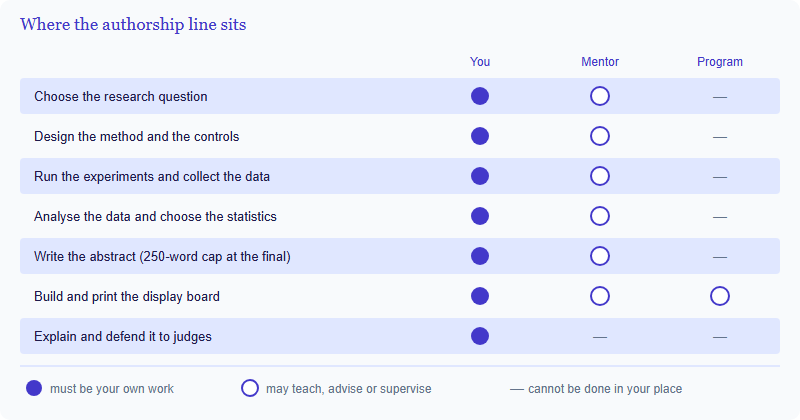
The practical version of the same test takes two minutes and no paperwork. Can you draw your experimental setup from memory? Can you say why you chose that control rather than another one? Can you re-derive the key number in your results without opening the file someone sent you? If any answer is no, the project is not yours yet — and the fix is to do that part again yourself, not to rehearse an answer.
Eight questions to ask before you sign
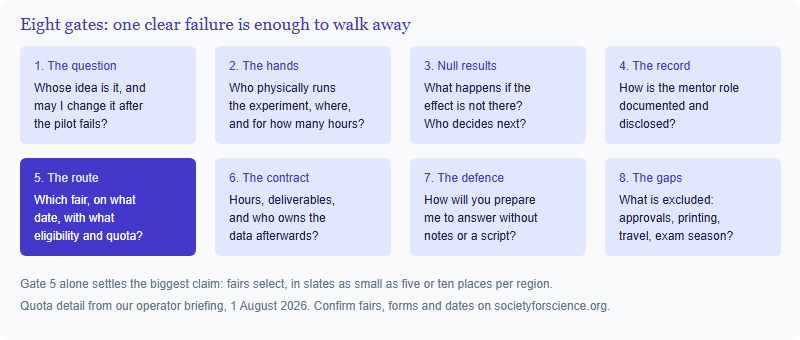
A few notes on the gates that most often produce a revealing answer. Gate 3 is the honesty test: a real research plan has a stated response to a null result, because null results are normal and a project built to guarantee a positive finding is not a study. Gate 4 matters procedurally as well as ethically — work done in an institutional lab and the role of any adult supervisor are things the organiser expects to see documented, and certain projects require review before experimentation begins rather than after. Confirm which forms and reviews apply to your project on societyforscience.org before the first data point exists, because that is not repairable later. Gate 8 is where budgets quietly double: approvals, board printing, travel and the collision with May exams are usually the family's problem, not the provider's.
Red flags, and what to ask instead
| What you hear | Why it should stop you | What a good answer sounds like |
|---|---|---|
| “We place students at ISEF every year.” | Placement is done by fairs, not providers; the phrasing borrows credit for a selection someone else made. | “Our students entered these named fairs; here is the fair, the route and what students had to do themselves.” |
| “The topic is already prepared, you just need to learn it.” | A pre-built project fails at the interview and is not your work. | “We propose three directions in your area of interest; you choose and refine the question in week one.” |
| “Our professor will run the experiments in his lab.” | You would not be able to describe your own setup, and the supervisory role still has to be disclosed. | “You run the protocol under supervision; here is how lab access, safety training and the record of supervision work.” |
| “No need to worry about forms, we handle everything.” | Some approvals must exist before experimentation and are signed by named people, not vendors. | “Here is the approval list for your project type, who signs each one, and the date we need them by.” |
| “Sign this week, places are almost gone.” | Scarcity pressure at the exact moment you should be checking your fair's eligibility. | “Take the eligibility question to your school and the fair first; we will still be here next week.” |
| “Everyone in the program produces a publishable paper.” | Volume promises about outcomes usually mean a template, and a templated study looks like one to judges. | “Some projects reach a write-up, some do not; here is what happens when the data does not support the claim.” |
The five sentences you should be able to write yourself
Before you pay, and again a month after you start, write these five sentences with no help and no documents open. They are the cheapest audit available, and they map almost exactly onto what a judge asks.
- My question is ___, and it matters because ___.
- My method is ___, in one paragraph, including the control and why it is the right control.
- My main result is ___, with this much uncertainty, based on this many trials or samples.
- A result that would have proved me wrong is ___.
- If I had another two months, I would change ___, because ___.
Students who can write those five sentences tend to do well in the interview even when their equipment was modest. Students who cannot tend to struggle regardless of how impressive the abstract reads. If you want to see how the same standard applies to picking a subject area in the first place, our guide to choosing your ISEF category works through the same logic: fit your contribution to the category, rather than choosing a category that sounds strong.
Our own disclosure. We are not a neutral party: Hanlin Education runs competition coaching, including ISEF research support, so we are one of the providers this article tells you to interrogate. Apply the eight gates to us exactly as written. We cannot guarantee entry to the final, because fairs select; we cannot guarantee an award, because judges decide; and results differ from student to student. Any provider — including us — that answers gate 5 with anything other than a named fair, a date and an eligibility rule should be asked again until they do.
Frequently asked questions
Can a program guarantee me a place at the ISEF final?
No. Affiliated fairs and official selection bodies choose finalists, so a guarantee of entry describes a power the provider does not have.
Is it wrong to work with a mentor or a paid tutor?
No. Supervision and teaching are normal. The line is substitution: the question, the method, the analysis and the defence must be yours.
Do I have to disclose the help I received?
Yes, the organiser expects mentor and institutional involvement to be documented. Confirm which forms apply to your project on societyforscience.org.
Does a more expensive program produce a better project?
Not by itself. Fee buys access and time; judges score the reasoning, the controls and how well you can defend your own decisions.
This is an independent guide operated by Hanlin Education for China-based international-school students. We are not affiliated with, endorsed by, or sponsored by the Society for Science or Regeneron ISEF. Hanlin Education provides competition coaching, which makes us an interested party in this topic; no provider can guarantee selection or awards, and outcomes vary by student. Rules, required forms, deadlines and fees change every cycle: confirm current details on societyforscience.org and with the fair you intend to enter. Quota detail is attributed to our operator briefing of 1 August 2026. Errors reported to our editorial desk are corrected within 7 working days.