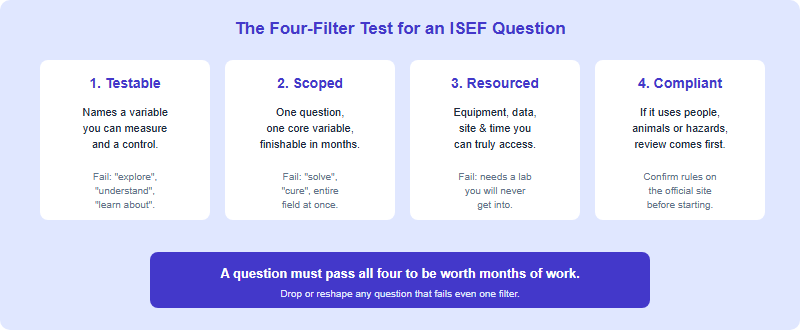
A strong ISEF research question is narrow, testable, original enough to add something, and feasible with the resources you can actually reach. It comes before you choose one of the 22 categories, because the question dictates your methods, your materials, and your review requirements. Most weak projects fail here — not at the board stage — by asking something too broad to test or too ambitious to run. This guide gives you a filter to pressure-test a question before you commit months to it. For specifics on rules and forms, confirm on societyforscience.org.
Question first, category second
Students often start by picking a category they like — “I want to do Biochemistry” — and then hunt for a project to fit. That is backward. ISEF judges and reviewers evaluate a piece of research, and research is organized around a question and a method, not a label. Choose the question first; the category usually becomes obvious once the method is clear. (If you are unsure which of the 22 categories your finished design lands in, our guide on how to choose your ISEF category sorts all 22 by strength, and our complete ISEF guide explains how the categories fit the wider competition.)
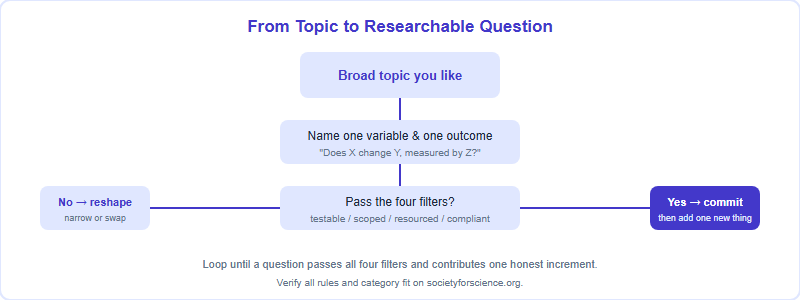
A good question has a shape you can say in one sentence: “Does X affect Y, measured by Z, under condition C?” If you cannot fill in all four slots, the question is not ready. “How can we solve climate change?” fails on every slot. “Does a 2% biochar amendment change nitrate leaching in sandy loam, measured by effluent concentration over eight weeks?” passes — it is narrow, it names a measurable outcome, and it implies a method.
Filter 1: Is it testable?
A testable question names an independent variable you can change, a dependent variable you can measure, and a comparison or control. Verbs are a quick diagnostic. “Explore,” “understand,” and “learn about” describe reading, not experiments. “Measure,” “compare,” “predict,” and “quantify” describe research. If your question’s verb could be satisfied by a literature review, it is not yet a research question — it is a topic.
Filter 2: Is it scoped to finish?
ISEF runs on a roughly year-long calendar, but your actual experiment window is a few months between your project start and your affiliated fair (affiliated fairs generally conclude by mid-April). A question with five variables, three populations, and a year of fieldwork will not finish — and an unfinished project does not place. Aim for one core variable explored well, with enough repeated trials to be statistically defensible, rather than five variables touched once. Depth beats breadth at every level of judging.
Filter 3: Can you actually resource it?
This is where China-based students lose the most projects. A brilliant question that needs a confocal microscope, a clinical patient pool, or a national dataset you cannot legally obtain is not a project — it is a wish. Before committing, write down exactly what the question requires and tick whether you have genuine access:
| Resource needed | Honest question to ask | If “no” |
|---|---|---|
| Specialized equipment | Can I book it on a real schedule, not in theory? | Reframe around accessible tools or simulation |
| A mentor / lab site | Has a specific person agreed, in writing? | Begin outreach early or pick a self-run design |
| Human / animal subjects | Can I meet review and consent requirements? | Expect committee approval before any data — confirm on official site |
| Datasets | Is the data public and licensed for my use? | Switch to an open dataset with clear terms |
| Time | Does the method fit my months before the fair? | Narrow the question until it does |
Computational, data-science, and engineering questions are often the most feasible for international students precisely because they lean on open datasets, simulation, and code rather than restricted physical facilities. That is a strategic point, not a consolation prize: a tightly executed computational study routinely outperforms a half-finished wet-lab project.
Filter 4: Is it compliant — and does review come first?
Some questions are testable, scoped, and resourced but still carry a hidden cost: they require documented committee review before experimentation. Projects involving human participants, vertebrate animals, or potentially hazardous biological agents fall into this group, and the exact forms, reviewers, and approval steps are defined in the official International Rules and Guidelines. Confirm on the official site — do not assume your project is exempt and do not infer requirements from other competitions. The planning point is simple: if your question is regulated, the approval clock starts before your experiment does, so factor those weeks into the calendar from the beginning. (Our complete ISEF guide outlines where rules sit in the overall process.)
The originality test: add one new thing
Originality at the high-school level rarely means “never been studied.” It means your specific combination adds something: a new variable on a known effect, a new context or population, a cheaper method, or a careful replication that resolves a contradiction. Read recent abstracts in your area — the Society’s project database holds abstracts from 2014 to 2026 — and ask: “What is the smallest honest new thing my project contributes?” If the answer is “nothing — I am redoing a textbook demo,” reshape the question until there is one genuine increment. Judges reward defensible contribution, not grandiosity.
Five questions, reshaped from weak to strong
- Weak: “How does pollution affect health?” → Strong: “Does PM2.5 exposure correlate with measured lung-function scores in a defined cohort, using an open air-quality dataset?”
- Weak: “Can AI detect disease?” → Strong: “Does adding feature F improve recall of a baseline classifier on a public, license-clear medical-image set?”
- Weak: “Are natural pesticides better?” → Strong: “Does neem extract at three concentrations change aphid survival on bean plants over 14 days versus a water control?”
- Weak: “How can we make solar cells more efficient?” → Strong: “Does surface texturing pattern P change measured output of a low-cost photovoltaic cell under fixed illumination?”
- Weak: “Why do people procrastinate?” → Strong (regulated): “Does a specific reminder design change task-start latency in a small participant study?” — note this involves human subjects, so review comes first; confirm on the official site.
Frequently asked questions
Should I pick my ISEF category or my question first?
The question first. Your method and materials flow from the question, and the right category among the 22 usually becomes obvious once the method is fixed.
How narrow should an ISEF question be?
Narrow enough to test one core variable well and finish before your affiliated fair. One variable explored deeply beats five touched once.
Do I need an original, never-studied topic?
No. You need one honest increment — a new variable, context, method, or careful replication. Read recent abstracts to find the gap your project fills.
What if my question needs human or animal subjects?
Those projects typically require documented committee review before experimentation. Read the official International Rules and Guidelines and confirm on societyforscience.org before collecting any data.
This is an independent guide operated by Hanlin Education for China-based international-school students. It is not affiliated with, endorsed by, or sponsored by the Society for Science or Regeneron ISEF. Competition rules, category definitions, and review requirements change — always confirm current details on societyforscience.org. We correct any reported errors within 7 working days.